ICICI Direct is India’s leading full-service broker that is operating for the last 2 decades. They have various brokerage plans to suit all types of people trading in the stock market. Be it a beginner, be it an investor or be it an active trader, ICICI Direct has plans for everyone. In this post let me take you through the ICICI Direct brokerage plans and let us compare them with the peers in the same industry.
Features of ICICI Direct
Generally ICICI Direct has a scheme of 3-in-1 account that is mainly sold by the bank branches. Here the client gets a savings bank a/c, a Demat account, and a trading account at the same time. The savings bank account is interlinked with the trading account and money can be transferred back and forth from the savings to the trading account and vice versa. Once the accounts are opened the clients will be able to trade equity, derivatives, currency, mutual funds, ETF, insurance, FD, or bonds from the same account.

ICICI Direct Brokerage Plans
- ICICI Direct has different plans for brokerage, like I-Saver Plan, I-Secure Plan, Prepaid Brokerage Plan, NRI Brokerage, and NRI Prepaid Brokerage.
- In the I-Saver plan, the intraday brokerage can vary from 0.375% to 0.125% depending on the trading volume.
- However, like all full-service brokers, they also offer less brokerage to high-volume customers.
- In the I-Secure, ICICI Direct brokerage plans are irrespective of the turnover. The effective intraday brokerage is 0.275%.
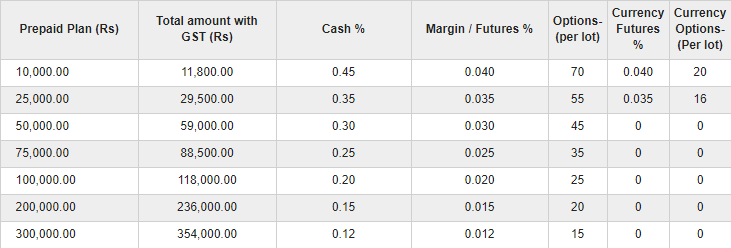
- In the Prepaid Plan, the brokerage varies from 0.45% to 0.12%. Options and currencies are charged per lot basis and brokerage charge varies from Rs. 15 per lot to as high as Rs. 70 per lot.
- For NRIs, the brokerage varies from 0.50% to as high as 1.25%.
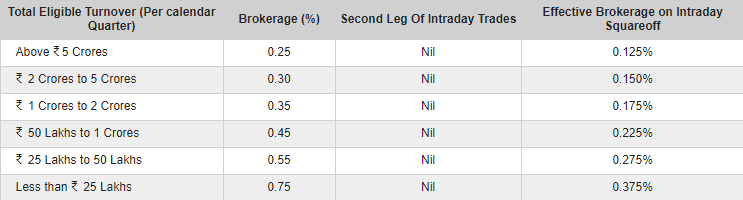
NRIs also have a prepaid brokerage structure where NRIs can save up to 72% if they use the prepaid plan. Check the image below for the prepaid brokerage structure for the resident Indians.



Pros and Cons of ICICI Direct Brokerage & Service
Pros
It has been seen that ICICI Direct brokerage plans are on the higher side if we compare them with the discount brokers. The pros of ICICI Direct are its nationwide branch network, where you can get help from your nearest branch. They have a web-based terminal, a desktop terminal as well a call and trade facility for both online and offline traders. ICICI is also known for its powerful research.
Cons
The brokerage charge is very high if we compare it with a discount broker like Zerodha. While discount brokers are not charging a single penny for equity investments, ICICI Direct is still charging brokerage as high as 0.75%. Even in the I-Saver plan, the delivery brokerage for a 1 crore turnover is 0.35%. That means a trader or investor needs to pay Rs. 35000 for brokerage wherein Zerodha the effective fees are zero. That is creating a huge gap. Even nowadays discount brokers have made a huge improvement in their terminals (for example the Upstox Pro by RKSV).
FAQs on ICICI Direct Brokerage Plans
The most popular plan from ICICI Direct is the Edge plan which offers customers low-cost trades and multiple features. This plan offers flat-rate trading costs across different asset categories starting from Rs 50 per Stock/ETF trade.
The operating cost for each order executed on ICICI Direct depends on factors such as type, size & complexity of the order, total turnover value, and segment traded in. The standard rates can range between 0.030%-0.05% depending upon your choice of segments/asset classes & volume traded over a given period.
Free Brokerage offered by ICICIDirect applies to all delivery (regular orders) placed on NSE between 9:20 AM to 3:30 PM Margin trades not included are provided at zero charges up to ₹1000/-per day per client Id or a maximum of 1% that applicable Turnover Charges whichever lower charges applicable taxes extra if any will be levied on the actual transaction amount. Also Round off, GTC orders are not allowed under Free Brokerage Facility.
Option Trading Orders incur a minimum service charge, for example, Index options have a minimum commission set at Rs 20+GST per contract or 2 percent of premium rounded off other prevailing charges higher whichever is higher excluding exchange transaction charges subject to a maximum limit up to 10%.
Conclusion
While the ICICI Direct brokerage plans are on the higher side, unless and until you have a big fascination for an ICICI Direct account we suggest opening an account in Zerodha and linking it with your ICICI Bank account to save money by not paying higher brokerage.