
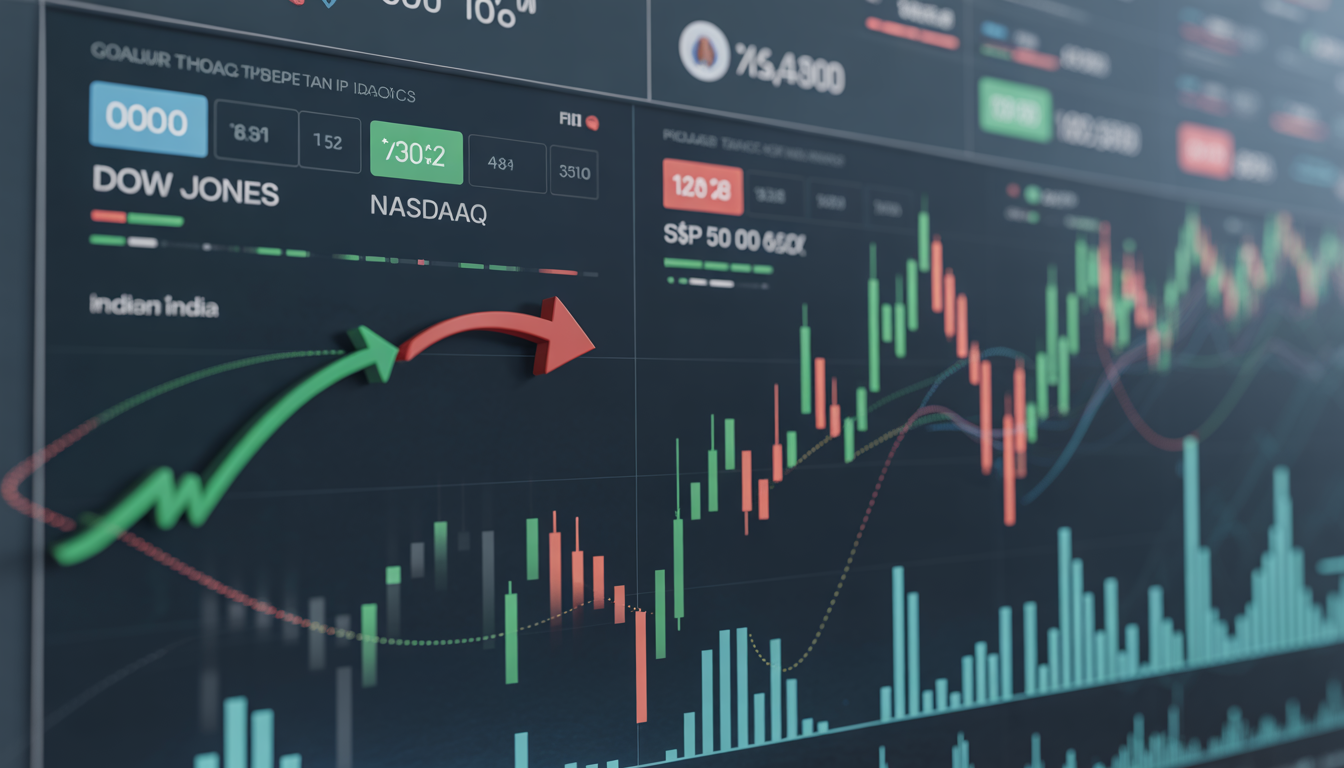
The performance and impact of the US stock markets play a crucial role in shaping the direction of the Indian stock market. Every trading day, Indian investors closely track the closing trends of the Dow Jones, Nasdaq, and S&P 500 to anticipate how Nifty and Bank Nifty may open.
Since global markets are interconnected, movements in the US often influence investor sentiment, institutional flows, and sectoral trends in India. Understanding this relationship can give traders and investors a significant edge.
How US Markets Influence Indian Markets
The Indian stock market does not operate in isolation. It reacts to global developments, especially from the United States, which is the largest economy in the world.
When US markets close strongly:
- Positive sentiment carries into Asian markets
- Foreign Institutional Investors (FIIs) increase exposure
- Indian markets tend to open higher
When US markets fall:
- Risk-off sentiment dominates
- FIIs may reduce positions
- Indian markets may open weak or gap down
This correlation is particularly strong during volatile periods or when major economic events occur.
Key US Indices to Watch
Dow Jones Industrial Average
Represents major industrial companies and reflects overall economic strength.
Nasdaq Composite
Highly tech-focused and influences IT stocks in India like Infosys and TCS.
S&P 500
A broader market index is the most reliable indicator of US market sentiment.
Together, these indices provide a complete picture of global risk appetite.
Live US Market Trend and Its Impact
Below is a real-time view of the US market movement. Use this to quickly assess how global cues may influence Indian markets.
Sector-Wise Impact on Indian Markets
US market performance doesn’t affect all sectors equally. Here’s how it typically flows into India:
IT Sector
A strong Nasdaq often leads to gains in Indian IT stocks. Since most Indian IT companies earn revenue from the US, this sector is highly sensitive.
Banking Sector
Global risk sentiment affects banking stocks. A positive US close supports financials in India.
Pharma
Often moves inversely during risk-off periods as a defensive sector.
Metals and Commodities
Driven by global demand expectations influenced by the US economic outlook.
Role of US Bond Yields and Dollar
Apart from equities, two other global factors matter:





US 10-Year Bond Yield
- Rising yields → Pressure on equities
- Falling yields → Support for stocks
US Dollar Index (DXY)
- Strong dollar → Weak emerging markets (including India)
- Weak dollar → Positive for Indian equities
These indicators often amplify or weaken the impact of US stock movements.
How to Use US Market Data for Trading
To make this actionable, follow a simple framework:
Step 1: Check the US Closing Trend
Was it bullish, bearish, or mixed?
Step 2: Analyse Futures Movement
Look at Dow Futures and Nasdaq Futures before the Indian market opens.
Step 3: Combine with GIFT Nifty
This gives a near-accurate prediction of Nifty opening.
Step 4: Identify Sectoral Strength
Tech strong? Focus on IT
Banks strong? Focus on Bank Nifty
Typical Scenarios of the US Markets and Their Impact
Strong US Rally
- Nifty is likely to open with a gap up
- Momentum stocks perform well
- Breakout trades work better
2: Weak US Close
- Gap down opening possible
- Defensive stocks outperform
- Shorting opportunities increase
Mixed US Markets
- Range-bound Indian market
- Stock-specific action dominates
Limitations You Must Understand
While US markets are important, they are not the only factor.
Indian markets can still move independently due to:
- Domestic news
- RBI policy decisions
- FII/DII activity
- Global events like oil price shocks
So always combine US cues with local factors.
Final Verdict: Why This Page Matters
Tracking US markets is not just about information — it’s about gaining an edge.
By understanding how global sentiment flows into India, you can:
- Predict market direction more accurately
- Improve entry and exit timing
- Align trades with global momentum
This page simplifies complex global data into actionable insights so you can make smarter trading decisions every day.