If a person doesn’t have any basic knowledge regarding the market mechanics and transaction process in the stock market, he is not considered to be a proper investor. You need to know all the process to place your order in the stock market so that your broker get the proper instruction to execute your order. If you understand the concept of the transaction, you will find it easy to handle. Placing orders by using different options is nothing but specifying your order clearly. You will get various types of orders for the transaction. Today we will cover what are the different types of orders in the stock market in simple terms.
What is an Order in the Stock Market?
In the Indian stock market, an order refers to a customer’s instruction to buy or sell securities. When placing an order, you can specify the price and quantity for which you are willing to buy/sell that security. Your broker will then send your instructions through a dealer network which will execute them based on their availability.
What are the Different Types of Orders in the Stock Market?
Stock Market Orders Based on the Product Type
Firstly, let’s start with the difference based on the product type, MIS/Intraday, and CNC or cash and carry.
MIS/Intraday
Intraday trading refers to buying and selling stocks on the same day. You can trade from 9 am to 3.20 pm. If you are using intraday you will get leverage based on the stocks you are trading. It is applicable in both cash and future products. It gives margin benefits to traders.
NRML/Normal
This mainly deals with future and options trading. It can be cash or future-based. In NRML you have to pay 10%-20% of the margin of the contract value.
CNC or Cash and Carry
It is a delivery-based trading. One of the biggest disadvantages of CNC is you will get little or no leverage. The margin is applicable for only cash or equity products. The order is best for the mid or long-term investor.
Stock Market Orders Based on the Price
Secondly, we are going to discuss classifications of orders based on Price in the stock market, Market Order and Limit Order
Market Order
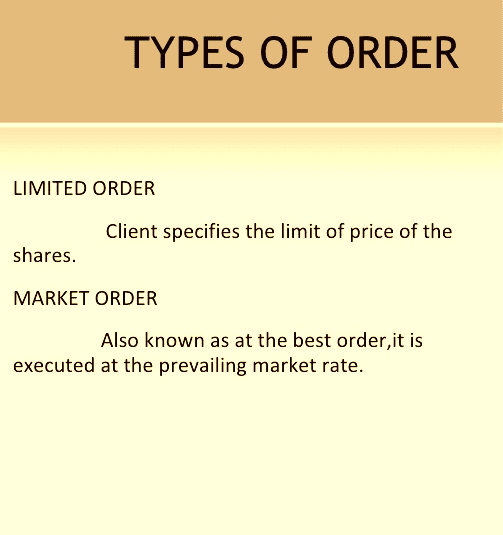
The market order is nothing but an immediate trade order at the best available price. The specific order works based on the current market price. The order’s immediate execution is done here.
There are a few points one must remember. The current market price is not necessarily the price at which the Market Order will be executed. The current market price you have seen is the last traded price but your trade will be executed on the best match price of that particular day. Therefore, whenever you go for the market order, the price will be slightly different from the current market price.
Limit Order
In this type of order, you can set your preferred price limit. The term “limit order” itself defines the meaning of it. By placing this order investors can set the limit according to their wish. One of the main disadvantages of these types of orders is these orders are only processed if the market reaches a specific price, otherwise, they remain open.



Stock Market Orders Based on Stop Loss
Most investors are familiar with the term “stop-loss”. There are two kinds of orders based on stop loss, Stop loss Market order (SL-M) and Stop loss Limit order (SL).
SL Market Order
You have to put a trigger price here in this category. Sometimes slippage happens in a highly volatile market where after hitting the trigger price, the price value goes up to some extent within a short period of time.
SL Limit Order
It consists of both trigger price and limits price. Your order will be active only after hitting the trigger price but the system will execute the order only when the limit price will match. Sometimes, before the execution of the order price goes below the limit price, in that case, your order will not execute.
Stock Market Orders Based on the Time Duration
Finally, let’s discuss the classification based on the time duration, Good Till Day (GTD), and Immediate or Cancel (IOC).
GTT Order
GTT or Good till Triggered order is a kind of limit order but it is more advanced. The GTT order will be active until it reaches the set price. The validation of the GTT is 1 year. Once the price reaches your set level, the system automatically executes the order. The Good till Triggered is good at minimizing your losses or booking maximum profits when you are not actively tracking the markets.
Types of GTT Orders
GTT order can be a Buy GTT or a Sell GTT order. The description is as follows:
Buy GTT Order
Traders basically use the Buy GTT to create triggers for buying delivery stocks. With this GTT buy order, once the trigger price is hit, a buy order with the previously set limit price is placed on the exchange.
Sell GTT Order
Reversely, Sell GTT is used to exit current stock holdings. Here either just a target order or both the stop loss and the target were triggering until one will cancel the other (OCO).
Brokers who Provide GTT Order Facility
Zerodha is such a broker that provides the GTT order facility. They are providing it for equity and futures, options segments. The traders can place this order only during market hours.
Good Till Day or GTD Order
It is valid for that specific date after that the system will cancel it automatically.
Immediate or Cancel or IOC Order
The order will execute immediately if the execution does not happen, the system will cancel it automatically.
What is Iceberg Order in Zerodha?
Iceberg order in Zerodha is a new and exciting feature added to the large array of facilities for the traders and investors of Zerodha. Iceberg order in Zerodha helps to slice a big order into smaller equal orders to reduce the impact price of the large order given at one time. For example, an institutional trader gives an order to buy 30,000 (thirty thousand) equity shares of SBIN (State Bank of India) at the CMP of Rs 560.00 each.
Such large orders impact the current buying price of shares heavily. The buying price increases because sellers want to sell the shares at higher prices. Consequently, the buyer ends up buying the shares at a much higher cost than desired. The average buying price of the shares goes up automatically. Also, you can see a price difference if you check the buy/sell prices. A minimum price difference of .05 or more always exists.
Real-Life Example of an Iceberg Order
Now, let’s say the SBIN is trading at Rs 560.00 which is the desired price of the large trader. Therefore the order goes into the system to buy 30,000 SBIN @ Rs 560. The selling price automatically becomes Rs 560.05. So, the resulting buying cost increases by Rs .05*30000 = Rs 1500. Hence the impact price is Rs 1500. But in case it was a smaller order, the limit price of buying 100 SBIN @560 will work.
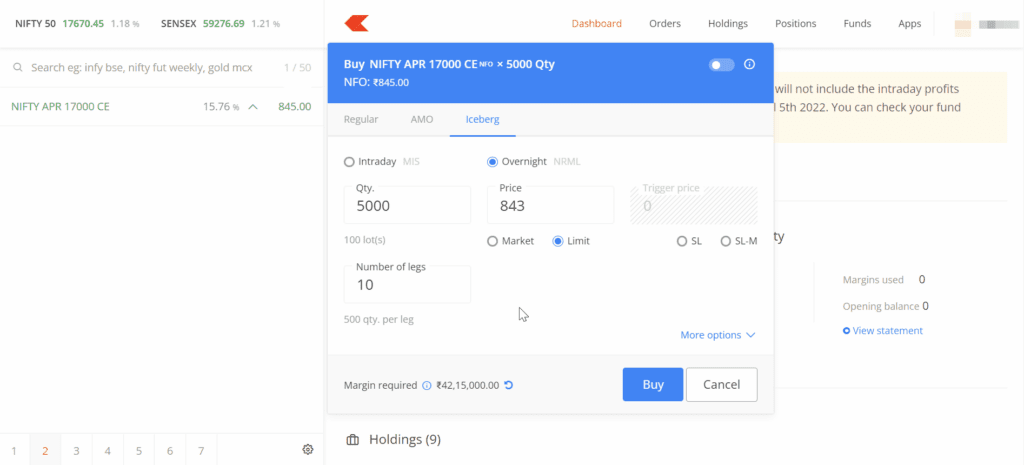
Iceberg order breaks the order into pre-determined equal parts into smaller quantities and lets the buyer buy at the desired limit order. Once the shares of the first lot are bought, the second lot goes into the system and so on. Thus the buyer can buy the whole lot without the effect of impact price.
Not only institutional but also retail traders can take this advantage now. For equity, the minimum limit is Rs 100000 and 5 lots for F&O. Any orders less than that will not benefit the trader as the impact price becomes too low.
FAQ
The stock market generally has three main order types – Market Order, Limit Order, and Stop Loss Order. A limit order is an instruction to buy or sell a security at a specified price or better; a stop loss order is used to limit losses by selling when the asset reaches certain price levels; and a market order will be executed immediately at the prevailing price.
The three main types of orders are Market Orders, Limit Orders, and Stop Loss Orders.
There are four major categories of stocks – common stocks, preferred shares, convertible securities, and exotic derivatives. Common stocks represent ownership stakes in companies while preferred shares often have set dividend payments as well as voting rights on corporate matters. Convertible securities can be converted into other forms such as cash or stock holdings while derivatives have pay-offs that depend on underlying market values.
The NSE offers five primary kinds of orders -Market Orders (order below best bid / ask), AMO (After-Market Order) Orders, Intraday Orders (MIS & CNC), Bracket Orders and Cover Orders (BO & CO). Each kind offers its own advantages depending upon your trading strategy/preference – you can use these options according to your preference when placing an order with your broker/trading platform in India’s leading exchange- National Stock Exchange (NSE).
Conclusion
In this post, we have discussed some of the basic classifications of orders in the stock market. Investors must have good control over these terms. In order to make an easier transaction one must know Different Types of Orders in the Stock Market. Most importantly, apart from knowing the order types, proper execution of them is the key to the success of a trader or an investor.