We have heard the term exchange-traded fund. But do we all know what is ETF? We have an idea of how mutual funds work. They take money from the investors and invest the same in different stocks. After that, they open a net asset value and create per unit price and sell the investor number of units according to their investment. The investor can track his unit price every evening, whether it is moving up or down. It also works as mutual funds, the only difference is they are listed on the stock exchange.
What is an ETF or Exchange Traded Fund?
A mutual fund company can make any of its funds with whatever number of shares in it, say 40 or 50 shares portfolio, as an exchange-traded fund. Stock exchanges list them, and you can buy or sell them like any ordinary share. Many companies have introduced their ETFs, like Nippon India Mutual Fund, Aditya Birla Capital Mutual Fund, SBI Mutual Fund, etc. Most of the companies that have an asset management company or AMC, have introduced their ETFs and listed them in the stock exchange.
Examples of ETF
So we understood what is ETF. ETF is generally made out of things that are not present in the physical form. Suppose Reliance Industries stock is present in the semi-physical form. If you wish you can take or buy a stock of Reliance. But if you want to buy the Nifty index, you can not buy it because Nifty is a benchmark index following 50 shares. Now if an investor wants to invest in Nifty directly he needs to trade its future or derivative. This is ok for a trader, but a long-term investor cannot buy it in cash and take the delivery. It is not possible for him to buy a future and roll over the contracts at every expiry.
Another way an investor can directly invest in Nifty is to invest in Nifty’s ETF or exchange-traded fund. This ETF is listed on the exchange in the name of NIFTYBEES. It works right like a stock. You can buy or sell it, short sell it, trade it on margin, and you can do everything that you can do with a stock. It has the same T+2 settlement.

The Price of Exchange Traded Fund
If we buy a mutual fund, we get to know the NAV only in the evening. But we can track the price of an ETF in the market hours just like a normal stock. It is also not necessary for an ETF to trade exactly at the same price as the underlying. Nifty BeEs can have some price differences with the Nifty index. Bank Nifty index also has an ETF or BeEs named Bank BeEs. It is also priced almost the same as the Bank Nifty index, but will never be exactly the same because the BEES price will be dictated by demand and supply. So an investor can invest in an ETF or BEES and keep it as long as he wants by taking the delivery.
Different Types of Exchange-Traded Funds
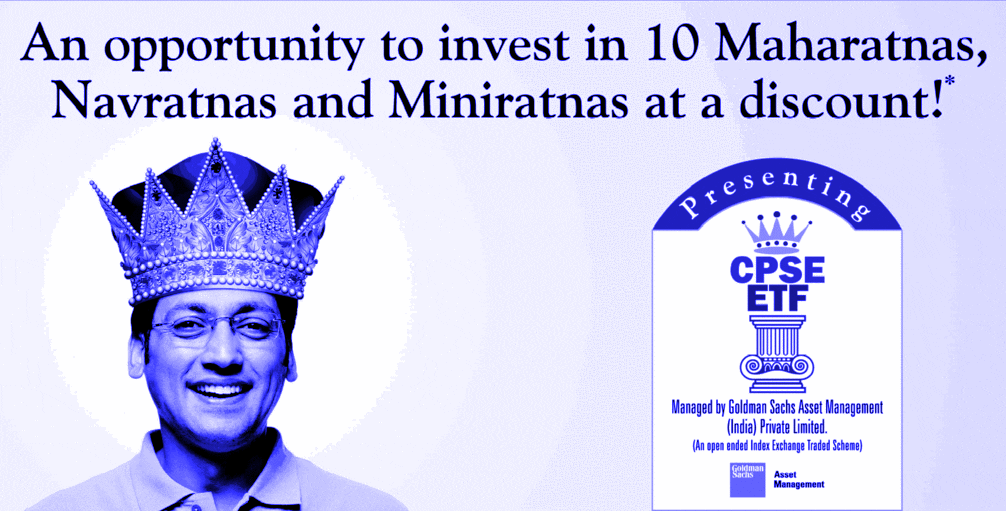
ETFs can be different investment products. Like Nifty ETF, Bank Nifty ETF, etc. There is an ETF called CPSE ETF. Its portfolio contains of some government company’s stocks, all the Maharatan, Navaratan, and Mini Ratan companies. It is also listed on the stock market. So by investing in the ETF, an investor can get a feeling of all those companies. Check the CPSE ETF advertisement, which gives you an idea of what is ETF.
The ETF will perform the same as the underlying companies will perform. If the companies do not perform well, the price of the ETF will go down and if they perform well, the price of the fund will go up. So to understand what is ETF, we got to know it is the same as a Mutual Fund. Just like MFs here also a unit price is decided and the same is listed in the exchange and the unit price moves up or down based on the demand and supply. Nowadays, Nifty is trading at around 10500, and its ETF or BEES is trading at around 1050. If you pay Rs. 1050 you can purchase one unit of Nifty. If we take 10 units by paying Rs. 1050 x 10 = Rs. 10500, we actually get one Nifty, which is also trading at Rs. 10500.
What is ETF Advantage?
So all ETFs can be taken in units and their prices are linked with the price and movement of the underlying. The best advantage of an exchange-traded fund over a mutual fund is that it is trading in the exchange. So anytime we can buy or sell it. You need not approach anyone, you just sell it, after 2 days money will automatically be credited to your trading account. Another advantage is it does not have any exit load. Some mutual funds have an exit load, which means you need to pay some charges if you want to exit before a certain time. But no exchange-traded fund is having an exit load. No fund manager fees, no fund management charge is there in these funds.
Use of ETF in Buying Gold
A major use of ETFs is in the commodity markets. There can be an ETF of Gold, Silver, etc. The price of Gold Bonds or ETFs moves up with the price of Gold and also comes down with the price of Gold. If you purchase a Gold ETF, you are investing in Gold, but there are no making charges, no fear of theft, and no vaults required. And you can sell it anytime to book your profit. To check what are the various types of exchange-traded funds, you can check the MoneyControl site.
FAQ
An Exchange Traded Fund (ETF) is a diversified collection of assets such as stocks, bonds, or commodities that can be bought and sold on an exchange like any other listed stock. An example of an ETF in India would be the Nifty50 ETF, which replicates the performance of the top 50 companies by their market capitalization at the National Stock Exchange (NSE).
ETFs are funds that track different indexes or underlying such as S&P500, FTSE 100, Gold, etc. while providing the flexibility to buy and sell shares throughout the day just like any other company stocks. They also provide diversification because they have multiple underlying securities in one set portfolio.
Unlike a Mutual Fund that may actively run money through buying/selling securities based on a predefined investment strategy, an ETF’s primary objective is always to replicate an index accurately reflecting its component parts & composition over time. Moreover, mutual funds often require high minimum investments whereas there are usually no entry barriers for entering into an ETF-investing space; purchasable even with Rupees 1/- per unit sometimes.
At first glance it appears both as quite similar strategies but actually far from it in reality – unlike stocks where you only invest in a single asset predominantly governed by “market forces”, an individual investor puts his desired surplus funds upon multiple baskets through one single purchase order called “Exchange Traded Funds” featuring many approaches altogether; purchasing thousands of profitable entities while keeping transaction cost relatively low & risk profile almost negligible than on any other asset class!
Conclusion
An ETF or Exchange Traded Fund is a type of mutual fund traded in the stock market. We can buy or sell them just like normal stocks. ETFs can follow certain themes, indices, or even precious metals like Gold. In conclusion, ETFs are a powerful investment tool for traders who wants to trade in mutual funds but wants the liquidity of stocks.