
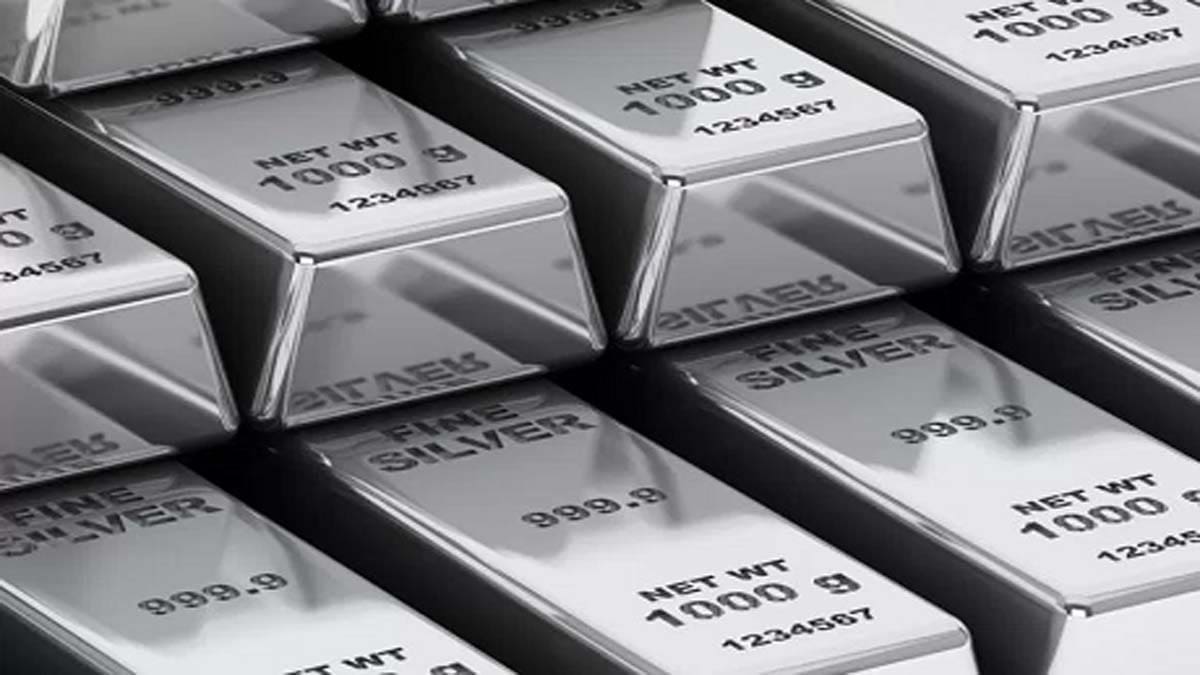
India has a diversified commodity market, which includes metal, energy, agriculture, etc. Since the ancient period, commodity trading has gained popularity among traders. Commodity traders must come across the term “bullion”. Literally, the term “bullion” refers to a bulk quantity of precious metals, especially gold and silver. As India is the leading consumer of both of these metals, the market of bullion commodities is quite promising. SEBI is the governing authority of the Indian commodity market. Another important component of the bullion bucket is gold; you may go through our page on the gold price chart and analysis. However, today, we come with the live silver price chart and analysis along with its usage and significance in the market.
How to Use These Widgets
Commodity Trading Exchange in the Indian Market
Most of the investments are executed through two distinct markets, OTC (Over Counter Market) and The Exchange Traded Market. OTC indicates spot trading, while in the exchange-based market, trades take place indirectly between two parties. In India, there are multiple national as well as regional commodity exchanges. Among them, here the list of the four major commodity exchanges:
- MCX or Multi-Commodity Exchange
- NCDEX or National Commodity and Derivatives Exchange
- NBOT or National Board of Trade
- NMCE or National Multi-Commodity Exchange (NMCE)
Silver Commodity Trading in the Indian Market
For many decades, silver has belonged to the bucket of eight precious metals. Its non-corrodible nature, colour, and lustre make the metal different and precious from others. We know the metal as Ag (as a Symbol) with the atomic number 47. Once, silver was used as a valuable exchange medium; after 1960, it was removed from the monetary circulation. Unlike Gold, Silver is basically imported to India as its domestic production is not sufficient. According to the yearly data for 2018, the imported quantity of silver to India was 2,889 metric tonnes. The demand of 8,667 metric tonnes is much higher than the production for the year 2018. The insufficient production of silver could not affect the consumption of silver. Hence, India is the third-largest silver consumer in the world after the US and Japan.
Various Silver Usage
The demand for silver is increasing day by day, and the reason is quite valid. Silver has multiple uses. In order to understand the various applications of silver, we have given a list below:
Jewelry and Silverware
Near about 68% of silver is used for jewellery-making purposes. Silver metal is quite popular because of its reflective, attractive nature. In comparison to gold, it is much cheaper in price. In India, jewellery plays a vital role. Therefore, we expect that the demand will increase more in the future.
Electronics Usage
For its excellent electrical conductivity, it is used as an electronic part in many types of machinery. For example, circuit boards, switches, TV screens, telephones, microwave ovens, computer keyboards, etc. The particular metal is highly durable.
Medicine Purpose
For centuries, people have been using silver for antibacterial purposes. It has medicinal properties. Besides this, its usage is also to purify as well as freshen water, wine, and vinegar. Its non-toxic characteristic is quite significant for medicine.
Investment
Silver as an investment option has already gained so much popularity among investors. Its rare availability and unique nature increase its value to some extent. Silver acts as a profitable investment avenue in the Indian financial market. Traders trade Silver both in the spot market and in the exchange market. In the spot market, they trade silver directly between buyers and sellers. In the exchange market, silver can be traded in a different way.

Top Reasons to Invest in Silver Instead of High Price
- High demand is one of the most significant reasons. Silver’s high demand makes the metal more valuable than others. Increasing demand uplifts its value to a great extent.
- Works as a hedging tool. During financial Inflation, silver acts as a hedging tool.
- Rare availability. Its rare availability pushes the demand in a high range.
- Use as a protector in financial deflation
Silver in the Indian Commodity Market
Traders basically do futures trading on the silver commodity. Among the various national and regional exchanges, MCX (Multi-Commodity Exchange) is quite popular. However, a future contract is basically an agreement between two parties on a pre-fixed date and time. Check the list below with the data of MCX:
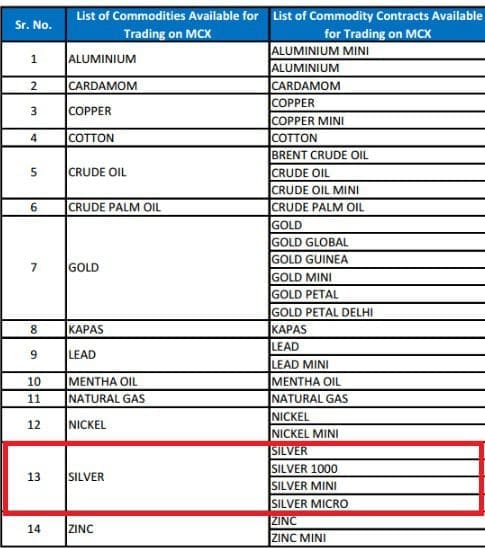
In future contracts, both buyers and sellers have the obligation to execute the trade. Apart from the physical contract and future contract, there is intraday trading in the commodity market. If traders are capable of analysing the market correctly. Therefore, they can earn a huge return from trading. As you can see in the above chart, silver can be traded in these separate ways. Here, you can get a live silver price chart, silver price support and resistance, silver future daily candlestick chart, etc.
The live Chart will be updated automatically; you only need to refresh it often. The chart will give you accurate data on the commodity.
So, the chart above the daily candles will update automatically with silver price movements. You need to refresh the page manually.
However, each investment option carries a trading symbol with it; the trading symbol of silver is SILVERDDMMMYYYY. The silver commodity lot size is 30 kg; the lot size defines the minimum quantity of trading. Based on the 1 kg silver price quote. So, commodity traders can trade Silver in the normal MCX timings. However, there are many trading strategies available for commodity trading. Among them, the open-range break strategy, Pivot Points, is popular.
Conclusion
On this page, you get every detail regarding the silver commodity along with its live share price and graph. Share price technicals and analysis processes are also available here. Just remember, you have to refresh the page to get an updated version of the price. With the growing demand for silver, it is expected to see a high value in the future. Investors must be aware of the ups and downs of the market so that they can properly utilise the price fluctuations.