

Various types of mutual funds in India are continuously evolving. In our modern world earning money is not just enough. In order to lead a comfortable lifestyle, the bank’s interest rate is inadequate. One has to do smart investment management. Pros recommend that don’t put all your eggs in one basket. You must save some of the resources thinking for any future mishaps. This is one of the most important rules of investment. As investment always comes with risk, a wise investor’s money is spread across different types of investment.
What is a Mutual Fund?
Mutual Fund is such an investment vehicle that trades in diversified holdings, funded by investors. The professionals manage these funds. Basically, the mutual fund is a professionally managed SEBI-registered financial institution that pools the savings of investors and invests money on their behalf in securities like stocks, bonds, money market instruments, commodities, etc. They have their own professional financial adviser, research analyst, and broker to generate maximum profit from the huge amount of investment. Types of mutual funds in India are as follows:
Types of Mutual Funds in India
I have made a chart to make the classification of mutual funds easier. See the chart below:
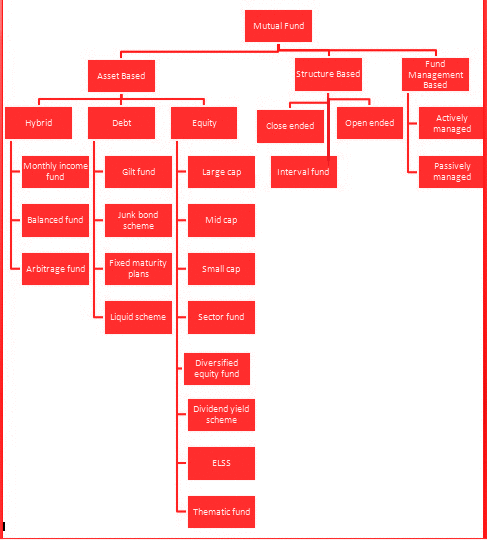
As I have stated above that there are various types of mutual funds in India. The chart consists of all the available classifications of mutual funds. The classification is based on three main categories which are Asset-based, Structure-based, and fund management based. Let’s start with the asset-based classification.
Mutual Funds Based on Assets:
In this category, there are three types of funds, Equity Fund, Debt Fund, and Hybrid Fund.
Let’s have a look at the sub-division of equity funds.
Equity Fund:
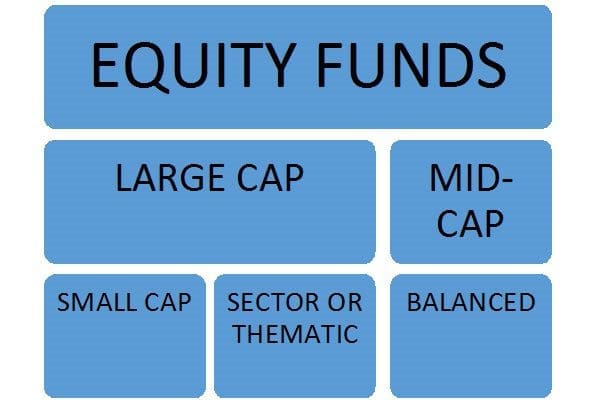
Equity-oriented funds invest money only in stocks or shares of companies. The fund bears high risk but also tends to provide a huge return. However, under this category there are eight sub-division as listed below:

Large-cap Fund
In order to understand the large-cap, mid-cap, and small-cap funds, you need to understand market capitalization first. Market cap is the value of a company, calculated by multiplying the present market value of a stock by the total number of outstanding shares in a company. A company with more than 75,000 cr. belongs to large-cap. These types of funds invest their money only in large-cap companies.
Mid-cap Fund
The fund infuses investors’ money into those companies which have a market cap of less than 75,000 cr. but more than 13,000 cr, consider as the mid-cap fund.
Small-cap Fund
Small cap companies deal with below 13,000 cr capitalization. This kind of mutual fund invests only in small-cap companies.
Sectoral Fund
Such investments are concentrated in a specific sector. Therefore, the risk factor is high here. To get e high return from this fund, entry and exit point is important as the fortunes of sectors change in different cycles in the economy. For example, Reliance Media and Entertainment fund invests only in the media and entertainment sector. SBI pharma fund invests in the pharma sector.






Diversified Equity Fund
The fund depends on the market view of the fund manager, who invests in different market capitalizations and sectors. This category is not related to a single sector or a specific market cap. Hence, the risk is quite lower than the previously described funds.
Dividend Yield Scheme
When a company shares some of its profit with shareholders, is called a dividend. The company’s board of directors takes the decision of providing dividends and it is optional. The fund generates regular income from the dividends. Dividend yield (dividend per share/prevailing price of the stock) funds invest in companies that provide high dividend yields.
ELSS or Equity Linked Savings Scheme
The ELSS is a tax saver mutual fund scheme. Here you will lock your investment for three years. It doesn’t just help to save taxes but also provides an opportunity to raise money. You can save tax up to 1.5 lacs.
Thematic Fund
Investment happens only in theme-based funds. For example, Rural Indian Theme, E-commerce Theme, etc. Just like the HDFC Housing Opportunities Fund’s theme is housing (cement, construction, paint, metal).
Debt Fund:
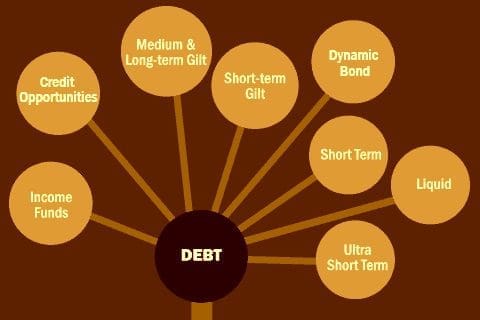
The term ‘debt’ indicate various instruments like debenture, bonds, certificates, mortgages, leases, etc. This categorized fund invests money only in debt instruments. The fund considers less risky than the equity fund. It also has four sub-divisions, as stated below.
Gilt Fund
Debt funds invest exclusively in Govt. securities refer to as gilt MF. As the Government itself issues Govt securities, that’s why default risk is zero. Therefore, it doesn’t carry any credit risk. There are two types of gilt funds, short-term and long-term.
Junk Bond Scheme
Here default risk is much higher than the gilt fund but the return is much higher. Therefore, investors get a huge amount of return. It is a fixed-income instrument.
Fixed Maturity Plan
Just like banks, the fund also has specifically predefined maturity. Investment areas are the certificate of deposit, commercial papers, corporate bonds, etc. However, the return is much higher than the bank’s interest rates.
Liquid Funds
Under this category, investment happens through money market instruments. By using the money market instruments such as certificates of deposit, treasury bills, commercial papers, term deposits, etc fund manager generates short-term interest. Investors who want to infuse their money short-term basis can try the scheme. The return is higher than banks. The risk factor is low along with low volatility. Investors can take out their investments anytime they want.
Hybrid Fund:
This fund is a composition of both equity and debt fund. Under this category, the fund manager invests money in both equity and debt. The hybrid fund is divided into three sub-divisions, as follows:
Monthly Income Fund
Under Monthly income fund managers infuse 60% to 90% of invested money in the debt instrument and the rest of the money goes into equity. As the maximum percentage of invested amount infuse into the debt instrument, the risk is much lower here. However, it isn’t a completely risk-free fund.
Balanced Fund
Though the fund is called a balanced fund, the ratio of investment in equity and debt is not balanced or the same. 60% to 85% of the invested amount goes into equity and the rest of it is in debt. As the equity percentage is higher, so is the risk factor.
Arbitrage Fund
Arbitrage fund concentrates on arbitraging – the difference between cash and derivatives markets. This fund exploits the difference to generate returns. Arbitrage funds are suitable for investors in the highest tax bracket looking to park money for a short time period.
Mutual funds based on Structure:
Under this category, there are three types of mutual funds. These are as follows:

Open-Ended Fund
Investors can buy and sell units at any time they want at NAV-related prices. Therefore, it doesn’t have any fixed maturity period. Here issues are unlimited. Investors can redeem this fund on a continuous basis.
Close-Ended Fund
It is the reverse of the open-ended fund. The maturity period is predecided or fixed. One can’t buy or sell units at any time. For example, The maturity period can be between 3-6 years. A close-ended fund is open for subscription only during a specified time of the launch of the scheme which is the NFO (New Fund Offer). It is listed on the stock exchange. As liquidity is quite low here, the buying-selling problem is generated.
Interval Fund
Very few funds come under this category. Basically, it is the combination of open-ended and close-ended funds. These schemes are open for both redemption and purchase during pre-specified intervals.
Mutual Funds Based on Fund Management:

Actively Managed
If fund managers actively participate in the investment process, known as an actively managed fund.
Passively Managed
If fund managers don’t take part actively in the investment process, refers to a passively managed fund.
These are some of the basic types of mutual funds in India. However, with the different types of mutual funds in India, the investment process becomes easier these days.
Mutual Funds FAQ
A mutual fund is a fully professionally managed investment fund that pools money from many investors to buy securities. The investors may be retail or institutional. A mutual fund can be of different types that cover different segments in the financial market.
If we broadly divide, there are four types of mutual funds. Equity (Stock), Long-term Debt, Hybrid Fund, and Fix-income Fund. Each of them carries a different risk and profit level. The riskier the security, the more profit-making probability it has. Equity is riskier than a Debt fund.
The blue-chip fund invests in those companies which are established and have a credible track record. Simply, blue-chip companies are safe, stable, and profitable. Big companies with large market capitalization are termed the Blue-Chip.
First, estimate your investing and risk-taking capacity.
Second, looking for an experienced management team.
Third, be analytical when choosing your fund house.
Fourth, invest as per your risk-taking ability.
If mutual funds are divided structure-wise, we will get three basic structures of mutual funds. These are open-ended funds, close-ended funds, and exchange-traded funds (ETFs).
Conclusion
Mutual funds are a great way to invest in the Indian markets, with several different types of mutual funds available – ranging from equity, debt, and money market-oriented schemes. From tax saving options like ELSS to funds designed for specific investment goals such as international investing or retirement planning, there is something suitable for every risk appetite and financial goal. Comprehensive research can help an investor easily understand the suitability of various types of mutual fund products while considering their financial objectives. Investors should select these instruments prudently after understanding their portfolio allocation and personal profile before taking any further action towards making investments in them.