
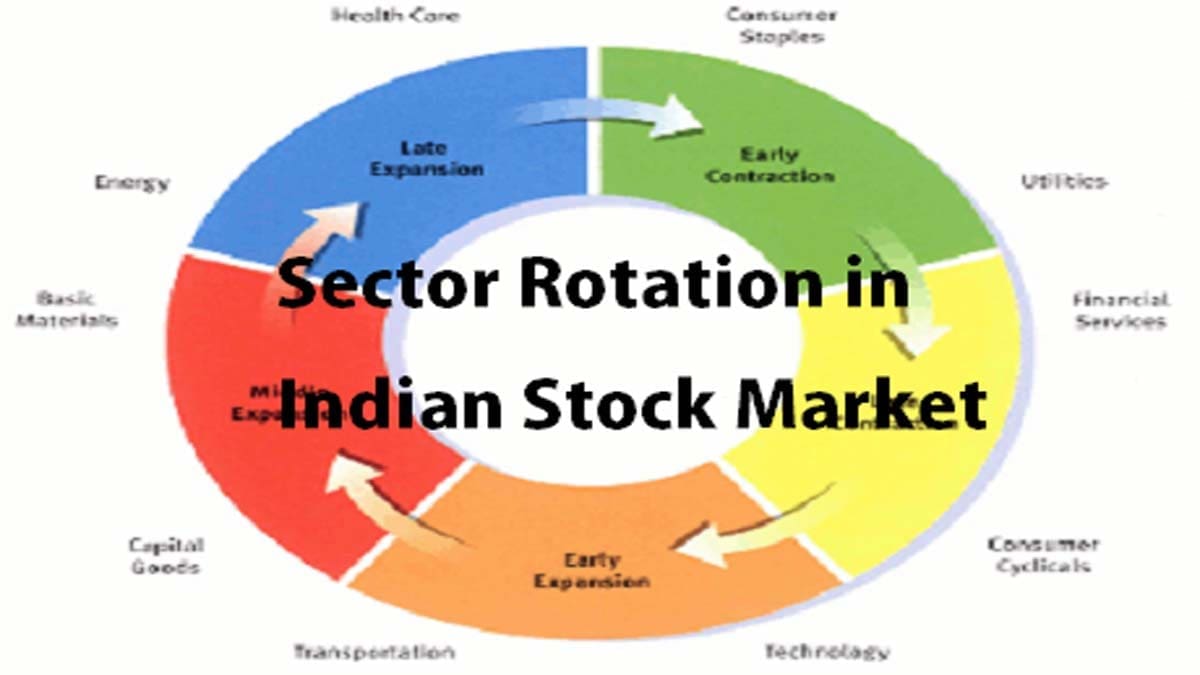
Sector rotation in the Indian stock market is one of the most popular strategies among investors. As the same suggests, the primary focal point of the strategy is on the different sectors of the market. Before stepping into the main points of the strategy, the definition of the term “sector” will be explained.
What is Sector in the Stock market?
A sector is an economic area where businesses share the same or related services and products. Sectors also reflect the industry or market that shares common operating characteristics. Dividing an economy into various sectors allows for a more in-depth analysis of the economy as a whole. For example, in the Indian share bazaar, there are sectors like the IT sector, Bank, Pharma, Energy, etc.
Sector Rotation in Indian Stock Market
Analyzing stocks separately without any base level is more difficult. If you consider sector-wise analysis, it would be easier. At a time, all sectors can’t perform well. Sector rotation is essential for investors who want to maximize their return with less risk.
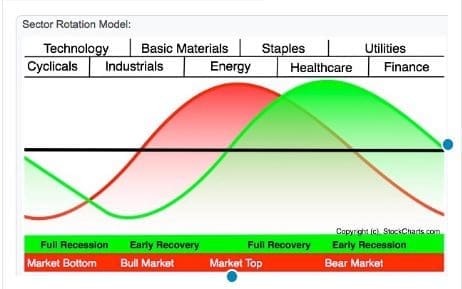
The theory of sector rotation was developed and popularized by Sam Stovall, in his two well-known works- ‘Sector Investing’ and ‘Standard & Poor’s Guide to Sector Investing’.






The specific investment strategy involves shifting the invested money from one sector to another. In order to get market-beating returns, investors should adopt the process, based on the performance at each economic cycle. Sector rotation is a popular top-down approach to investment involving the movement of money from one industry sector to another by anticipating the various stages of the economic cycle in an attempt to beat the markets.
The Need for Sector Rotation
The strategy is based on the assumption that certain sectors give relative strength to different stages of business cycles. It has the capability to outperform the markets. Sector rotation is almost similar to tactical asset allocation. Investors construct a portfolio using selected economic sectors or industries instead of investing in a particular asset class—such as stocks, bonds, commodities, etc—in order to take advantage of current market conditions.
Sector rotation matters to stock market investors as certain sectors perform well in a particular stage of the business cycle, while others do not. If one can assess the possible performance of each sector during a different phase of the market cycle, it will be easy to select the stocks. Once that phase of the economic cycle is over, one can shift the invested money to another proper sector that is for the next market cycle.
Types of Stock Sectors
One way of grouping the sectors further is to depend on their behaviour in each of the market cycle phases. The sector which moves in accordance with the cycle is called the cyclical sector and the one that is not impacted by the market cycle is called the defensive sector.
FAQ
The sector rotation cycle is a regular and repetitive pattern in which sectors move from under- to over-performing, based on economic data. As investors adjust their portfolios accordingly, it reverses and cycles back as investor sentiment changes.
We can predict stock market sector performance by assessing news events, aggregated opinions or expert analysis. Additionally, investors can evaluate measures such as price movements over time and use algorithms to monitor potentially profitable opportunities.
An example of a typical stock market sector rotation includes technology stocks doing particularly well when consumer confidence rises sharply. At the same time, defensive sectors such as utilities tend to do better when growth slows or declines unexpectedly.
Currently, healthcare stocks are excelling in the Indian markets due to increased awareness among the population about preventive healthcare coupled with improved drug availability at more affordable costs.
Conclusion
Overall, sector rotation in the Indian stock market is a very effective strategy for any investor; however, newcomers should use it with caution. The decision-making process requires an intimate knowledge of the different sectors of the Indian stock market. As your understanding grows and your experiences increase, sector rotation can help you achieve greater returns on your investments. With all the information available online today combined with empirical knowledge through trial and error investing strategies like sector rotation become incredibly rewarding for newer investors as well as experienced ones!