

There are thousands of investment avenues available in India. Among them, we are acquainted with the financial scheme Systematic Investment Plan or in short SIP but only under the mutual fund. Most of us are entirely unaware that SIP exists in Equity also. Though the risk in equity SIP is quite higher than in mutual fund SIP still many investors are earning millions by applying the scheme. The overall concept of the systematic plan is the same in both equity and mutual funds. The concept of SIP in equity shares in India is still not quite popular among investors. Therefore, we have decided to come up with the topic. From this article, you will get a detailed discussion on the subject.
What is Systematic Investment Plan (SIP)?
A Systematic Investment Plan (SIP) is an investment plan offered by mutual funds wherein the investors commit to invest a fixed amount of money in the mutual fund scheme periodically at regular intervals, generally monthly or quarterly. SIP allows people with limited resources to regularly save and accumulate wealth over time. It follows a disciplined approach to offer benefits such as cost averaging and Rupee Cost Averaging which makes it all the more attractive.
What is SIP in Equity Shares?
As the name suggests, it builds a long-term horizontal portfolio with small systematic investments at regular intervals. We know that the equity market is quite a volatile market. But in the SIP scheme, investors can efficiently manage this volatility. The intervals could be either monthly, quarterly, or yearly. The key point behind the profitable return is averaging the costs. The benefit of compounding is also there in this plan. Generally, longer the investment horizon, the greater the benefits. It works as a great risk management scheme by reducing market timing risk.
Different Types of SIP Schemes for Equity
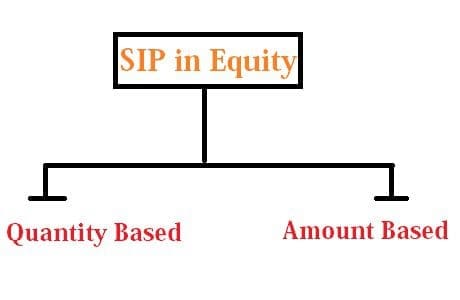
Investors can choose between a Quantity-Based Systematic Investment Plan and Amount Based Systematic Investment Plan. The types are as follows:






Quantity Based Plan
According to this plan, the number of shares will be fixed. You can only choose the company as per your wish. The quantity will be specified to you prior to the investment. At the time of the order execution, the value is calculated based on the prevailing market price. At specific periodic intervals, the particular quantity of shares will be brought automatically.
Amount Based Plan
The previous type was quantity based while this is the amount-based SIP. Here, a fixed amount is invested at a pre-defined frequency. The amount will be fixed as per your desire. The fixed amount will be automatically subtracted from your bank account (monthly, quarterly, or yearly). You can also choose your preferred companies for investment.
Benefits of SIP in Equity Shares
- The SIP scheme not only provides you with a lump sum profit but also helps you to lead a disciplined financial life.
- As it doesn’t come with a huge investment necessity, investors need to shell out small amounts at regular intervals of time. For that reason, investors don’t have to go through any kind of financial pressure.
- Flexible options are available in it, like amount-based and quantity based.
- Flexibility in terms of intervals (Daily, Weekly, Fortnightly, or Monthly) is there under this scheme.
- Investors who lack time and resources may choose the SIP option without any doubt.
- You can start SIP with a very small amount of money.
- Investors can accomplish their long-term financial goals with SIP. After a specific period, investors get a huge amount of return from it.
- There are no additional charges in this plan, investors have to make a one-time entry.
Example of SIP in Equity Market
Suppose you decide to do SIP on Ashok Leyland CMP Rs. 129. According to your view, the stock has the potential in the medium to long term. Now, you have two options, either you can invest a specific amount or you can invest a particular quantity at a pre-defined interval. If the price falls to 115 after 2 months, you don’t have to suffer a loss for that as SIP works on the averaging method. Your loss will be minimum.
In other words, we can say that the systematic plan works as a hedging tool in the investment. Investors with low savings capability can easily afford the option, without taking any high risk.
FAQ
Yes, Systematic Investment Plans (or SIPs) are a great way to invest in equity. You can regularly set aside money over time and the returns gradually accumulate with market fluctuations. It’s one of the simplest yet most effective ways to save for the long term by creating wealth over time.
It’s simple. All you have to do is decide an amount you want to commit every month into your portfolio and sign up for a scheme offered by mutual funds or brokers that offer this type of investment plan. Moreover, your broker can guide you through it if necessary and help pick out schemes that work best for your goals.
Absolutely! Starting a SIP has never been easier – authorized stockbrokers enable investors across India to directly initiate their own flexible investments right from home on secure e-trading platforms like Samco’s Star investing app or website via demat accounts & digital signatures. Invest as much as per the budgeted amount and enjoy the benefits of regular investments coupled with compounded benefits tailored according to investor requirements & diversified risk appetite profiles invoked at any given point during years of economic cycles w/ seamless execution & lower brokerage costs online!
No, Equity holdings made through Systematic Investment Plans are subject like all other taxable forms of earnings under Indian Income Tax Slab Rates applicable upon various memberships holding belonging abroad, partial gains can be exempt depending on Stamp Duty Charges based on percentage rate structure applicability status within the region at the discretion
Conclusion
However, the plan considers one of the most systematic plans in the equity market. Hence, investors can easily afford the scheme as per their requirements. It is advisable to select the stock on which you want to apply the systematic investment scheme. In conclusion, I think you can invest better after going through this brief overview of SIP in equity shares.