
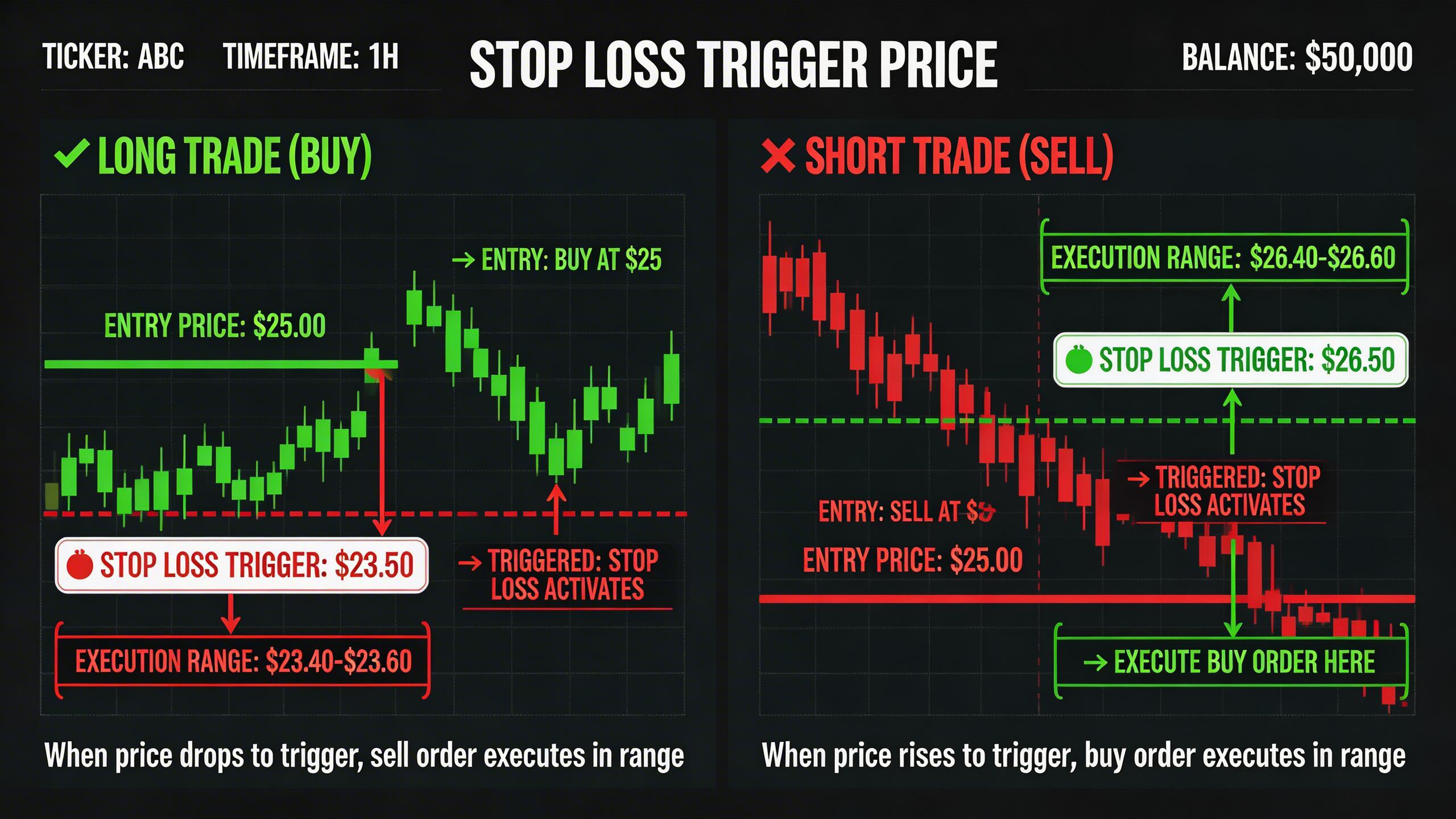
Quick answer: The meaning of the trigger price is the price level at which your stop loss order becomes active and gets sent to the exchange for execution. After it triggers, the limit price (in SL orders) decides the worst price you’re willing to get.
If you are an intraday or short-term swing trader, this one concept decides whether your stop-loss actually protects you or just sits there “Triggered but not executed.”
Read this if: you trade on Zerodha, Angel One, Upstox, Dhan, ICICI Direct, Kotak Neo, etc. and you keep getting confusion between trigger price and limit price or stop-loss is not executing in fast moves.
Trigger price meaning (simple definition)
Trigger price meaning: It is the price point that activates your stop-loss order. Until the market hits that level, your order is inactive. Once the market reaches the trigger price, your stop-loss order becomes active and is sent to the exchange.
Think of it like this:
- Trigger price = Activation
- Limit price = Execution condition
When does the trigger actually fire?
Retail confusion is common because many brokers trigger using LTP (Last Traded Price) rather than bid or ask quotes.
Why does the trigger sometimes fire, but the chart doesn’t show it?
Orders trigger on tick-by-tick trades, while charts may display aggregated candles. A tick may hit your trigger even if your candle view doesn’t clearly show it.
Trigger price vs limit price (most important difference)
In a Stop Loss Limit (SL) order you see two fields:
- Trigger Price – activates the stop-loss
- Limit Price – the price your limit order is placed at after activation
Simple rule
Trigger = “Start the order”
Limit = “Don’t fill worse than this.”
If the market moves too fast, your order may trigger but not execute if the limit is too tight.
Difference Between Trigger Price and Stop Loss Limit Price
| Parameter | Trigger Price | Stop Loss Limit Price |
|---|---|---|
| Function | Activates the order | Execution price |
| Location | Broker system | Exchange order book |
| When used | Stop-loss orders | Limit orders |
| Example | ₹95 | ₹94.90 |
Example:
- Buy price = ₹100
- Trigger price = ₹95
- Limit price = ₹94.90
When the market hits ₹95, the order activates and places a limit sell order at ₹94.90.
SL vs SL-M: price control vs execution certainty
Most Indian brokers provide two stop-loss types.
SL (Stop Loss – Limit)
- Trigger + Limit
- Better price control
- Execution not guaranteed in fast moves
SL-M (Stop Loss – Market)
- Only trigger price
- Guaranteed execution
- Can slip in volatile markets
When to use which?
If you fear “not executed”
Use SL-M or keep a wider limit gap.
If you fear “slippage”
Use SL with a buffer between trigger and limit.
How To Put a Correct Stop Loss Trigger Price
Intraday and short-term swing trading can be risky. Stop-loss orders help limit losses.
Importance of Stop Loss Order
Every trader must keep losses small to protect capital. A stop-loss order should be placed immediately after entering a trade.
How to Place a Stop Loss Order
- If you buy a stock, place a stop loss below the buying price.
- If you short sell, place a stop loss above the selling price.
Example:
Buy at ₹100
Target ₹105
Stop loss ₹98
Short sell at ₹100
Target ₹95
Stop loss ₹102
Observations on Stop Loss Order
Many traders place stop loss incorrectly. Beginners often place stop orders in the wrong direction, which causes broker rejection errors.
3-step method
- Stop loss must be below buy price
- Stop loss must be above short-sell price
- Maintain an optimum gap between trigger and limit price
Importance of Optimum Gap between Stop Order Price and Trigger Price
If the gap between trigger and limit price is too small:
- The order will trigger
- But may not execute
Example:
In stocks like Dr Reddy’s, the bid-ask spread may be ₹0.50 to ₹1.
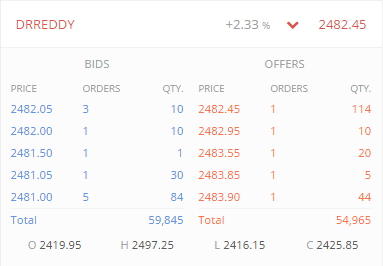
If your trigger-limit gap is only ₹0.05, the order may trigger but remain pending.
Practical buffer rule
- Large-cap stocks → small buffer
- Volatile stocks → wider buffer
- News days → consider SL-M
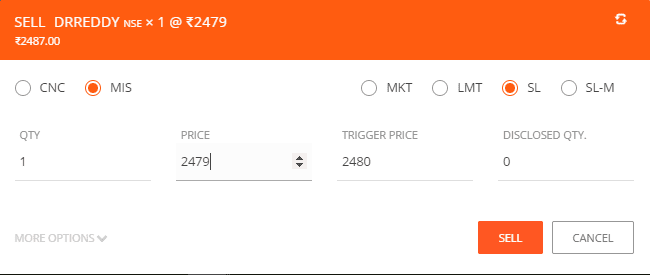
Example of Placing a Stop Loss Order (DR REDDY)
Example 1: Long Position
Bought DR REDDY at ₹2487
Stop loss setup:
Trigger price = 2480
Limit price = 2479
If the price falls to 2480, the sell order triggers with a limit of 2479.
Execution range: 2479–2480
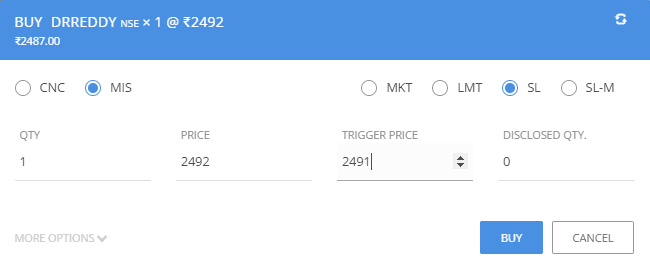
Example 2: Short Position
Short sold DR REDDY at ₹2487
Stop loss setup:
Trigger price = 2491
Limit price = 2492
If the price rises to 2491, buy order triggers with a limit of 2492.
Execution range: 2491–2492
Common mistakes
1) Confusing trigger price with limit price
Trigger activates the order.
Limit controls execution price.
2) Trigger price can’t be higher/lower
This happens when trigger and limit directions are reversed.
| Position | Order | Correct Relationship |
|---|---|---|
| Long position | SL Sell | Trigger ≥ Limit |
| Short position | SL Buy | Trigger ≤ Limit |
Example:
Long trade
Trigger = 2480
Limit = 2479
Short trade
Trigger = 2491
Limit = 2492
3) Expecting guaranteed execution
Stop-loss orders do not guarantee execution price.
SL-M → guaranteed execution but may slip
SL → better price but may not execute
4) LTP vs Bid-Ask confusion
Triggers usually activate based on LTP (Last Traded Price), not bid or ask.
Free Tool: Stop Loss Trigger Price Calculator
This tool converts your points or percentage stop loss into an exact trigger and limit price.
📊 Stop Loss Trigger Price Calculator
Convert your stop loss (points or %) into exact trigger & limit price
Note: SL-M requires only trigger price. SL requires both trigger and limit.
Checklists + PDF downloads
1) Trigger Price Cheat Sheet
Includes:
- Trigger vs limit
- SL vs SL-M
- Long vs short rules
2) “Triggered but not executed” Checklist
Includes:
- Spread check
- Buffer rule
- Volatility warning
- SL vs SL-M decision
3) Broker Field Mapping Guide
Shows:
- How Zerodha
- Angel One
- Upstox
- ICICI Direct
display trigger and limit fields.
Helpful videos
Zerodha Stop Loss Tutorial
Kotak Neo Trigger vs Limit
Angel One Stop Loss Guide
FAQs on the Meaning and Usage of Stop Loss Trigger Price
The main difference between a stop-loss trigger and a limit price is that when a stock reaches the stop-loss trigger, it triggers an order to sell your shares at whatever market rate exists at the time. A limit price order only lets you buy or sell your shares if they are available at a certain predetermined price.
The trigger price in a stop-loss order refers to the specific value of a security that must be reached before the trade execution. Once this threshold is met, then the sale will occur automatically regardless of market conditions. This ensures your position to liquidate as soon as the stop loss triggers.
The best way for traders to determine their preferred stop-loss strategy depends on what type of trading style they favour (day trading vs swing), and how much capital they are comfortable risking per trade versus how much risk per trade is acceptable over their portfolio overall. In general, finding cost-effective points for entry and exit should focus more on mathematics rather than gut reactions. Hence, every trader would benefit from back-testing different strategies against historical market data first before falling into emotional trades fueled solely by intentions instead of facts.
When a stop loss order is triggered, it means that an investor’s open position has been sold or closed automatically based on some predetermined criteria. In most cases, this happens either by reaching one set level below its purchase price (for long positions) or above (for short positions). This action helps protect profits while minimising losses where possible. This uses sensible investing tactics alongside proper money management techniques such as maintaining appropriate levels of leverage.
Conclusion
Placing the correct stop-loss trigger price is essential for intraday and swing traders.
A proper stop-loss:
- Protects capital
- Limits losses
- Reduces emotional trading
Key rules to remember:
- Stop loss below buy price
- Stop loss above the short sell price
- Maintain a proper trigger-limit gap
Understanding trigger price helps ensure your stop-loss actually works when the market moves fast.



Hi Sir,
How do I place stop loss for swing trades in stocks/Futures when gaps happen? For example: Today I bought at 9000 and my SL-M is at 8990 holding it for next day. Next day gap down happens and price is at 8950 so I have lost 50 points. Is there a way to avoid the above?
Kumar, there is no way you can remove overnight gap issue. But sometimes gap will be in your favor and sometimes not. So there is a 50% probability.