
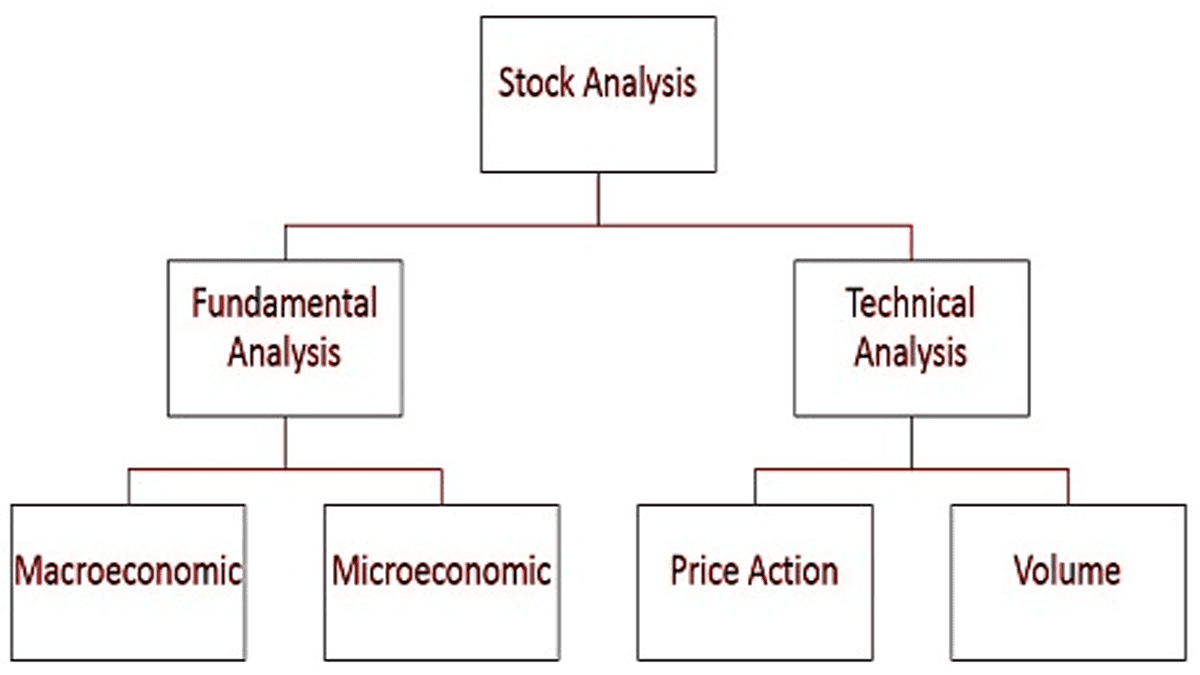
Fundamental analysis vs Technical analysis is one of the main topics of stock market investment. The one and only primary objective of investors is to earn maximum profit. We can generalize investment mainly in two ways, long-term investment, and short-term investment. Before investing one should analyze market movements, price fluctuations, and most importantly to understand the relation between buyers and sellers. In order to analyze the market in a proper way, there are two basic approaches, fundamental and technical. There is a clear distinction between fundamental analysis and technical analysis. So fundamental analysis and technical analysis are quite significant in this context.
FAQ
Fundamental analysis attempts to determine the intrinsic worth of securities. Traders use statistical trends in the stock’s price and volume in technical analysis, which differs from fundamental research. For researching and projecting future patterns in stock values, both methodologies are applied.
Technical analysis is better for short-term trading and market timing, whereas fundamental analysis is better for long-term investments. Both can be used in tandem to plan and execute medium- and long-term initiatives.
Some technical analysis approaches work well in conjunction with fundamental analysis to give investors with additional information. These are some of them: 1) Volume Trends: It’s useful to know what other investors think about a stock when an analyst or investor is examining it.
What is Fundamental Analysis?
Fundamental analysis (FA) is a way of determining the intrinsic value of a security by looking at linked economic and financial elements. Fundamental analysts look at everything that can influence the value of security. From macroeconomic issues like the state of the economy and industry circumstances to microeconomic elements like the company’s management effectiveness. All fall under the fundamental analysis.
When it comes to long-term investment, it is better to do fundamental studies. Fundamental studies consist of an overall economic condition, a company’s earnings, expenses, assets, liabilities, and economic events. Investors mainly calculate the stock value using these kinds of economic factors, as we mentioned above.
Benjamin Graham is the father of Fundamental analysis.
What is Technical Analysis?
Oppositely, when investors approach the market from a short-term view or want to go for intraday trading, it is better to follow technical analysis. Analyzing price movements and the volume of the stock and focusing on the chart pattern, are some of the basic characteristics of technical analysis.

The study of past market data, such as price and volume, is known as technical analysis. Technical analysts seek to analyze previous performance to anticipate future market behavior using insights from market psychology, behavioral economics, and quantitative research. Chart patterns and technical (statistical) indicators are the two most popular types of technical analysis.
Charles Dow is the father of technical analysis and the famous “Dow Theory” is the foundation of technical analysis.
Comparison of the two Analyses
So when it comes to comparing fundamental analysis vs technical analysis, we can differentiate the two analyzing technic base on the four aspects which I have described in the following.






i) Focus on Fundamental and Technical Analysis
Fundamental analysis focuses on the tangible and intangible aspects of the company to figure out the accurate value of the stock.
While technical analysis focuses on internal market sentiments and price movements.
ii) Benefits of Fundamental and Technical Analysis
Fundamental prediction is beneficial mainly for long-term investing. Long-term investors hold their investment for many years through market fluctuation.
The Technical Analysis is beneficial mainly for short-term traders when they buy and sell stock within a short time span.
iii) Assumption aspect of Fundamental and Technical Analysis
In technical analysis, assumption plays a vital role. Because the market movement is quite dependent on the trader’s emotions.
But in fundamental analysis, there is no such clear assumption. Because we focus on the history sheet of the company and the other details.
iv) Analyzing Aspects of Fundamental and Technical Analysis
The fundamental analysis mainly consists of various studies, such as financial statements, earnings growth, demand forecast, etc.
The technical analyst listens to the market, the movements of the market are the most determining factors to predict stock prices.
v) Purpose of Fundamental and Technical Analysis
Fundamental analysis aids in determining the inherent value of a stock in order to determine its long-term investment potential. This analysis will also take into account the economy’s overall state, as well as factors like production, interest rates, employment, incomes, housing, GDP, promoters and management, and manufacturing.
Technical analysis is a trading discipline that uses price trends and patterns on charts to evaluate investments and uncover trading opportunities. Past trading activity and price variations of an asset, according to technical analysts, might be useful predictors of future price movements.
Comparison of Fundamental Analysis with Technical Analysis
So these are some of the basic distinctions between fundamental analysis with technical analysis. It is a vital topic in the case of investing. According to the investors’ requirements, he should have a clear idea about these two main analyses. If the investors and traders learn to use these two analyzing technics very well then it will be easy for them to earn profit from the market.
As the technical analysis is more assumption-based rather than paperwork. That is the reason the technical analysis flows with the trader’s emotion. The traders affect Technical analysis directly. But on the other hand, the fundamental analysis is based on the company’s balance sheet, past performance of the company, and upcoming deals. That is why fundamental analysis is preferable to investors.
Conclusion
While discussing fundamental analysis vs technical analysis, we have learned both are good in their own ways. Investors are more tilted towards fundamental analysis. On the other hand, traders are also looking forward to technical analysis. According to my view, before investing in any stocks you should do a fundamental as well as technical analysis. Because if you analyze a company’s stock by both the analyzers that will only help you to gain more and more profit. The more clear in investment status the less possibility to go through a loss in the stock market.