

In this article, we will discuss the tax aspects of the stock market. That means how much tax a trader or an investor needs to pay on the income from the stock market. Everyone who is new to the share market has a curiosity to know the tax slabs on the returns from stock trading. So let me discuss the income tax on share trading calculation in a simple and easy way.
When There is Income – There is Tax
The first advice to the newcomers will be to concentrate on income first, because if there is income, then only there will be a question of tax. If there is no income, the government will not charge a single paisa as a tax. So before we go deep into the Income Tax on share trading calculation, let us know how many types of tax are there.
Types of Income Tax on Share Trading
There are 3 types of tax in the stock market:
- Long-term capital gain tax (LTCG)
- Short-term capital gain tax (STCG)
- Speculative and non-speculative business income
Let me assume, Ravi is an investor who buys a stock and holds it at least for 365 days or more. On the other hand, Raghu is a trader who trades in the equity market and he frequently buys and sells his holding. Raghu does not hold his trades for more than a few months or few weeks or few days and he never holds his trades for a year. And Rahul is a trader who mainly trades intraday or trades futures or options.
Long-term Capital Gain Tax:
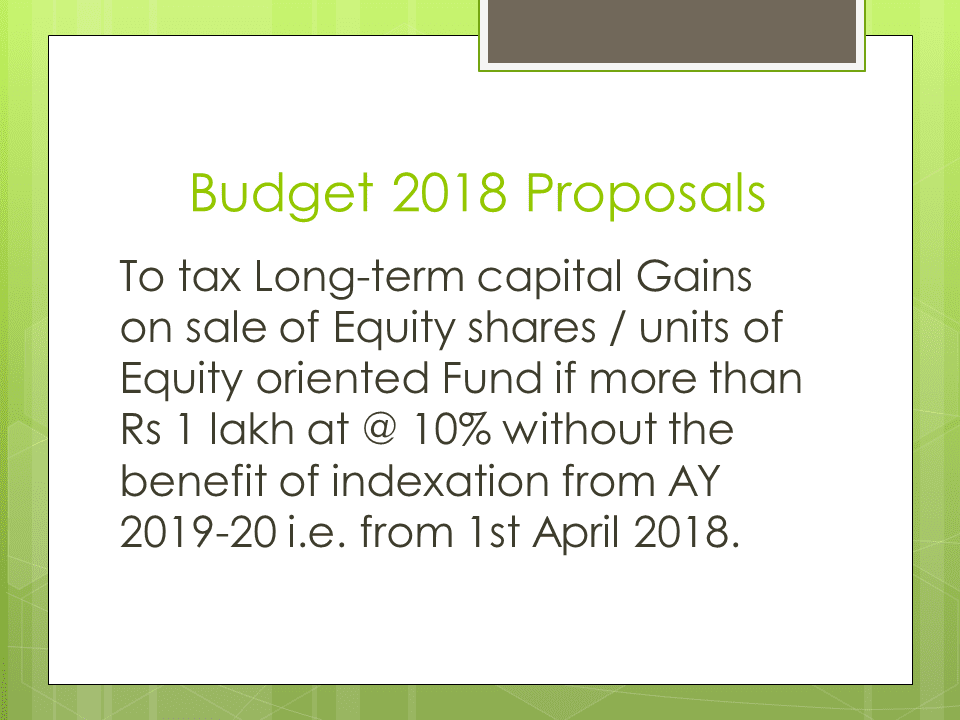
Previously only STT was charged which is also known as Securities Transaction Tax. So there was no LTCG. So, previously if we used to hold a stock for more than 365 days, the gain was completely free from any income tax. But recently on the Union Budget 2018, the Finance Minister, Mr. Arun Jaitley has proposed for a 10% LTCG on both the stock market as well as on the mutual funds. So previously there was no tax if we bought any stock and held them at least for 365 days and then sell them. But now the scenario is going to change. Previously, Ravi was not paying any income tax on his profits, but now he is likely to pay a 10% tax on his profits apart from the STT.


Short-term Capital Gain Tax:
As Raghu does not hold his trades for 365 days or more his trades are termed as short-term trades. As per current tax rates, Raghu needs to pay a flat 15% income tax on his profits. So if he makes Rs. 1 Lakh profit in a financial year, he needs to pay 15% of Rs. 1 Lakh or Rs. 15,000 as income tax. A short-term trader needs not think of tax slabs. Whatever tax slab he is in, he can pay just a 15% flat tax on his profits.
Tax on Speculative and Non-speculative Business Income:
Rahul mainly is mainly doing intraday trading. He also does futures and options trading. Rahul’s trading activity is known as speculative and non-speculative business. While doing the calculation of income tax on share trading, this third type of trader’s trading is seen as a business. So any profit Rahul is making is taxed as a normal business. This tax does not have a fixed rate and this will depend on the amount of profit and Rahul will be taxed as per the current income tax slab his profits come under. If his income is below 2.5 Lacs or 3 Lacs, he need not pay any income tax as per current tax slabs. If he makes more income eventually he needs to pay 10%, 20%, and ultimately 30% income tax depending on the amount of income and current tax slab.
In case Rahul earns Rs. 2 Lacs from some other business and he earns Rs. 3 Lacs from intraday trading, his total business income will be Rs. 2 Lacs + Rs. 3 Lacs = Rs. 5 Lacs. This Rs. 5 Lacs will decide his tax slab and he needs to pay tax accordingly. Rahul can deduct his expenses from his income before final taxing, as this is a business income. So he can deduct his expenses like computer price, internet expenses, any staff expenses, etc from his income before final taxing. See the current income tax slab below:

Adjusting Loss in Calculation of Income Tax on Share Trading
In all three kinds of taxes, investors and traders can deduct the losses before the final taxing. So if a trader is making a profit of Rs. 5 Lacs from a few trades and on the other hand if he makes a loss of Rs. 2 Lacs from another few trades, he can deduct the loss from the profit before final taxing. So he needs to pay tax only the net profit of Rs. 5 Lacs – Rs. 2 Lacs = Rs. 3 Lacs. For speculative and non-speculative business income, the loss can even be carried forward to the next year. If next year a trader makes a profit, he can adjust it against the loss made last year. In this way, in speculative and non-speculative business income, the losses can be carried forward for 7 years. This can create a huge saving in the tax for a trader.
Calculating Turnover in Calculation of Income Tax on Share Trading
We have already discussed, how to do the calculation of income tax on share trading. A few important points are still there to discuss. If a salaried person works in the stock market and does intraday trading, he can show his income both as a salaried or as a business as his income is a mix of the two. On the other hand, if the yearly turnover of a speculator, rises above Rs. 2 Crores, which is very normal if he trades in futures and options, these kinds of traders will also need to undergo an audit before taxation. Previously this limit was Rs. 1 Crore. But now it has been increased to Rs. 2 Crores.
The turnover is calculated by adding both the profit figure of any financial year and the loss figure simultaneously. Suppose, Rahul has made Rs. 10 Lacs profit in a few trades and made Rs. 5 Lacs loss in another few trades, his total turnover is Rs. 10 Lacs + Rs. 5 Lacs = Rs. 15 Lacs. So, this turnover is not the same as the turnover calculated by the brokers.
FAQ
Income generated from share trading in India is taxed according to the current income tax rates. It may vary depending on individual circumstances and the type of share transactions.
Profit tax on trading can be calculated by subtracting the total purchase price and associated costs (transaction fees, brokerages, etc.) from the sale price of your shares or mutual funds.
Tax charged on stock market trades varies depending upon the category that you fall into as per applicable rules and regulations. Generally, short-term capital gains are subject to taxation while long-term capital gains are eligible for certain exemptions.
Generally, taxes are deducted before payout from the demat account based on the investor’s given PAN and Aadhar card information but it needs to be validated regularly with required documents when asked by the concerned authorities politically & legally valid documents mentioned above are always needed for better reconciliation reports.
Conclusion
So we discussed tax aspects of share trading. We have understood there are 3 types of income tax calculation in share trading. They are long-term and short-term capital gain taxes and speculative and non-speculative taxes on business income. We have also understood how to adjust losses and calculate turnover while income tax calculation for traders. By learning this tax calculation you can plan for investments for tax planning. I will be happy to answer your queries on this taxation topic in the comments section below.



I want to begin trading.suggest me a good broker..how is 5paisa.com?? I’m practicing trading by a app(stock trainer)..which type of trading I should start??Inrta day?? Suggest me a good broker..Thank you in advance.
Shuvro, you can send your contact number so that we can help. You can consider Zerodha, Upstox or 5Paisa.
My income is less than Rs.2.5 lacs per annum. I buy and sell stocks in short term also. My short term gain is only Rs.15000/- this year. Do I need to file IT return as my turnover in stock market (both buy and sell of stocks) exceeds Rs.10.00 lac in a financial year?
We suggest you file a return. Your lawyer may check the case and file a nil return and you may be exempted from paying any tax, but filing a return is always a must for a trader.