
Introduction: The “Cheap Broker” Question Isn’t Enough
If you’re searching for a fyers review, chances are you’re not just comparing ₹20 brokerage headlines—you’re trying to answer a more important question: Will this platform hold up when the market turns fast, my order must execute, and my money must move on time? That confusion is real, especially for Indian retail traders who are moving from “learning mode” to “execution mode” in intraday and options.
In my experience as a trader and analyst since 2002, I’ve seen the same pattern repeat with every new wave of platforms: the marketing promise is speed and simplicity, but the lived experience is about edge cases—order rejections, platform freezes, margin confusion, withdrawal delays, and support loops. And in 2026, FYERS sits right in that tension: it’s genuinely feature-rich for chart-driven traders, yet it attracts loud complaints from active users who hate surprises mid-trade.
This article is written for Indian beginners to intermediate traders and investors who want clarity—especially if you use TradingView, Python, Excel, or Google Sheets to become more systematic. We’ll walk through (1) FYERS’ platform strengths, (2) what the most common complaints actually mean in practical terms, (3) brokerage and fee reality (including what changed recently), and (4) a no-drama way to compare FYERS with Zerodha, Dhan, Groww, Angel One, and Upstox based on your style—not hype.
One important note before we begin: a broker is not just an app. It’s a risk engine, a settlement process, and a customer support system. When people say “FYERS is great” or “FYERS is the worst,” they’re often reacting to very specific scenarios—like SL orders being blocked in certain segments, MIS being disallowed after square-off time, or withdrawals being rejected because funds were added the same day. If you understand those mechanics upfront, you’ll make a calmer, more confident decision—and you’ll trade with fewer nasty surprises.
What are Fyers brokerage charges?
- Equity Delivery: ₹0 (Free)
- Intraday Trading: ₹20 or 0.03% per order (whichever is lower)
- Futures Trading: ₹20 per order
- Options Trading: ₹20 per order
- Account Opening: Free
Apart from brokerage, charges like STT, GST, exchange transaction fees, SEBI charges, and stamp duty apply.
1) Direct verdict: Who should (and shouldn’t) pick FYERS in 2026?
Direct answer: FYERS is a strong pick in 2026 if you’re a chart-first trader who values TradingView-style execution tools and can tolerate a stricter risk system; it’s a weaker fit if your biggest fear is order rejections, platform hiccups, or withdrawal uncertainty during busy market periods.
The “best fit” trader profiles
From what I’ve observed across traders I’ve mentored and worked with, FYERS tends to fit these profiles well:
- Chart execution traders who want fast decision-to-order flow (especially on-chart workflows). FYERS is consistently positioned as TradingView-native in its web experience, and that matters if you trade levels, breakouts, and pullbacks.
- Active F&O traders who like clean pricing and don’t want brokerage complexity per segment. FYERS’ flat-fee positioning remains competitive in the ₹20-per-order landscape.
- System builders who use spreadsheets/Python and want flexibility around workflows (including APIs). FYERS leans into tech users as a segment.
A quick real-world example: one of my long-time readers moved from “indicator hopping” to a simple price-action approach—marking levels, waiting for structure, then executing only when the candle closes to confirm direction. For this kind of trader, the platform matters less for “research calls” and more for chart clarity and fast, repeatable execution. FYERS can feel like a good match here—when it’s stable.
Internal reading that complements this style: my price action base page is a good refresher before you judge any platform’s chart workflow.
The “avoid if” list (be honest with yourself)
You should think twice about FYERS if:
- You’re the kind of trader who places many rapid-fire orders and gets frustrated by conservative risk checks.
- You want the most “polished” back-office reporting and a smoother support ecosystem from day one.
- You’re extremely sensitive to any downtime/latency during volatile market windows.
This isn’t theoretical. Public complaints frequently cluster around order rejections, charts not loading/ticks freezing, and withdrawal delays, with some users calling the risk controls overly conservative.
Who Should Use FYERS? (Quick Decision Table)
| Trader Type | FYERS Fit | Why | Better Alternative |
|---|---|---|---|
| 📈 Active Intraday Trader | ⚠️ Maybe | Low brokerage is good, but order rejections & occasional platform lag can impact fast trades. | Zerodha / Dhan |
| 🧠 Options Trader (F&O) | ✅ Yes | Flat ₹20 pricing + TradingView chart trading is excellent for options strategies. | Dhan (for speed) / Zerodha |
| 📊 Chart-Based Trader | ✅ Yes | Best-in-class TradingView integration with drag-and-drop order execution. | No strong alternative (FYERS excels here) |
| 🤖 Algo Trader | ⚠️ Maybe | Free API is a plus, but MTF charge confusion & execution reliability concerns exist. | Dhan / Zerodha |
| 💰 Long-Term Investor | ❌ No | No strong research tools or ecosystem; delivery is no longer fully free. | Groww / Zerodha |
| 🚀 Beginner Trader | ❌ No | Steep learning curve + complex UI + limited handholding. | Groww / Angel One |
| 🏦 Conservative Investor | ❌ No | Concerns around withdrawal delays & platform stability may not suit low-risk users. | Zerodha / ICICI Direct |
| 🌍 NRI Trader | ✅ Yes | Competitive NRI pricing + low brokerage makes it attractive. | Zerodha (if support needed) |
Practical takeaway: Don’t choose FYERS because it’s “cheap.” Choose it if its execution workflow matches your trading method—and you’re willing to learn its risk/withdrawal rules upfront.
2) FYERS Web + App experience: where it shines, where it frustrates
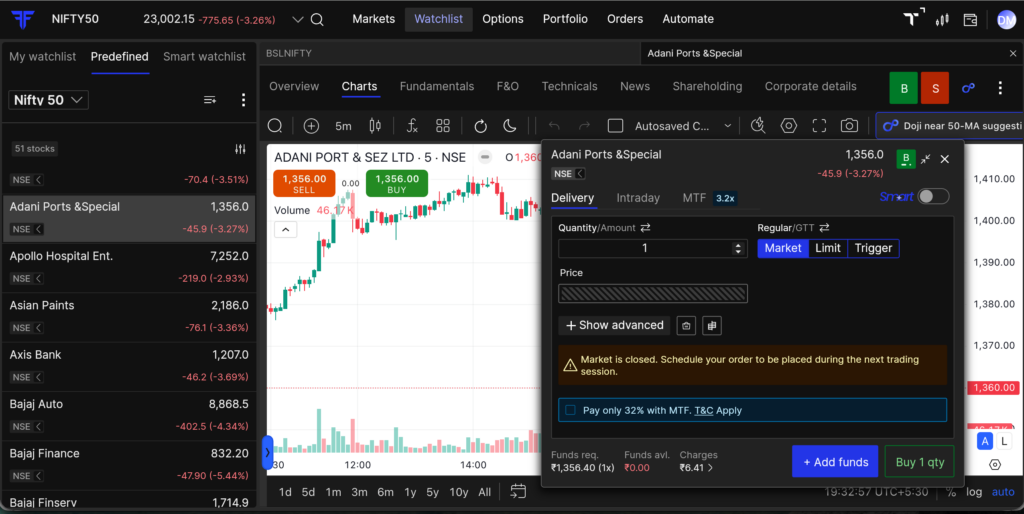
Direct answer: FYERS’ platform experience is strongest when you trade visually from charts and want a TradingView-like workflow; it frustrates users when performance dips—especially chart loading, ticks, and symbol switching—because execution confidence drops instantly.
What traders genuinely like (the “why this exists” layer)
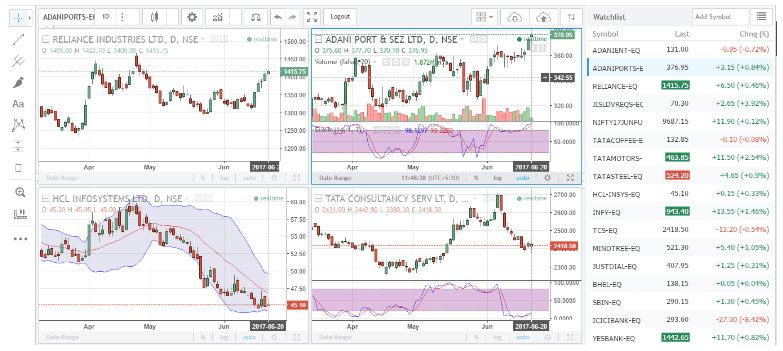
FYERS is repeatedly positioned as tech-first with a multi-platform stack: web, mobile, and desktop-style terminal options, designed for active traders. The consistent praise is about chart-native trading and workflow speed.
In practical terms, if your strategy is built around:
- Breakout + retest entries,
- SL placement at the structure,
- Partial booking at mapped targets,
…then a chart-native platform can reduce your “click friction.” That matters because most trading mistakes happen in the 10 seconds between decision and execution—especially when you’re under stress.
A story I’ve seen too often: a trader identifies a clean setup, but then spends 20–30 seconds fighting the UI—switching symbols, loading charts, waiting for responsiveness. By the time the order is placed, the edge is gone. This is exactly why people obsess over platform feel.
Where complaints spike: stability, speed, and micro-friction
User-generated complaints often use blunt language: charts taking ages to load, blank white screens, and ticks not updating. These aren’t “nice-to-have” issues; for intraday and options, they directly impact P&L via missed entries and sloppy exits.
Even small UX annoyances can become daily irritation—like repetitive confirmation/disclaimer flows during login that some app users mention. Over hundreds of logins, that friction adds up psychologically.
A simple way to “test” the platform before committing fully
If you’re evaluating FYERS in 2026, do a structured 3-day test:
- Day 1: Observe watchlist + chart loading during the first 30 minutes.
- Day 2: Place a few small orders (including SL-L orders).
- Day 3: Do a withdrawal test with a small amount (and don’t add funds the same day you test withdrawal).
This isn’t paranoia—it’s process. A platform is only “good” if it behaves well during your trading hours, on your internet, and in your instrument set.
Practical takeaway: Evaluate FYERS like you evaluate a strategy: by running a controlled test, not by trusting a single glowing (or angry) review.





3) Brokerage, fees, and the 2026 change most people miss
Direct answer: FYERS pricing is broadly a “flat-fee discount broker” territory, but the big practical update is that equity delivery is no longer the old ‘free’ story—it’s now charged at a capped rate (still competitive, but not zero).
The headline model (simple, but read carefully)
FYERS prominently communicates a brokerage structure that caps per-order brokerage, and its own calculator examples show how the ₹20-or-0.03% logic works in practice.
Just so you think like a trader (not like an ad):
- Low brokerage matters most when your average trade size is large, and you do many trades.
- Statutory charges (STT, exchange charges, GST, stamp duty, SEBI fee) matter regardless of broker, and they’re often the “silent P&L leak” for overtrading.
FYERS also publishes the statutory/regulatory charge schedule (STT/CTT, exchange transaction charges, SEBI turnover fee, GST basis, stamp duty). If you’ve never studied this properly, do it once—it will upgrade your trading maturity instantly.
A worked-style example (how I’d sanity-check costs)
Let’s say you’re an intraday equity trader doing 8 trades/day (4 round trips). Brokerage might look “small,” but the combined friction can change your break-even.
My practical workflow:
- Estimate brokerage per executed order (cap logic).
- Estimate STT (sell-side for intraday; both sides for delivery).
- Add exchange + GST.
- Decide whether your average edge per trade is even worth it.
If you want to sharpen this kind of thinking, bookmark and revisit: intraday vs delivery trading
The user trust issue: “calculator mismatch” complaints (especially MTF)
A notable pain point in 2026 discussions is perceived opacity—especially around MTF charges and how costs show up in net vs gross P&L views, with some traders claiming the brokerage calculator is unreliable in MTF contexts. Even if you don’t agree with the wording, treat it as a signal: you must verify how funding charges are displayed before scaling size.
Brokerage & Charges Estimator (FYERS-style)
Quick estimate for planning trades (NSE assumptions).
FYERS Pro Brokerage Calculator
Practical takeaway: Don’t compare brokers only on “₹20.” Compare them on how clearly they help you predict total trading friction—and whether that friction is visible before you scale.
4) Why FYERS orders get rejected (and how to fix it fast)
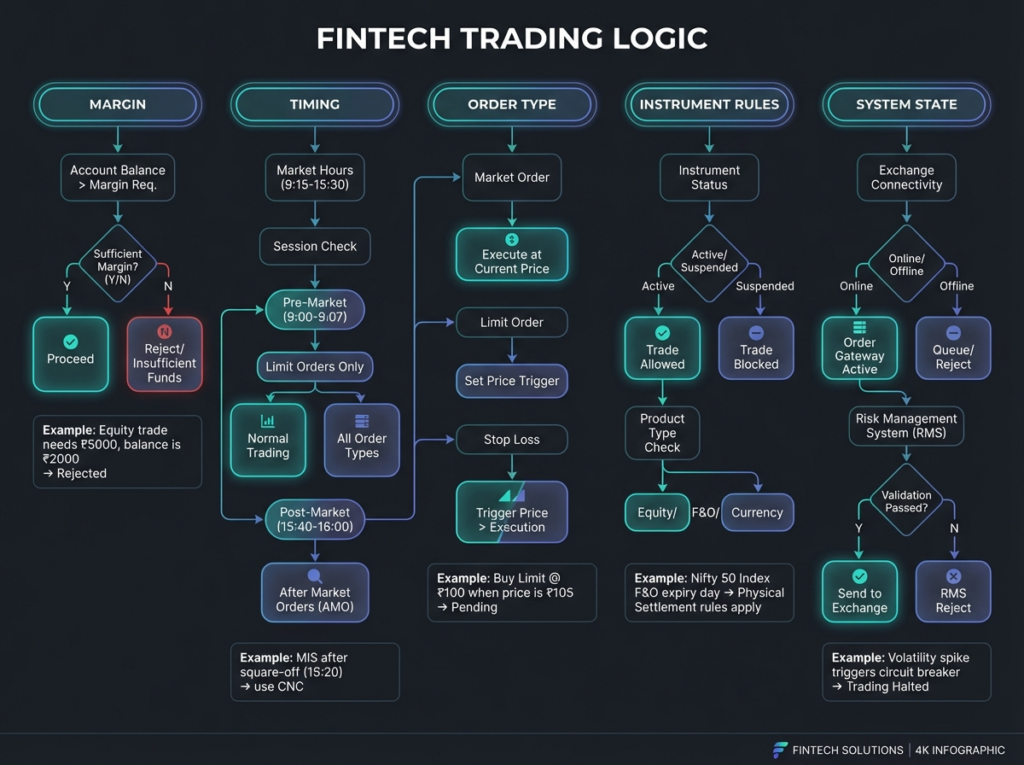
Direct answer: Most FYERS order rejections are not “random glitches”—they’re risk checks, timing rules (like MIS after square-off), segment restrictions (like market orders blocked in some option contracts), or margin/peak margin constraints. Once you map rejection text to a fix, your execution improves immediately.
The rejection patterns that hit active traders most
FYERS documents a long list of rejection messages that traders see in real time. The high-frequency ones include:
- Margin shortfall (you think you have margin, but usable margin is lower due to risk or collateral rules).
- MIS is disallowed after square-off (common if you try after ~3:15 pm).
- Market orders are blocked in certain option segments/contracts (forcing limit orders).
- Stop-loss order type restrictions (e.g., SL-M not allowed in specific option segments).
- Peak margin checks (you’re slightly short vs peak requirement).
- Risk engine downtime messages (rare, but emotionally explosive when it happens).
This is where Reddit-style frustration comes from: a trader doesn’t care why a rule exists when a clean setup is running away. They only care that they missed the move. And if it happens twice, they label the broker “unusable.” FYERS gets this heat often in public discussions.
My trader’s “two-minute rejection drill”
When an order is rejected, I want you to think like a pilot—short checklist, no drama:
- Read the rejection line fully (most traders don’t).
- Ask: is it margin, timing, order type, instrument restriction, or system state?
- Apply the lowest-effort fix: reduce quantity, switch MIS→CNC/NRML, switch MKT→LIMIT, switch SL-M→SL-L, change strike/contract, or retry after a few seconds for system readiness.
A real example that I’ve seen with options traders: they place an SL-M in index options out of habit. It gets blocked. Panic starts. The fix is simply switching to SL-L and placing the trigger closer to LTP—simple, but only if you know the rule beforehand.
If you’re serious about lowering these execution errors, improve your method discipline too—especially your risk-reward planning.
Practical takeaway: FYERS order rejections become manageable when you treat them as “rule mismatches,” not personal attacks. Build a small cheat sheet for your top 10 rejection messages.
5) Withdrawals, payouts, and the real reason “delays” happen
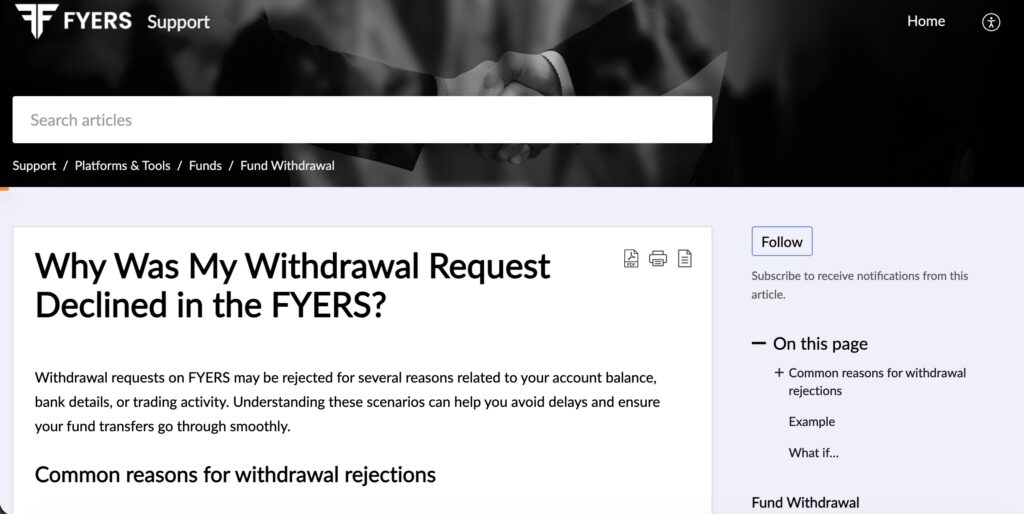
Direct answer: Most FYERS withdrawal failures happen due to same-day fund addition rules, collateral/margin usage, bank detail mismatches, or trades executed after the payout request—so the fix is usually process, not panic. Escalation should be systematic, not emotional.
The five reasons your withdrawal gets declined (in plain language)
FYERS lists common decline reasons that map cleanly to trader behaviour:
- Same-day fund addition: you added money today and tried to withdraw today.
- Collateral/margin in use: You have pledged holdings or open positions that “lock” funds.
- Bank discrepancies: inactive/blocked account, wrong IFSC/account number, KYC issues, or trying to withdraw to a non-primary bank.
- Trading after request: new positions or losses reduce the withdrawable balance after you request a payout.
- Technical/backend issues: banking network failures or processing errors.
Now the emotional part: public forums include sharp complaints about delayed withdrawals, and some users claim extreme scenarios. Whether or not every allegation reflects the full story, it does influence trust—so your job is to reduce your personal exposure by following clean payout hygiene.
My “withdrawal hygiene” checklist (what I’d do before scaling capital)
Here’s a practical routine I recommend to active traders:
- Don’t test withdrawals on the same day you add funds.
- Check withdrawable balance (not just ledger balance).
- Avoid placing new trades after a payout request if you want same-cycle processing.
- Keep bank details clean and unchanged unless necessary; if changed, verify with a small payout first.
- Keep screenshots of payout request status when something looks abnormal.
A real trader story: a beginner makes a profit, gets excited, requests a withdrawal, then re-enters a trade. The second trade loses, the margin is consumed, and the payout fails. They blame the broker. In reality, the system did exactly what it’s supposed to do—protect settlement obligations.
Escalation: when you should move beyond tickets
If you’ve followed the rules and still face unresolved issues, you should know the formal complaint path. The SCORES system is designed for lodging and tracking grievances with defined timelines and escalation layers. You can learn the complaint process on the SCORES portal here.
Practical takeaway: Withdrawal anxiety drops sharply when you treat payout as a process: test small, follow rules, document steps, escalate only when needed.
6) FYERS vs Zerodha vs Dhan: what matters in real trading
Direct answer: FYERS vs competitors is not about “₹20 vs ₹20.” It’s about platform workflow (especially chart execution), reliability under load, transparency of margins/charges, and how quickly issues get resolved when money is stuck or orders are rejected.
FYERS vs Zerodha: the chart-trader vs ecosystem trade-off
The most consistent split I see among active traders is:
- FYERS advantage: chart-first execution feel and TradingView-style flow.
- Zerodha advantage: product maturity, perceived polish, and a stronger “all-rounder” ecosystem for most retail users.
Public comparisons regularly frame FYERS as attractive for on-chart tools while describing Zerodha as more polished overall.
If you’re a systematic trader, remember: execution workflow impacts discipline. The easier it is to place the correct order type (and avoid rejection), the more consistent you become.
FYERS vs Dhan: speed expectations + sentiment around withdrawals
The FYERS vs Dhan debate in community discussions often heats up around operational comfort—especially withdrawals and how quickly support closes loops. Some users explicitly mention moving because they want “same day” style withdrawal expectations (whether or not that’s realistic in all cases).
From a trader’s lens, here’s the clean way to decide:
- If you’re scaling size and your stress trigger is fund mobility, test withdrawals early and pick the broker that gives you fewer payout surprises.
- If your stress trigger is order rejection, pick the broker whose risk rules you can live with.
FYERS vs Groww / Angel One / Upstox / INDmoney: investor-first vs trader-first
FYERS tends to read as trader-first (platform tooling, flat-fee culture). App-first platforms often feel simpler for long-term investors but may not satisfy advanced chart execution needs.
If you trade options actively, also invest in knowledge—not just platforms. Two internal reads that will help you judge any broker more intelligently:
FYERS vs Zerodha vs Upstox vs Groww vs Dhan vs Angel One vs INDmoney
| Broker | Best For | Platform Strength | Common Friction | Deal-Breaker Risk | My Fit Score |
|---|---|---|---|---|---|
| FYERS | Chart-based & options traders | TradingView integration, drag-and-drop trading, flat pricing | Order rejections, chart lag, withdrawal delays | Execution reliability during volatility | 3.5/5 |
| Zerodha | Serious traders & investors | Stable platform (Kite), strong ecosystem, reporting tools | No built-in TradingView, slower feature updates | Occasional downtime in peak volatility | 4.8/5 |
| Dhan | Active intraday & algo traders | Fast execution, TradingView integration, advanced tools | UI not beginner-friendly, evolving ecosystem | Less mature support/documentation | 4.5/5 |
| Groww | Beginners & long-term investors | Simple UI, easy onboarding, strong brand trust | Limited trading tools, weaker for F&O | Not suitable for active trading | 4.2/5 |
| Upstox | Balanced traders | Modern app, good pricing, improving tools | Past tech glitches, inconsistent experience | Platform stability concerns (historical) | 3.8/5 |
| Angel One | Research-driven traders | Advisory, research tools, full-service features | UI clutter, upselling products | Higher complexity for beginners | 3.7/5 |
| INDmoney | Investors (stocks + US markets) | Wealth tracking, US investing, modern UX | Limited active trading features | Not built for intraday/F&O traders | 3.5/5 |
Practical takeaway: Pick your broker like you pick your strategy—based on your failure points. If your weakness is execution panic, choose the platform that makes correct execution easiest.
Conclusion: A practical decision framework for FYERS in 2026
FYERS in 2026 is neither a “magic broker” nor an automatic “avoid.” It’s a tool—and like any tool, it performs brilliantly in the hands of the right user and irritates the wrong user in predictable ways. If your trading is chart-led and execution-led, FYERS can feel very natural because the workflow is built around acting on what you see. That’s a real advantage for price-action traders, breakout traders, and anyone who wants to reduce the time between analysis and order placement.
At the same time, the loudest complaints around FYERS are also the most serious for active traders: order rejections, platform stability, and withdrawal delays. The key insight is that many of these issues are not mysterious. Order rejections often come from well-defined constraints—margin checks, order-type restrictions, timing rules (like MIS after square-off), and segment-specific limitations. Withdrawals often fail due to same-day deposits, collateral use, bank detail mismatches, or trades placed after the payout request. When you know these rules in advance, your experience improves dramatically.
So here’s the decision framework I’d want you to use:
- Define your style (intraday equity, options buying, options selling, delivery investing).
- Identify your failure point (execution speed, rejection frequency, payout reliability, reporting polish).
- Run a 3-day controlled test with a small size: charts during open, a few order types, and a small withdrawal test.
- Scale only after behaviour is stable, not after one good day.
Finally, remember the deeper truth: a broker won’t fix a weak method. If you’re still jumping between strategies, work on process first—build a simple system, track outcomes in a sheet, and focus on risk control. If you want structured learning that aligns with modern tools, start with my foundations on the basics of fundamental analysis and build your trading execution discipline with automated trading system basics.
When you approach the decision this way, you won’t feel confused. You’ll feel equipped—and that’s the real goal of any broker review.
FAQ
FYERS operates within India’s regulated market structure, and if you ever face an unresolved grievance, there is a formal escalation mechanism through SCORES with defined timelines and review steps. For most traders, “safety” is less about rumours and more about process: verify your bank details, understand withdrawable balance rules, and test payouts early with small amounts.
Order rejections typically come from rule mismatches—insufficient usable margin, peak margin checks, timing restrictions (like MIS after square-off), and order-type limitations in certain option contracts. The fastest fix is to categorise the rejection (margin/timing/order-type/instrument/system), then apply a targeted change like switching to a limit order, using SL-L instead of SL-M, or changing product type.
A key 2026 change discussed widely is that equity delivery is no longer positioned as “free” in the same way older reviews claimed; it’s now charged with a cap-based model (still within discount-broker territory). If delivery investing is your main activity, compare total friction (brokerage + statutory charges) and not just the headline number.
The most common causes are same-day fund additions, collateral/margin usage due to open positions, bank detail mismatches, and trading activity after placing the payout request. The practical approach is: don’t test payout on the same day you add funds, check “withdrawable” balance (not ledger), avoid new trades after payout request, and run a small payout test early before scaling capital.
It depends on your personal failure point. If you’re chart-first and execution-first, FYERS can feel natural. But, if you prioritise ecosystem polish and broad retail stability perception, Zerodha often attracts that crowd. And, if your priority is operational comfort, like payouts and complaint sentiment, many traders compare Dhan closely. The right move is a small-scale, real-market test with your preferred order types.