The Bombay Stock Exchange (BSE) is one of the oldest stock exchanges in Asia, founded in 1875. It is located in Mumbai, India, and is also known as the Stock Exchange, Mumbai (SEM). The BSE Sensex is the benchmark index of the BSE, which tracks the performance of the top 30 companies listed on the exchange. In this article, we will provide an overview of the BSE and BSE Sensex and their importance in the Indian stock market.
History of Bombay Stock Exchange:
The BSE was founded in 1875 as the Native Share and Stock Brokers’ Association. It was initially a small group of brokers who would meet under a banyan tree in Mumbai to conduct business. In 1956, the BSE became the first stock exchange in India to be recognized by the government under the Securities Contracts (Regulation) Act. Over the years, the BSE has gone through several key milestones, including the introduction of the BSE SENSEX in 1986 and the launch of the BSE online trading system (BOLT) in 1995.
IPO details and listing of Bombay Stock Exchange:
The BSE went public in 2017 with its initial public offering (IPO). The IPO was oversubscribed by more than 50 times, making it one of the most successful IPOs in Indian history. The BSE was listed on its own exchange, becoming the first Indian stock exchange to do so. The significance of the BSE’s listing is that it provides transparency to its investors and demonstrates its commitment to sound governance practices.
Current Share Price of BSE Sensex:
As of 24th of March 2023, the BSE Sensex is trading at 57928.90, up 0.01% from its previous close. The BSE Sensex has delivered a compounded annual growth rate (CAGR) of 18% in 2022. Factors affecting the current share price of the BSE Sensex include the uncertainty in banks in America, the Sri Lankan crisis, and the ongoing Russia-Ukraine war. But, the MarketClub Trade Triangle analysis still shows that the BSE Sensex is still in a long-term uptrend.

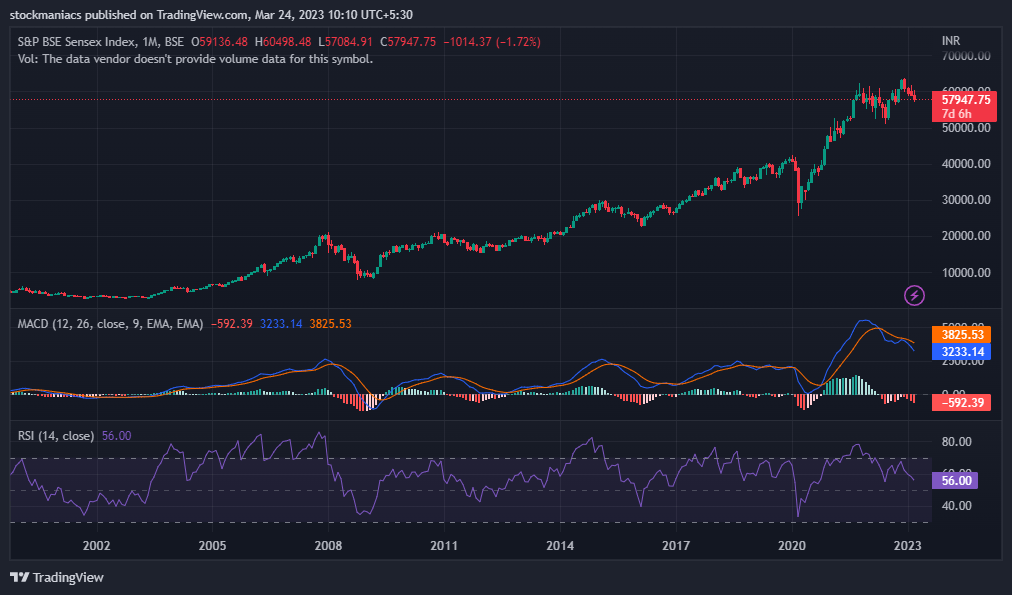
The above technical platform chart indicates that the index is creating short-term red candles inside a strong trend on the upside.
Fundamental Analysis of BSE Share Price:
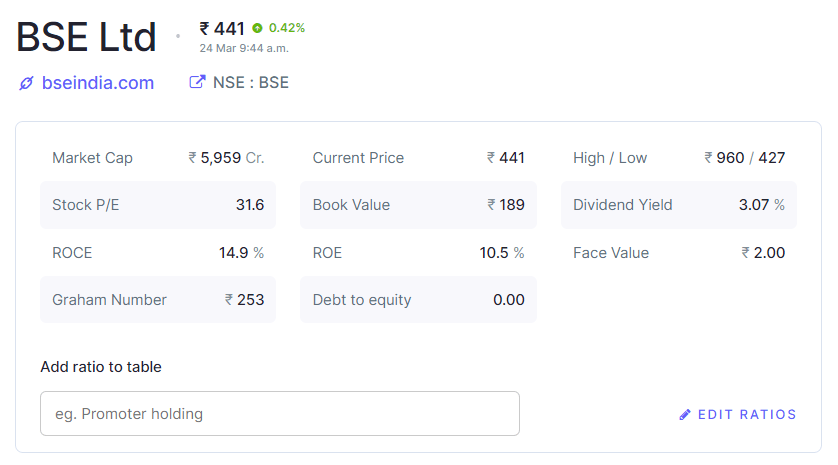
The fundamental data of BSE share price involves examining the financial statements and economic indicators of the company. BSE is a profitable company with strong financials. Its revenue has grown consistently over the years, with a CAGR of 15%. BSE’s profit margins are -8%, which is lower than the industry average. Additionally, BSE has a low debt-to-equity ratio of 0.00, which indicates that it has a strong financial position.
FAQ on Sensex and BSE:
The BSE is a public company, and its shares are listed on its own exchange. The company has a diverse set of shareholders, including institutional investors, retail investors, and trading members.
The NSE and BSE are both leading stock exchanges in India. The choice between the two depends on individual preferences and investment strategies.
BSE stands for Bombay Stock Exchange, which is located in Mumbai, India.
The main difference between the NSE and BSE is the number of companies listed on each exchange. The NSE has more companies listed on its exchange than the BSE. Additionally, the NSE has a higher trading volume than the BSE.
Conclusion:
In conclusion, the Bombay Stock Exchange (BSE) and BSE Sensex are important institutions in the Indian stock market. The BSE has a rich history and has evolved over the years to become a modern and efficient exchange. This provides transparency to its investors and maintains sound governance practices. The BSE Sensex is a crucial benchmark index that tracks the performance of the top 30 companies listed on the exchange. Factors affecting the current share price of the BSE Sensex include various economic and political factors. The fundamental analysis of BSE share price reveals that it is a profitable company with strong financials, making it a desirable investment option for investors.
It is worth noting that the choice between the BSE and NSE, the two leading stock exchanges in India, depends on individual preferences and investment strategies. Both exchanges have their unique features, and investors must research and analyze both exchanges’ performance before making any investment decisions.
Overall, the BSE and BSE Sensex play a crucial role in the Indian economy and provide ample opportunities for investors to invest in a diverse range of companies. As India continues to emerge as a leading global economy, the BSE and BSE Sensex may also maintain their importance in the Indian stock market.