

As a newcomer to the Indian stock market, one of the key challenges you will face is finding the right trading strategy for Nifty. Nifty is a popular index in the Indian stock market that comprises 50 stocks from various sectors. Trading Nifty can be challenging, but with the right trading strategy, you can increase your chances of success. In this post, we will discuss some of the best trading strategies for Nifty that you can use to improve your trading performance.
Understanding Nifty Trading
Before we dive into the trading strategies, let’s briefly discuss what Nifty is and why it is an important trading instrument. Nifty is the flagship index of the National Stock Exchange (NSE). It represents the performance of the top 50 companies listed on the NSE. Nifty is widely used by traders and investors to gauge the overall performance of the Indian stock market. Trading Nifty allows you to participate in the growth of the Indian economy and make profits by buying and selling Nifty contracts.
Gap Fade Trading Strategy for Nifty
The intraday gap fading strategy is a popular strategy used by traders to take advantage of the gap between the opening price and the previous day’s closing price. In this strategy, traders look for the Nifty index to open with a gap up or gap down. They then fade the gap by taking a position in the opposite direction. For example, if the Nifty opens with a gap up, traders will look to sell the Nifty futures. Similarly, if it opens with a gap down, traders will look to buy the Nifty futures. The idea behind this strategy is that the price of Nifty will eventually fill the gap and return to its previous level.
Renko and SuperTrend Trading Strategy for Nifty
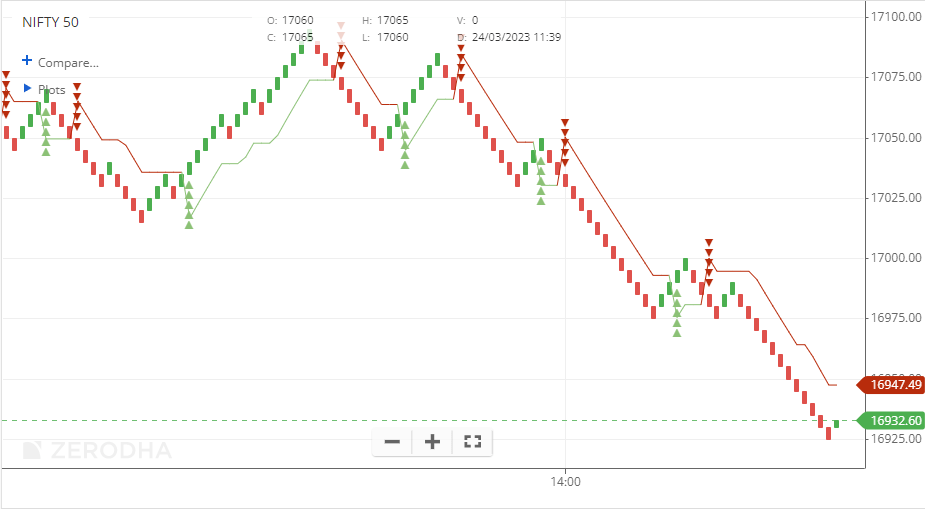
Renko charts are a type of chart that focuses on the price movement rather than the time frame. SuperTrend is an indicator that helps traders identify the trend direction and potential entry and exit points. Combining these two tools can create a powerful trading strategy for Nifty. In this strategy, traders look for a trend using the SuperTrend indicator and then use the Renko charts to enter and exit the trades. Renko charts filter out the market noise and provide a clear picture of the price movement.






Using Open Interest and Change of Open Interest Charts
Open interest is the total number of outstanding contracts in the market. The change in open interest can help traders identify the trend direction and potential entry and exit points. Using the change of open interest charts along with the price charts can help traders make better trading decisions. In this strategy, traders look for a change in open interest and then use the price charts to confirm the trend direction before entering the trades.
Using RMO Indicator for Nifty Trading
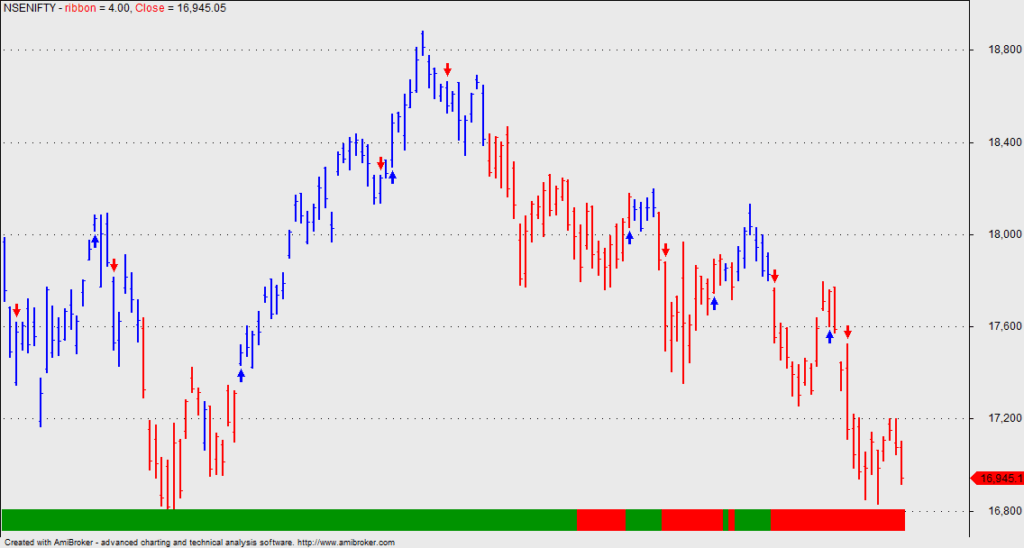
The RMO (Rahul Mohindar Oscillator) indicator is a popular indicator used by traders to identify the trend direction and potential entry and exit points. It is based on the concept of moving averages and is used to filter out market noise. The RMO indicator is nicely coded on platforms like AmiBroker and Metastock. Apart from the buy or sell signals traders also look for the bar color and the ribbon color to filter a trade. Look for a buy signal only in blue bars and green ribbons. Similarly, look for a sell signal only in red bars and red ribbons.
Using Pin Bars for Nifty Trading
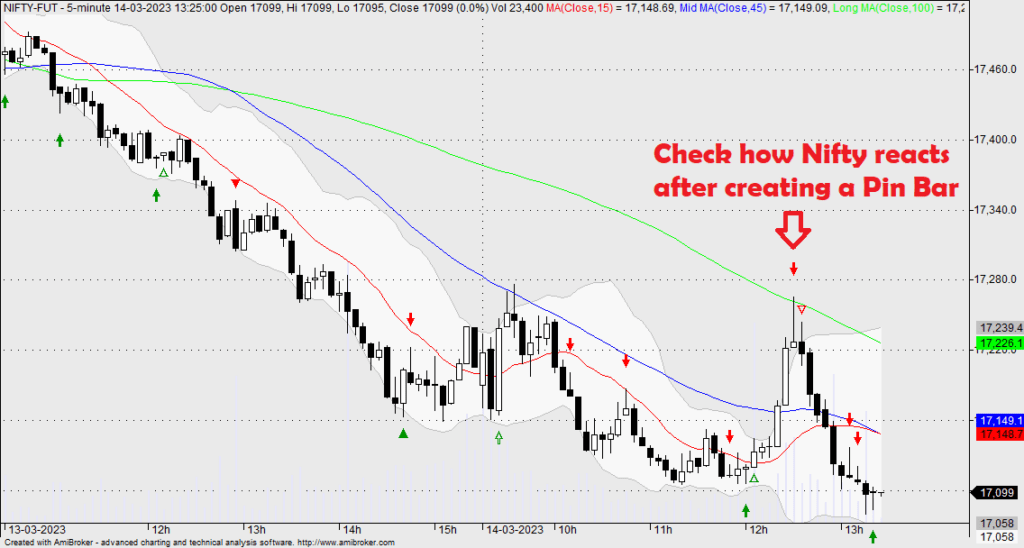
Pin bars are a type of candlestick pattern that can be used to identify potential reversals in the market. They consist of a long wick and a small body and indicate a rejection of a price level. In this strategy, traders look for pin bars near support or resistance levels and use them to enter and exit trades. Pin bars can be a powerful tool in identifying potential trend reversals and can help traders make better trading decisions.
3 Line Break Charts Trading Strategy for Nifty
3 Line Break charts are a type of chart that focuses on the price movement rather than the time frame. They consist of three lines and are used to identify the trend direction and potential entry and exit points. In this strategy, traders look for a trend using the 3 Line Break charts and then use other technical indicators to confirm the trend direction and potential entry and exit points.
FAQ:
The 9 20 strategy is a popular trading strategy for Nifty options straddles. The traders enter the trade just a 9:20 AM, ie, after 5 minutes after the opening of the stock market. They sell the straddle with a stop loss and book profit in intraday gains. In case the straddle price drops the traders make a good amount of profit using the time decay.
Day trading in Nifty involves buying and selling Nifty contracts within the same trading day. To day trade Nifty, traders need to have a trading account with a brokerage firm, a trading strategy, and a risk management plan. Traders can use various trading strategies like gap fade, Renko and SuperTrend, open interest, RMO indicator, and pin bars to do day trading in Nifty. Traders also need to keep an eye on the market news and events that can affect Nifty’s price movement.
The best time frame for Nifty trading depends on the trading style and strategy of the trader. For short-term trading, traders can use intraday time frames like 5-minute, 15-minute, or 30-minute charts. For swing trading, traders can use daily or weekly charts, while for long-term trading, traders can use monthly charts. Traders need to choose the time frame that suits their trading style and strategy.
To master Nifty, traders need to have a good understanding of the Indian stock market, technical analysis, trading psychology, and risk management. Traders can start by learning the basics of trading and then gradually move on to advanced trading concepts. Traders can also practice trading using a demo account before investing real money. Additionally, traders can read books, attend trading courses, and follow market experts to gain more knowledge and insights into Nifty trading.
Conclusion
In conclusion, there are various trading strategies that traders can use to trade Nifty. The key to success is to find the right strategy that suits your trading style and risk appetite. Gap fade, Renko, and SuperTrend, using Open Interest and Change of Open Interest charts, RMO indicator, Pin Bars, and 3 Line Break charts are some of the popular trading strategies for Nifty. However, it is important to note that no trading strategy is 100% accurate. Traders should always use proper risk management techniques to minimize their losses. Happy trading!