Trading since 2002 and running StockManiacs.net since 2008, thousands of Indian traders have asked a new version of an old question: Can ChatGPT Predict Stocks? The answer is: ChatGPT can sometimes help you anticipate how markets may react to information, but it cannot “predict” stock prices the way most people imagine—and it is especially risky to treat it like a buy/sell signal generator for Nifty intraday or options.
What “Predict” Really Means in Trading?
If you’ve ever watched a YouTube video claiming “ChatGPT gave me 100% winning trades” or read a Reddit thread where someone doubled money in days, the confusion is normal. The AI writes confidently. The screenshots look convincing. And because the market itself is noisy, a few lucky trades can look like “proof” of prediction. Then reality hits: the same AI that sounded like a genius last week gives absurd entries this week, ignores spreads, forgets liquidity, and has no clue about your risk tolerance.
Here’s what makes this topic tricky for India: our markets are fast, sentiment-driven, and highly sensitive to local events—RBI policy language, FII/DII flows, sector rotation, weekly expiry behaviour, and even rumours spreading in Indian Telegram groups. ChatGPT doesn’t see live NSE prices. It doesn’t track real-time OI changes. It doesn’t know your broker’s margin rules. And, it can’t feel the panic candle when Bank Nifty swings 400 points in 5 minutes.
But that doesn’t mean ChatGPT is useless. In fact, used correctly, it can be a powerful research assistant—helping you think better, test ideas faster, and avoid common mistakes. The smartest traders don’t use AI to replace decision-making; they use AI to improve decision quality.
In this post, you’ll get a clear, practical framework for Indian traders and investors:
- What “prediction” really means in markets (and what it doesn’t).
- What credible studies say (not just hype).
- A realistic Nifty-based testing approach you can replicate.
- Where ChatGPT shines (analysis, screening, journaling) and where it fails (timing, leverage, execution).
- A step-by-step method to use it safely with TradingView, AmiBroker, and basic Python.
- Red flags, scams, and risk controls that protect your capital.
If you want a simple takeaway before you begin: Treat ChatGPT like a junior research analyst, not a trader. If you do that, you’ll benefit. If you don’t, you’ll eventually pay tuition.
Can ChatGPT Predict Stocks in real life?
With 20+ years of live market experience, one pattern is consistent: markets punish certainty. The answer is: ChatGPT cannot reliably predict stock prices, but it can estimate sentiment and help structure analysis—especially when you provide clean data and ask the right questions.
What “predict” means in trading (simple definition)
Prediction in markets has two meanings:
- Directional bias: “Probability of up vs down is higher.”
- Precise forecast: “Nifty will go to 25,842 by 1:45 PM.”
ChatGPT is only sometimes useful for the first type, and mostly unreliable for the second.
Here’s a practical analogy:
ChatGPT can behave like a smart friend who reads news and tells you whether the mood is good or bad. But it cannot be your GPS telling you the exact turns and timings.
Verified evidence: what studies suggest (without hype)
A highly-cited academic paper by Lopez-Lira & Tang tested LLMs on news headlines and found that GPT-style sentiment scores could correlate with next-day returns, with GPT-4 producing stronger risk-adjusted results (reported Sharpe ratio around 3.8 in their framework). That is not the same as predicting Nifty intraday, but it supports a real point: language understanding can detect market-relevant tone.
Now here’s the uncomfortable truth traders must accept: even in that research, when realistic transaction costs were applied, performance dropped sharply. Translation for India: if your strategy needs frequent trades, your edge gets eaten by:
- brokerage + taxes,
- spreads,
- slippage,
- and timing delays.
A realistic Indian view
In Indian markets, “prediction” must pass one brutal test: can it survive weekly expiry noise and real execution?
ChatGPT doesn’t see:
- live option chain shifts,
- sudden OI unwinds,
- order book pressure,
- or the real-time “market mood” on the screen.
So the honest answer is:
- Yes, ChatGPT can help you prepare better (research, planning, filtering).
- No, ChatGPT should not be trusted to predict prices or give “today’s sure-shot trades.”
If you came here hoping for a magic prompt that prints money—this post will save you money by disappointing you early.
What proof exists that ChatGPT can predict stocks?
After building systems in AmiBroker and testing strategies since 2008, one rule is non-negotiable: proof must survive repetition, costs, and bad market regimes. The answer is: the strongest “proof” is not viral claims—it’s longer-horizon evidence, transparent methodology, and realistic assumptions.
The best kind of proof: transparent experiments
When someone says, “ChatGPT beat the market,” the first question should be:
- What was the method?
- What were the rules?
- How many trades?
- Was it live money or paper?
- Were costs included?
A credible example is the “GPT Investor” style approach discussed on tech forums where the author documented multiple experiments and compared outcomes to a benchmark. These types of reports are not perfect, but they are closer to “proof” than short viral wins because they describe the process, not just the result.
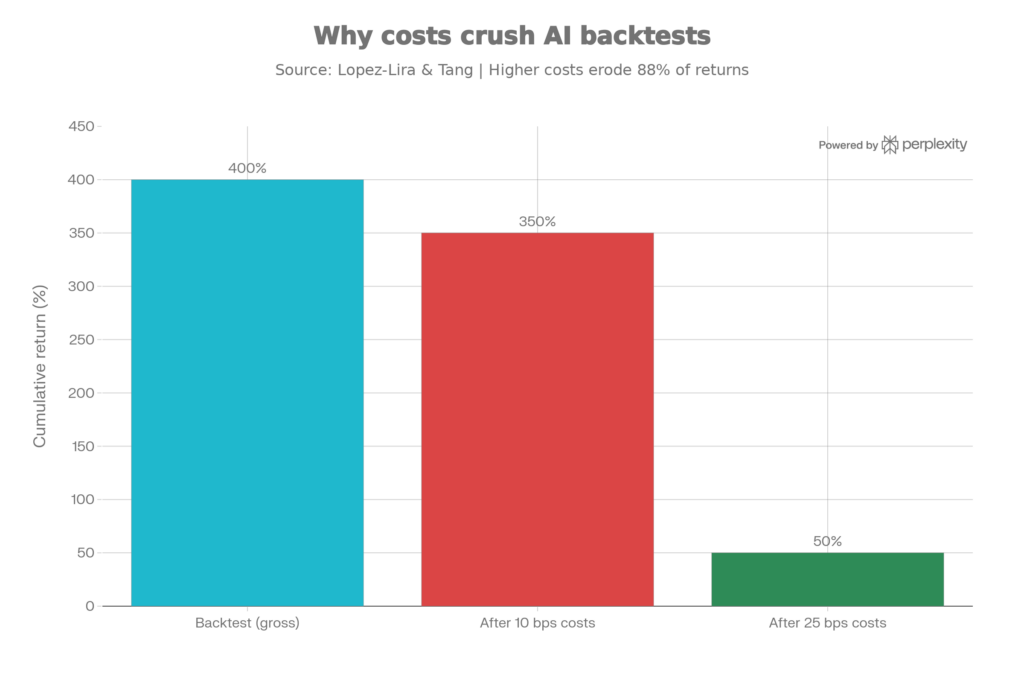
For readers who want the original study of the above graphical data, here is the full research paper.
Why viral proof is usually misleading (a real trader’s explanation)
Let’s talk about the famous pattern:
“₹X doubled in 10 days using AI.”
As a trader, that triggers immediate red flags:
- 10 days is a tiny sample.
- Market regime matters (bull phases make everyone look smart).
- A few winners can happen randomly.
- No serious system is validated without dozens to hundreds of trades.
A useful mental model:
- 10 days = a screenshot.
- 6–12 months = evidence.
- 3+ years across regimes = closer to truth.
A simple credibility checklist you can apply today
Before believing any “ChatGPT stock prediction” claim, check:
- Method disclosed: prompts, data source, rules.
- Benchmark used: Nifty 50 TRI, Nifty 500, or a comparable index.
- Costs included: at least approximate Indian trading costs.
- Drawdowns shown: worst peak-to-trough fall.
- Losing trades shown: anyone hiding losses is selling something.
A short story from my mentoring experience
A beginner I mentored once told me: “Sir, my strategy is 90% accurate.”
When asked for logs, it turned out he counted “almost hit target” as a win and ignored slippage. After adding realistic fills, accuracy fell, and drawdown doubled.
That’s the AI trap too. ChatGPT’s words sound clean. Markets are not clean. Your job is to force cleanliness through rules.

ChatGPT Trading Real Results: what happens when you test it?
From years of building trading systems, the fastest way to end confusion is testing. The answer is: ChatGPT trading real results look good when you use it for analysis and filtering, but break down when you use it for timing and leverage.

My honest “Nifty-style” test framework (replicable)
To keep this practical for Indian readers, here’s a testing approach that matches how most retail traders operate:
Test Setup (simple, realistic):
- Pick 5 liquid Nifty stocks (example: Reliance, HDFC Bank, Infosys, ICICI Bank, TCS).
- Use daily timeframe (not intraday).
- Provide the same dataset to ChatGPT:
- last 6–12 months OHLC,
- earnings notes (summary),
- major news headlines,
- sector trend (IT/banks/energy),
- and your risk rule (max 1% risk per trade).
- Ask ChatGPT for:
- trend direction,
- key support/resistance,
- invalidation level (where the idea is wrong),
- and a conservative “if/then” plan.
This avoids the biggest lie in AI trading: pretending it can see the live market.
A hypothetical example (how it looks in practice)
Suppose you ask:
“Given Infosys daily chart and last quarter commentary, is the bias bullish or bearish for 2–4 weeks?”
ChatGPT might respond:
- Bias bullish if price holds above a support zone.
- Resistance zones where partial profit makes sense.
- Risk-based position sizing.
That output is often useful, because it’s structured.
Now the dangerous version: “Give me today’s exact entry and target for Bank Nifty options.”
That output is almost always harmful, because the model is guessing without market microstructure.
Why people see “amazing” results (and why they disappear)
Most “ChatGPT success” comes from one of these:
- The trader already had a bias; AI just confirmed it.
- The market was trending; almost any trend-following idea wins.
- The trader took small profits quickly; losses were ignored or hidden.
- Paper trades created fake confidence.
A failure story you should learn from
Some viral discussions reported catastrophic failure cases where AI-driven trading lost the majority of trades in leveraged setups. Whether it’s crypto or derivatives, the lesson is identical for India: leverage magnifies the cost of being slightly wrong.
ChatGPT can be slightly wrong often—because markets are probabilistic.
So if you want “real results,” use ChatGPT where it is strong:
- planning,
- filtering,
- risk explanations,
- journaling,
- scenario thinking.
Not where it is weak:
- exact timing,
- weekly expiry scalps,
- high leverage,
- revenge trading.
AI Trading Works India: what actually works (and what doesn’t)?
After working with Indian traders across bull markets, bear markets, and sideways phases, the answer is: AI trading works in India when it supports a rules-based process, but it fails when you outsource judgment and execution to it.
Where AI genuinely helps Indian traders
AI (including ChatGPT) can improve outcomes in India in four strong areas:
- Research speed: reading annual report highlights, earnings call summaries, sector tailwinds.
- Idea generation: screening 200 stocks down to 10 candidates.
- Process discipline: checklists, pre-market plans, post-trade journaling.
- Learning curve: explaining indicators and mistakes in plain language.
Think of it like upgrading from a bicycle to a scooter. It gets you faster—if you still steer.
India-specific challenges AI cannot magically solve
Indian markets have quirks that break generic AI advice:
- FII/DII flow sensitivity: Nifty can reverse on flows even when charts look perfect.
- Weekly expiry behaviour: options pricing changes rapidly; theta and vega punish late entries.
- Gap risk around events: RBI policy, Union Budget, global cues.
- Liquidity differences: small/mid caps can trap you with spreads and circuits.
ChatGPT does not “feel” these the way a trader watching tape does.
A practical India-ready workflow (my recommended approach)
If you want AI trading to work in India, use this layered decision process:
- Market regime check (human):
- Trending, range-bound, or volatile?
- Setup identification (TradingView/AmiBroker):
- moving averages, structure, breakouts, mean reversion.
- AI validation (ChatGPT):
- “What could invalidate this setup?”
- “What risks am I ignoring?”
- Risk management (rule-based):
- fixed risk per trade,
- predefined stop,
- no averaging down.
- Execution (human + broker):
- place trades with discipline.
- Post-trade review (AI-assisted journaling):
- what worked, what didn’t, next improvement.
A relatable case study (new trader)
A newcomer with ₹50,000 capital tries to trade options after watching a viral AI video.
Without a plan, they overtrade and burn 30% in a week.
Now same person uses AI correctly:
- trades only cash segment swing setups,
- uses 1% risk,
- takes 6–10 trades a month,
- journals with AI.
They might not “double money in 10 days,” but they survive—and survival is the first edge.
How to use ChatGPT safely for Nifty and Indian stocks
After building scanners and strategy systems for years, the answer is: the safest way to use ChatGPT for Indian markets is to feed it your data, ask it to produce scenarios, and force it to follow your risk rules—never the other way around.
Step-by-step: a safe prompt framework (copy and use)
Use this structure:
- Context
- “I am trading Indian stocks on NSE. My holding period is 2–4 weeks.”
- Data
- paste OHLC summary (or upload CSV),
- paste earnings highlights,
- paste recent news headlines.
- Risk rule
- “Max risk per trade: 1% of capital. No averaging down.”
- Output format
- “Give me bias, key levels, invalidation, and 2 scenarios (bullish/bearish).”
Example Prompt
- “Can ChatGPT Predict Stocks? Help me analyze RELIANCE on daily timeframe for the next 2–4 weeks. Here is 6 months OHLC data. My max risk is 1%. Give (1) bias, (2) support/resistance, (3) invalidation level, (4) two scenarios, (5) what news risks I should watch.”
This makes ChatGPT useful without pretending it’s an oracle.
Tools I recommend combining with ChatGPT
- TradingView: charts, alerts, structure.
- AmiBroker: scanning and backtesting (my long-time toolkit).
- Python (basic): quick backtests, data cleaning.
- Google Sheets: trade log and rule tracking.
AI works best when plugged into a system.

A mini “Nifty weekly plan” you can run
Every weekend:
- shortlist 20 stocks using a scanner,
- pick 5 best charts,
- ask ChatGPT for scenario risks and invalidation,
- create alert levels in TradingView,
- trade only when alerts trigger.
This turns AI into a planning assistant—not a trigger-happy tipster.
ChatGPT Stock Tips Nifty: the right way to interpret “tips”
If you must search “ChatGPT stock tips Nifty,” remember:
- A “tip” without risk management is gambling.
- A “tip” with invalidation and position sizing becomes a plan.
So don’t ask for tips. Ask for structure.
What are the risks of using ChatGPT to predict stocks?
With two decades of trading, the answer is: the biggest risk is not wrong information—it’s false confidence. ChatGPT can make bad ideas sound professional.
The top risks (India-focused)
- Hallucination risk: confident answers with incorrect facts.
- No live data: recommendations can be outdated the moment you receive them.
- Overfitting bias: AI can justify any narrative after the fact.
- Execution ignorance: spreads, liquidity, margin rules, circuit limits.
- Leverage temptation: traders use AI to justify bigger bets.
- Psychology trap: “AI said so” becomes an excuse to break rules.
A real-world style scenario (common mistake)
You ask AI: “Bank Nifty will go up or down tomorrow?”
It gives a bullish-sounding answer.
Next day, RBI commentary changes sentiment. Market gaps down. You hold because AI sounded confident. Loss grows.
This is not an AI problem. This is a process problem.
Markets reward humility.
Risk controls that actually protect you
Use these non-negotiables:
- Position sizing: fixed % risk per trade (0.5–1%).
- Stop-loss: always define invalidation.
- Max trades per day: prevent overtrading.
- No revenge trades: after 2 losses, stop.
- Paper test first: 30 trades minimum before scaling.
- Keep AI in a box: AI can suggest; rules decide.
Trust and transparency note (important)
If any blog, video, or influencer claims:
- “100% accuracy,”
- “sure-shot tips,”
- “no loss strategy,” they are selling a fantasy.
On StockManiacs.net, affiliate links (if used) must be disclosed clearly. And any AI strategy must be framed as education, not a guarantee. Your capital deserves honesty.
Conclusion: So, can ChatGPT predict stocks?
From my experience since 2002—through scams, booms, crashes, and endless “holy grail” tools—the answer is: ChatGPT cannot predict stock prices reliably, but it can make you a better trader or investor if you use it as a research assistant inside a rules-based system.
Here’s the reality you can trust:
- ChatGPT can help interpret language: headlines, earnings notes, sentiment, narratives.
- It can help structure thinking: scenarios, checklists, invalidation points.
- It can speed up learning: explaining indicators, mistakes, risk concepts.
- But it cannot replace market observation: live price action, liquidity, options dynamics.
- And it cannot replace risk control: position sizing, stops, discipline.
If you’re an investor, the best use is:
- summarize annual reports,
- compare competitors,
- build a checklist,
- and avoid emotional decisions.
If you’re a trader, the best use is:
- create a pre-market plan,
- validate risk and invalidation,
- backtest ideas,
- and journal trades.
And if you want a confident next step (do this today):
- Pick one Nifty stock you understand.
- Collect clean daily data for 6–12 months.
- Ask ChatGPT for bias + invalidation + scenarios (not “tips”).
- Put alerts in TradingView.
- Trade small with strict risk.
- Review results after 20–30 trades.
That’s how AI becomes an edge instead of a trap.
If you want, the next post can be a full practical walkthrough:
- the exact prompts I use,
- a sample Google Sheet trading journal,
- and a simple Python backtest template for Nifty stocks.
FAQs (quick answers)
Can ChatGPT predict Nifty tomorrow?
The answer is no. It can discuss possible scenarios, but it cannot reliably forecast tomorrow’s Nifty move without live market data and execution context.
Can ChatGPT generate intraday buy/sell signals?
The answer is: it can generate ideas, but you should not treat them as signals. Intraday trading needs real-time order flow, spreads, and timing.
Is AI trading profitable in India?
The answer is: it can be, when AI supports a rule-based strategy with strict risk management. It fails when used as a tip engine.
What is the safest way to start with AI in trading?
The answer is: use AI for research and journaling first. Paper trade 30 setups before risking meaningful capital.
What’s the biggest mistake beginners make with ChatGPT trading?
The answer is: trusting confident text more than a tested system. Confidence is not accuracy.