
Introduction
In the stock market, the share price of a company tends to rise when it starts doing well. However, if the price of a share becomes too high, it can pose a problem for small and retail traders. That’s where stock split and reverse split come into play. In this post, we will discuss what stock split and reverse split are, and why companies use them.
What is Stock Split and Why Do Companies Use It?
If a company starts doing well its share price also starts to rise. Sometimes we see a company, say XYZ company started trading at Rs. 200. The previous day it was trading at Rs. 1000. How is it possible? This is called a stock split.
Companies split a stock into a few parts for smooth trading operations. Suppose a company got listed in an initial public offering at Rs. 50. Then the company’s business starts to grow and the share price also started rising, from Rs. 50 to Rs. 200 to Rs. 500 to Rs. 1000 and so on. Now the company sees that small and retail traders are getting difficulty in trading an Rs. 1000 share and trading participation is reducing.
How Does Stock Split Work?
Whenever a company lists its share in the stock exchanges, the shares are having a face value. The face value is the initial value of the share certificate. The company can keep any face value starting from Rs. 2 to Rs. 100. Now when a company splits its shares suppose in 5 parts, it divides its face value into 5 parts. So suppose pre-split a company’s face value was Rs. 10, post-split it will become Rs. 2. Before spitting if the company had a total of 100 shares, after spit they will have 100×5 = 500 shares.


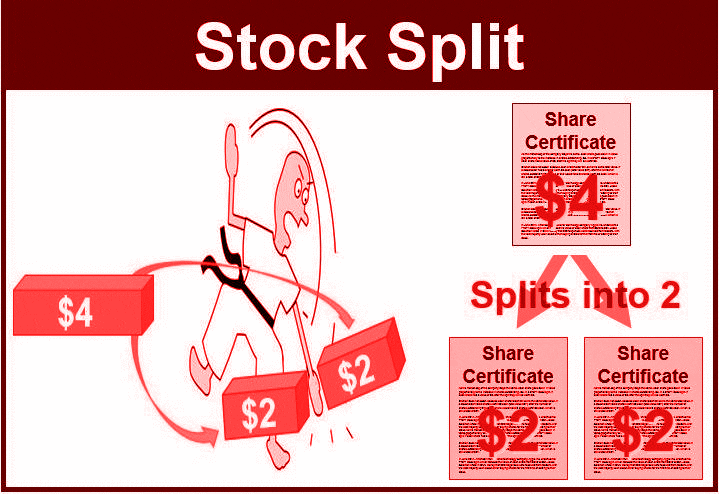
Example of a Stock Split
An example the Tata Motors share split from a face value of 10 to a new face value of 2 on the 13th of September 2011.
Benefits of Stock Split
Suppose XYZ company’s share whose face value is Rs. 10, is quoted at Rs. 1000 in the market and the company thinks the share price is high for the retail investors. Hence, they split their shares into 5 parts. The market price of the shares becomes Rs. 200 and the face value becomes Rs. 2. This is what is a stock split. Once the stock is split the participation in the counter increases and traders who were avoiding the share till now will start trading now. This is because people have a general idea that a 1000 rupee share is costly and a 100 rupee share is undervalued. Actually, this is a misconception, a 100 rupees stock can be more costly than a 1000 rupees share.
What is Reverse Split and Why Do Companies Use It?
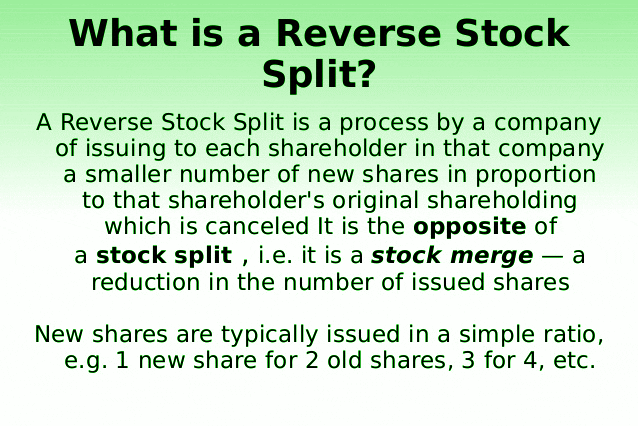
In our topic of discussion about the stock split and reverse split, we have already discussed a stock split. We will now discuss reverse split. In a reverse split, suppose company XYZ has 1000 shares of Rs. 15 each. Say they declare a reverse split 5:1. So it will reduce the number of shares. The new number of shares will be 1000 / 5 = 200 shares. The new price of the shares will be 15 x 5 = Rs. 75.
Why Do Companies Use Reverse Split?
Now why a reverse stock split is done? If a company’s prices become too low and reach the penny stock zone, a reverse split is a way to increase the share price and thus increase investor confidence. You can get the information on splits here in Money Control. Hence, we have completed our discussion on stock split and reverse split. I will be happy to answer your queries on the stock split and reverse stock split in the comments section below.
FAQ
Split means that a company divides its existing shares into multiple new shares, so each individual shareholder ends up with more shares but of lower worth. Reverse split on the other hand means that shareholders own fewer units after the process of amalgamation, but their share value increases as well.
A reverse split can be beneficial to both investors and the company in some cases. It can indicate improved financial performance or help address liquidity issues faced by some companies. However, one must keep an eye out for any associated risks prior to investing in such stocks.
It means that each original unit held will now become ten units (10:1). For instance, if you hold 5 original units of XYZ stock before conversion they turn into 50 units after Split 10:1.
Typically there is no standard ratio however most commonly seen ratio used by companies ranges from 2-for-1 splits to 20-for-1 splits when it comes to stock splitting whereas for reverse splitting it ranges from 0.5 -to.25 per pre-existing unit revenue though this solely depends on what’s convenient for both stockholders and respective firms involved upon undergoing this process.
Conclusion
In conclusion, the stock split and reverse split are common tools in the share bazaar that companies use to manage their share prices. A stock split can make shares more affordable for small and retail traders, increase participation in the stock, and boost investor confidence. A reverse split can increase the price of shares and improve investor confidence, especially when the share price falls too low. Overall, understanding these concepts can help investors make informed decisions about their investments.