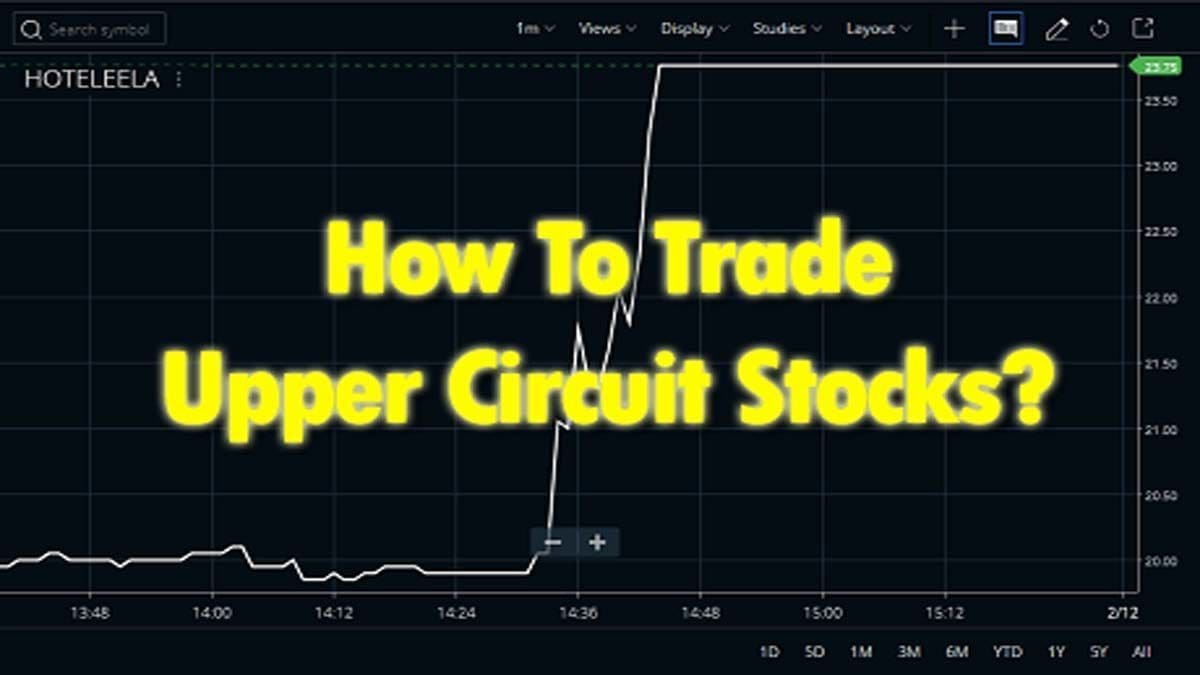

From time to time we hear this stock has hit the upper circuit OR that stock has hit the lower circuit OR that stock has upper froze. So what exactly is freezing or circuit in the stock market? The market price is based on sentiments. In case of sudden news OR extreme euphoria single-sided the sentiment can become uncontrolled. The price of scrip can increase OR decrease in an uncontrolled way in case of extreme sentiments. That’s why the exchange has the provision of circuit filters. In this post, I shall discuss more on upper and lower circuits and will also discuss how to trade upper circuit stocks.
What is the Meaning of a Circuit in the Stock Market?
A circuit in the stock market is the limit of gain OR loss in a single day for any stock. That means in a simple day the stock cannot go above or below the circuit limit. We also call it the circuit breaker in the stock market. A circuit breaker is also applicable to indices apart from stocks. The circuit breaker system applies at 3 stages of the index movement – 10%, 15%, 20%. When the index circuit breaker triggers there will be a trading halt in the stock market. This is created by the stock exchange to stop the manipulation of a stock price. They fix an upper limit and lower limit on every stock.
What is a Circuit Breaker?
Circuit breakers are in place for various stocks on the Indian stock market. The usual values of these are 2%, 5%, 10% or 20%. Only Stocks that are traded in the derivatives segment do not have any circuit breakers. On the Indian stock exchanges, an index-based market-wide circuit breaker system applies at all three stages of the index movement on either side, at 10%, 15%, and 20%. These circuit breakers, when triggered, bring about a coordinated trading halt in all equity and equity derivative markets nationwide. Market-wide circuit breakers trigger by the movement of either the BSE Sensex or the Nifty50, whichever of the two hits the trigger first.
What Happens When the Circuit Hits or the Circuit Breaker Triggers?
So when the circuit breaker triggers in any equity the trading of equity also becomes limited. In the case of the upper circuit or buying freeze no further buying is allowed and in the case of the lower circuit or selling freeze no further selling is allowed. The circuit breaker limit depends on the stock to stock between 5%-20%. The circuit limit also is changed based on the stock behaviour.



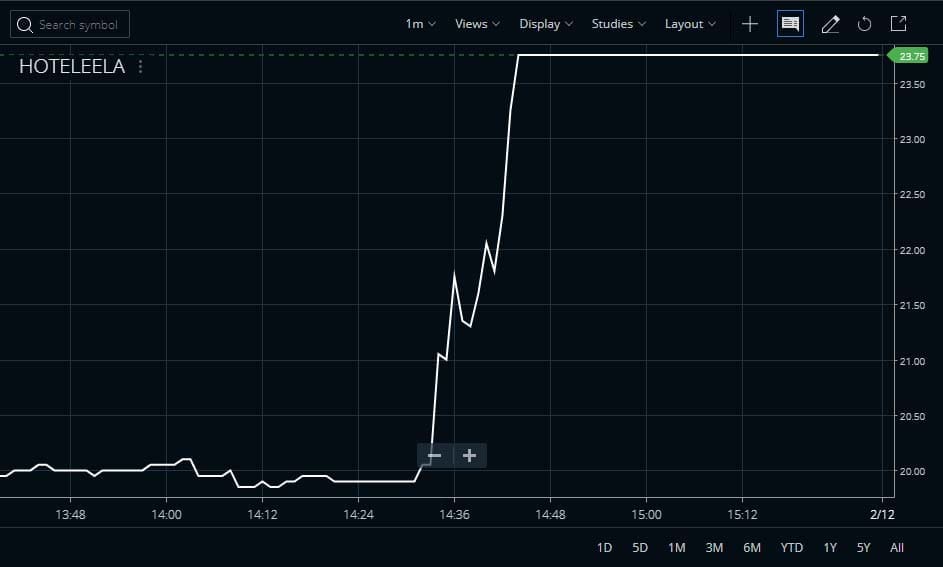
Suppose the stock is hitting a 20% upper circuit every day, so after a few days, the exchange will limit the circuit to 10% or 5%. Once a circuit is hit the graph becomes a straight line in intraday charts. See the image below for an example of a circuit in the stock market on Hotel Leela’s share.
After that, if the stock continues to move up or down at the same pace, then again the exchange will limit the circuit to 5% now. This is the same as we try to tame an uncontrolled child. One thing to remember is that the futures do not have any circuit filter and hence it is extremely risky to trade them.
Circuit Filter for the Nifty Index
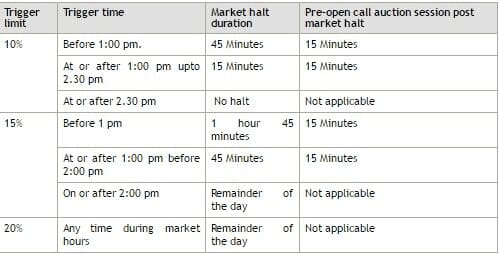
Just like stocks our stock indices like the Nifty index etc also have a circuit filter of 10%. If the day the index hits the upper or lower circuit trading gets halted for 1 hour and then again trading starts. This is once again done to safeguard the traders. If any day market moves 20% on any side, the exchange halts trading for the whole day.
Let us give the Nifty circuit limits below:
The drawback of the Circuit System in the Stock Market
1. The first downside of circuit breakers is that it prevents actual price discovery in stock both on its way up or down, at least for the limited time period they are imposed.
2. On the other hand, they allow early investors to gain an advantage and make a move before circuit breakers are eventually invoked, thereby restricting the moves of other investors, who make a move a little later in the day.
The Current Scenario
Generally, election days and any political, extreme environmental events cause a circuit in the stock market. Today the Loksabha election is going on, so there is a chance of it. If it does not happen, investors get to see extreme volatility in the market.
FAQ
When a stock ‘hits the circuit’, it means its trading price has reached either the upper or lower limits, as determined by the Securities and Exchange Board of India (SEBI). This helps to control volatility in markets and prevent any kind of manipulative behaviour.
A ‘circuit limit’ specifies how much a stock’s trading value can change from day to day. SEBI determines circuit limits for each stock based on its volatility history, closing pricing data at intervals like 5%, 10% & 20%.
We usually consider the upper Circuit shares, not suitable securities for long-term investments as they could be highly volatile and prone to sudden changes in prices. Therefore, only experienced investors should consider investing in such instruments with caution after doing adequate research on them.
The current “Circuit Limit” set by SEBI for NIFTY 50 is a band between 10%, 15%, and 20% from the reference point which will be the previous week’s close/ take the previous 3 months’ average, whichever is higher.
Conclusion
In conclusion, the circuit in the stock market is a great trading tool for Indian newcomers. By understanding how circuits work and formulating strategies to minimise your loss based on them, you can make smarter investments. However, it’s important to be aware of the risks involved in investing as well since the stock market has its ups and downs. Nevertheless, with sufficient knowledge and careful risk management practices, you could turn this powerful tool into large daily profits!