
Everyone who is eager to invest in the financial market enters the market with high hopes of maximum return. The market has various segments with different investment options. Like the equity market and commodity market, there is a derivates market too. Let’s begin with the basics, then we will cover futures and options lot size in the NSE exchange.
What is the Derivatives Market?
Derivate market stands on underlying variables. Basically, it’s a derived form of underlying assets, the assets can be equity, interest rates, currencies, or commodities. Today, in this article, the focus point would be the Future and Options under the Derivative market. You may go through our previous articles on Future Derivatives.
Suppose, ABC is a farmer and XYZ is a buyer. The farmer decides to sell his corp at Rs. 1000 to the XYZ buyer after 1 month. The buyer also agrees to his condition. Therefore, they enter into a contractual agreement that after one month whatever the value of the corp will be, the buyer will buy the corp at Rs.1000. Now, if the corp value will increase to Rs. 1200, XYZ buyer will make a profit by Rs. 200 but if the opposite happens, the value will reduce to Rs. 800, the ABC farmer will make a profit in this case. The same thing happens in the Future and Options market too.
What are Future and Options Derivatives?
Future Contract
The name of the contract itself defines its meaning. This type of contract will execute in the future. Like any other contract, it also has four factors buyers, sellers, price, and, expiry. The contract or agreement happens between buyers and sellers to buy or sell a specific asset at a specific future date and price. In other words, the asset price and execution day are prefixed here. If on or before the particular date, the price of the asset becomes high, buyers take the profit and if it becomes low, sellers book a profit. The futures contract was basically introduced to hedge against changes in the prices of farmers’ crops.


Option Contract
The basic principle of the future and the options contract is almost the same. Here, also a contract is listed between buyers and sellers at a prefixed price and date. Obviously, there is some basic distinction between the two. In future contracts, both buyers and sellers have obligations but in options, only sellers have the obligation while buyers have the right to buy it. Unlike future trading, investors can’t carry forward the position in the options contract. Future trading requires a huge amount of principle while in options, buyers only have to pay the premium.
What is the Futures and Options Lot Size?
Unlike equity and commodity, future-options investors can’t trade as per their requirements. If they enter into the Future-Options derivative market, they are bound to trade on the pre-determined number of securities, refers to as Lot Size. In simple words, Lot size refers to the quantity of an item or security. In the derivative market, investors buy a contract with a pre-determined lot size, depending upon the underlying securities.
Example of the Lot Size in Futures and Options
For example, if someone wants to buy SBIN SEP FUT (State Bank of India September Future contract) one lot, he has to buy 3000 future shares. This means one can’t have to buy a minimum of 3000 shares under a lot. The same thing is applicable to the options contract also.
In the National Stock Exchange of India, you can get each and every detail of listed underlying securities of the Future-Options trading. You also get the futures and options lot size along with the last traded price.
A screenshot of 25 underlying securities lot sizes is attached below:
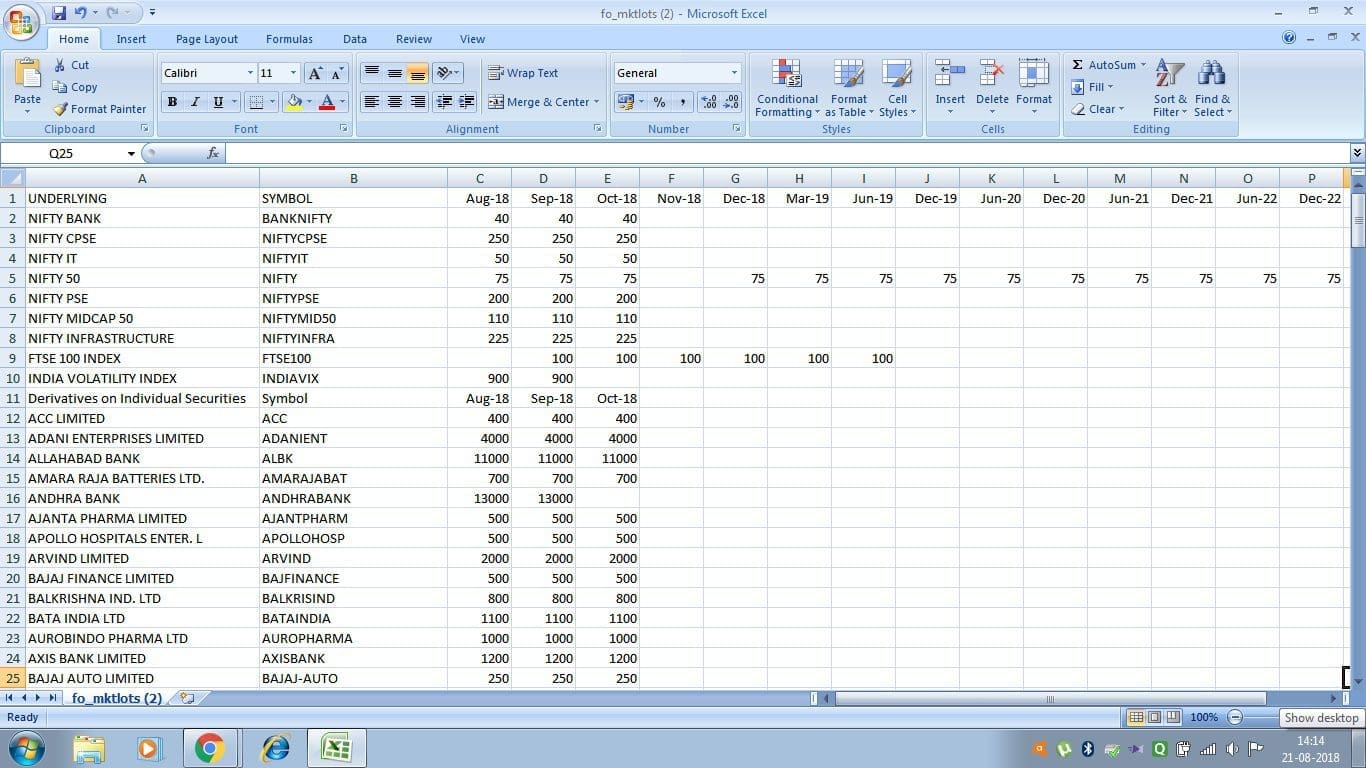
One thing should be clear to you that the futures and options lot size remains the same. In Future-Options, intraday and delivery both the trading system are available. You can buy and sell securities within a day or hold it till the expiry date.
FAQ
The lot sizes of options and futures are different, depending on the particular stock. For F&O stocks, the lot size may vary from one stock to another.
Lot sizes for most F&O stocks listed in NSE range from 1 to 500 with some exceptions. Prospective investors need to check out the details with their brokers or look at the details available online before investing.
Lot sizes for options trading tend to be smaller than that of regular stock investments and can generally be anywhere between one contract and up to twenty lots (20 x 100 shares). This varies from company to company and traders must ensure they have sufficient funds when placing orders according to a given lot size allowed by their brokerage firm before they trade in derivatives instruments such as options.
The majority of securities traded on NSE’s Futures & Options (F&O) segment carry an underlying quantity equivalent or close approximation thereof, which serves as its default contract value or “lot” subject only to minor fractional adjustments based on specific contracts featured in this market – usually fixed at rounds like 5/10/25 etc., more so than other parts where magnitude varies significantly across select series/expiries.
Conclusion
Although the futures and options lot size may seem confusing at first, it’s important to take the time to understand what it is and why it matters. This knowledge can help you make better-informed decisions when trading futures and options because you will be aware of how many units of a security (or currency pair) you are dealing with in each transaction. The key takeaway from this blog post is that understanding your lot size before getting involved in futures or options contracts can help ensure an easier, more profitable experience.