
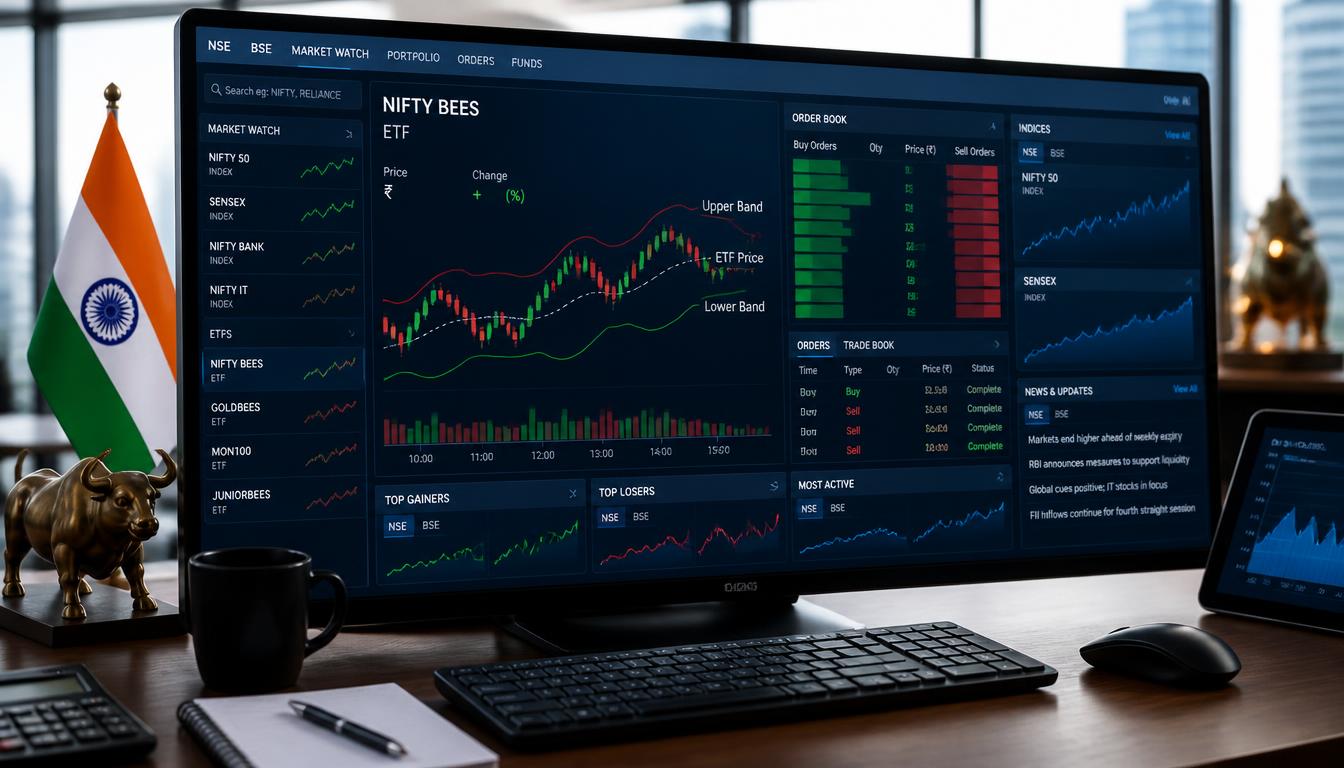
If you trade ETFs on NSE or BSE, the SEBI new ETF trading rules that took effect from September 7, 2026 are worth understanding before you place your next order. The changes aren’t about what an ETF owns. They change something more practical: how the exchange decides the ETF’s base price, how far it can move during the session, and how some ETFs discover their opening price. SEBI originally planned these changes for September 1, but extended the implementation date to September 7 after feedback from stock exchanges.
That distinction matters.
An ETF can track Nifty, Bank Nifty, gold, silver, bonds or another basket, but it still trades like a security on an exchange. So you can have a perfectly good ETF trading at a price that doesn’t immediately match the value of its underlying holdings. Liquidity, spreads, market orders and the timing of NAV calculations all matter.
SEBI’s June 15 circular was aimed partly at this problem. Under the earlier framework, ETF price bands were based on a T-2 day NAV, while many ETFs had a fixed ±20% band. SEBI’s view was that this could create a mismatch between the ETF’s permitted trading range and what’s happening in the underlying market.
The new framework moves the reference point closer to the actual exchange price. For most equity and debt ETFs, the initial band is now ±10%, with scope to widen it after a cooling-off period. Gold and silver ETFs get their own mechanism because their underlying markets trade internationally while Indian ETF trading happens during domestic market hours.
For a long-term ETF investor, much of this may happen in the background.
For someone buying an ETF at 9:15 AM, trading a less liquid fund, using market orders, or trying to exit during a sharp move, it matters a lot more.
I’ve always preferred looking at the actual trading mechanics rather than treating an ETF as simply “a mutual fund that trades like a share”. That’s too simplistic. If you want to trade ETFs properly, you need to understand the difference between NAV, market price, liquidity and the exchange’s trading limits.
Here’s what has changed, and more importantly, what I’d actually do with this information.
What exactly changed in the new SEBI ETF rules?
The short answer is that SEBI has changed four pieces of the ETF trading framework: the base price, price bands, the pre-open mechanism for gold and silver ETFs, and certain close-out rules.
Why was the old ETF framework a problem?
Previously, the base price used for ETF price bands was generally linked to the T-2 day NAV. Equity, debt and commodity ETFs generally had a fixed ±20% price band, while Overnight ETFs had a ±5% band.
Think of the base price as the starting reference from which the exchange calculates the day’s permitted range.
Using an older NAV isn’t necessarily wrong, but it can become awkward when the underlying asset has moved significantly since that NAV was calculated.
The new framework initially uses the previous trading day’s closing price. Specifically, the base price is the ETF’s VWAP, or volume-weighted average price, during the last 30 minutes of T-1 trading. If there was no trade during those final 30 minutes, the T-1 LTP is used. If there was no trade at all on T-1, the latest available closing NAV becomes the fallback. Corporate actions are adjusted for as applicable.
There is another planned change. SEBI has asked exchanges and AMCs to work towards using the T-1 closing NAV as the base price from April 1, 2027. That’s separate from the base-price method that has now started.
What happens to the price bands?
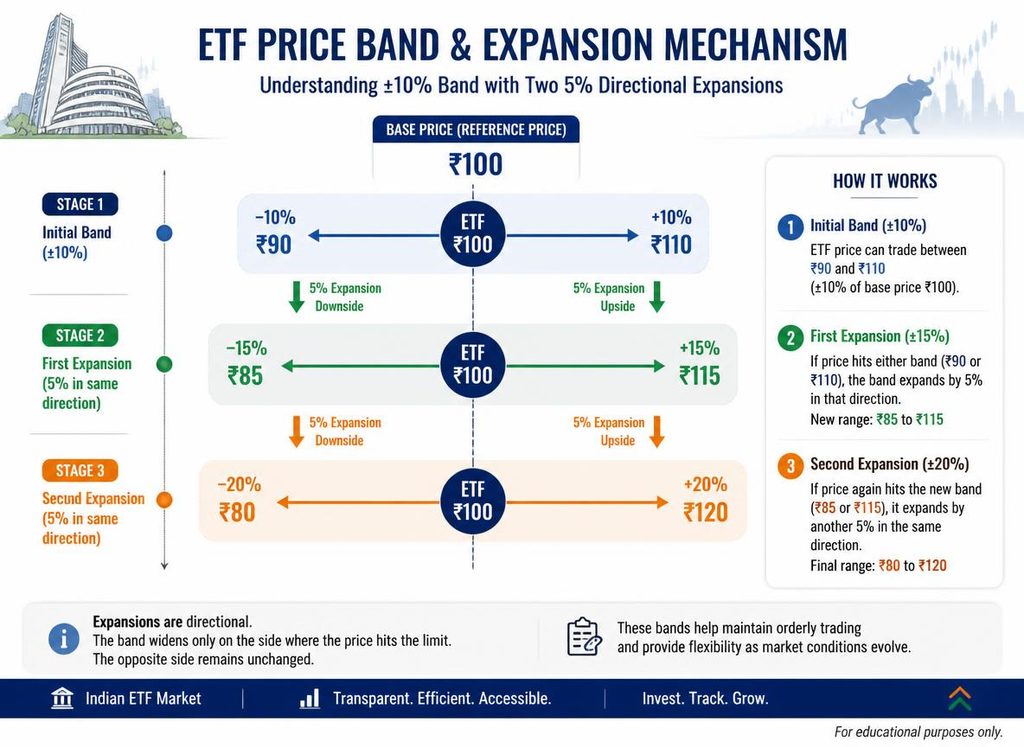
For equity ETFs and most debt ETFs, the new band starts at ±10%.
It can then be widened by 5% of the base price after the prescribed cooling-off period, up to ±20%. The first two flexes are the relevant maximum under the SEBI framework. The cooling-off period is generally 15 minutes, reduced to 5 minutes when the trigger occurs during the last 30 minutes of trading.
Overnight and Liquid ETFs remain at a fixed ±5% band.
Gold and Silver ETFs are different. They start with a ±6% dynamic band and can be flexed by 3% after the cooling-off period. If international prices move beyond the aggregate Daily Price Limit of 9%, the exchange can further relax the band in stages, with appropriate market notice.
Hypothetical example: suppose an equity ETF has a base price of ₹100.
It starts with a ₹90 to ₹110 range. If the conditions for flexing are met and the cooling-off period passes, the upper side can move to ₹115. A further permitted flex can take it to ₹120. The lower side doesn’t automatically move down when the upper side is widened. That’s an important detail that can easily get missed.
So this isn’t simply “SEBI reduced ETF circuits from 20% to 10%”.
The better description is that SEBI has replaced a broad fixed range with a more graduated mechanism for many ETFs.
ETF Price-Band Framework: Old vs New
Comparison of the earlier fixed bands with the new initial bands and permitted expansion.
Values represent percentage-point price-band limits from the stated ETF framework. Gold and Silver ETF flexing is shown as a 3 percentage-point step, not as a maximum band.
How should you trade ETFs under the new framework?
I wouldn’t change a sound ETF investment plan just because the price-band rules changed. I would change how I execute ETF orders, especially in less liquid ETFs.
The biggest mistake is to look only at the ETF’s displayed price and ignore the order book.
Start with liquidity, not the ETF name
Suppose you’re comparing two ETFs that both track broadly the same index.
One has a healthy bid-ask spread and plenty of visible orders. The other barely trades.
I’d take the liquid one unless there’s a very strong reason not to.
The new SEBI new ETF trading rules don’t magically make an illiquid ETF liquid. A narrower regulatory price band doesn’t guarantee better execution either.
This is where retail traders often get confused. They see an ETF trading at ₹100 and assume they can buy ₹100 worth of exposure for ₹100.
Not necessarily.
If the best seller is at ₹101 and the next meaningful sell order is much higher, your market order can get filled at a price you didn’t expect. With a large order, the problem gets worse because your order can eat through several levels of the book.
That’s why I prefer limit orders for ETF purchases, particularly when the ETF isn’t among the most actively traded names.
Check the underlying market too
For an equity ETF, look at the index and its major constituents.
And for a Gold ETF, look at what’s happening in gold globally.
Similarly, for a Silver ETF, remember that the underlying commodity trades internationally even when the Indian ETF doesn’t.
The new framework recognises exactly this issue for commodity ETFs. SEBI has introduced a pre-open call auction for Gold and Silver ETFs because the underlying commodities trade across international markets while the Indian ETF trades during domestic exchange hours.
A call auction is simply a process where orders are collected and an equilibrium opening price is discovered instead of immediately matching every order as it arrives.
What should you actually check before placing an order?
My basic ETF execution checklist would be:
- Check the bid-ask spread.
- Look at available quantity near your intended price.
- Compare the market price with the ETF’s indicative value or underlying reference.
- Avoid blindly using market orders in thin ETFs.
- Be extra careful around the opening and during sharp moves.
- Don’t assume a price band tells you anything about fair value.
Hypothetical example: you’re buying ₹2 lakh of an ETF. The displayed price is ₹100, but the order book is thin. Instead of sending one market order, you place a limit order near your intended price and watch the fills.
You may take a little longer to complete the order.
That’s fine.
I’d rather miss part of an ETF entry than pay an unnecessary spread just because I wanted instant execution.
The SEBI ETF trading framework proposals were discussed partly because the old structure didn’t always fit the underlying market. The final framework addresses that through the base-price and price-band changes, but execution discipline is still your responsibility.
How would the new rules affect a real ETF trade?
Let’s use a hypothetical example because this is where the mechanics become much easier to understand.
Imagine an equity ETF finished the previous trading day at a T-1 closing VWAP of ₹100.
Under the new framework, ₹100 becomes the base price, assuming there was sufficient trading in the final 30 minutes to establish that VWAP. The initial price band is then ₹90 to ₹110.
Hypothetical: the ETF suddenly moves higher
Suppose strong buying pushes the ETF towards ₹110.
That doesn’t automatically mean the ETF can immediately trade at ₹120.
The framework provides a cooling-off mechanism. If the prescribed trigger is met, the exchange waits through the applicable cooling-off period while trading continues inside the existing band. After that, the band can be flexed by 5% of the base price.




So the upper limit could move from ₹110 to ₹115.
If another permitted flex occurs later, it could move to ₹120.
The key point is that the band expands in the direction of the move. It isn’t automatically shifted on both sides.
This is quite different from simply saying, “The ETF has a 20% circuit.”
The market gets room to respond to a genuine move, but that room isn’t available all at once.
Hypothetical ETF Price-Band Expansion
Example using a ₹100 base price. The permitted upper band expands from ₹110 to ₹115 and then ₹120.
₹90–₹110
₹90–₹115
₹90–₹120
Hypothetical example only. Starting with a ₹100 base price, the initial range is ₹90–₹110. After the prescribed cooling-off process, the upper limit can expand to ₹115 and then ₹120, while the lower limit remains ₹90 in this upward-move example.
Hypothetical: the ETF is barely traded
Now consider a different ETF.
It doesn’t trade during the final 30 minutes of T-1. In that case, the exchange uses the day’s LTP instead of the final-30-minute VWAP. If there wasn’t any trade on T-1, the latest available closing NAV is used.
This is important for anyone trading ETFs with weak liquidity.
The new rule doesn’t eliminate the consequences of poor trading activity. In fact, the fallback mechanism should remind you that an ETF’s last traded price can be less informative when trading is sparse.
I would not look at the last traded price of a thin ETF and assume it represents a highly reliable live valuation.
Hypothetical: Gold ETF at the open
Now take a Gold ETF.
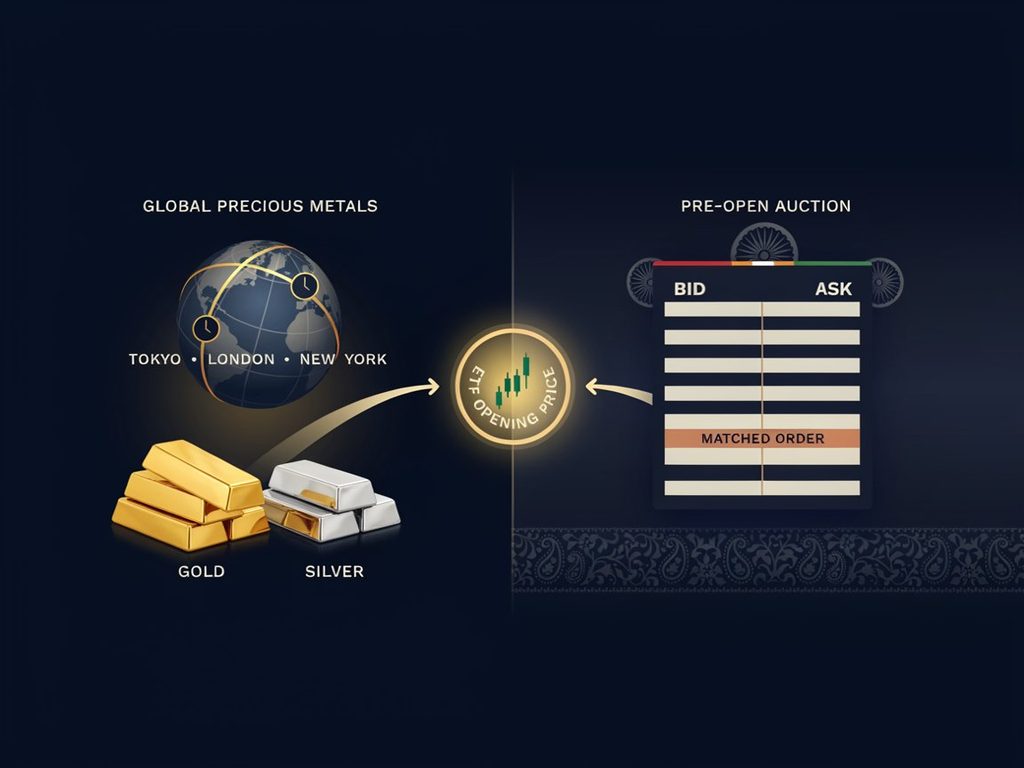
Gold may have moved sharply in overseas markets while the Indian stock exchanges were closed. Under the new framework, Gold and Silver ETFs get a pre-open call auction to help discover an equilibrium opening price.
That’s a sensible change.
If you place an aggressive order before understanding where the market is likely to open, you’re effectively volunteering to be the other side of someone else’s better-informed order.
The SEBI new ETF trading rules don’t remove opening gaps. They give the exchange a better mechanism for discovering the opening price when international markets have moved.
That’s a meaningful difference.
Where can the new ETF framework still hurt you?
Here’s where I think some commentary around the SEBI new ETF trading rules misses the point.
Better rules don’t mean better trades.
A dynamic price band can improve market mechanics while you still lose money because you bought the wrong ETF, paid too much, ignored liquidity or entered during a poor setup.
Price bands aren’t valuation tools
A ±10% band doesn’t mean an ETF is fairly valued anywhere inside that range.
It only defines the permitted trading range under the exchange framework.
That’s a very different thing.
If an ETF tracking an index is trading at a premium to its underlying value, the fact that the exchange allows it to trade doesn’t make the premium reasonable.
This is why I prefer to separate three questions:
- What is the ETF worth?
- What price is the market offering?
- Can I execute at that price without giving away too much through spread and impact?
Most retail investors ask only the second question.
Thin ETFs remain a problem
This is especially relevant in India.
You can have an ETF listed on NSE or BSE that looks perfectly respectable on a search screen but has very little real trading activity. The displayed last price can give a false sense of liquidity.
Hypothetical example: an ETF shows ₹100 as its last traded price. You want to sell a sizeable position, but the bid side has very little quantity around ₹100.
You don’t actually own something that is instantly saleable at ₹100.
And you own units that last traded at ₹100.
Those are different statements.
If you need to sell quickly, the difference can become your cost.
And there are other costs too: brokerage where applicable, STT and exchange-related charges, taxes and, more subtly, bid-ask spread and market impact. Don’t judge an ETF only by its expense ratio.
Dynamic bands can also change your trading behaviour
A wider permitted range can be useful during a genuine market move.
But it can also give a trader more room to chase.
That’s not a regulatory problem. It’s a trading psychology problem.
If your plan says, “I’ll buy because the ETF has moved 12% and the band has widened”, you’ve mixed up trading permission with trading opportunity.
The SEBI ETF trading framework proposals were about market structure and price discovery. They were never a substitute for risk management or a trading system.
For me, that’s the main practical warning.
Don’t turn a regulatory change into a new trading signal.
Are these rules better than the old ETF system?
Yes, I think the new framework is an improvement for ETF market structure, particularly because it brings the base-price reference closer to actual trading and gives different ETF categories different treatment.
But “better framework” doesn’t mean every ETF becomes easier to trade.
| Feature | Earlier framework | New framework |
|---|---|---|
| Base price | T-2 day NAV | T-1 closing price, initially based on last 30-minute VWAP |
| Equity/debt ETFs | Fixed ±20% | Initial ±10%, can flex up to ±20% |
| Overnight ETFs | ±5% | Fixed ±5% |
| Liquid ETFs | Previously under the broader ETF framework | Fixed ±5% |
| Gold/Silver ETFs | Fixed ±20% | Initial ±6%, dynamic flexing |
| Gold/Silver pre-open | No dedicated ETF call auction | Pre-open call auction |
| Overnight/Liquid close-out | Existing process | Revised close-out formula |
These changes come directly from SEBI’s June circular, with the implementation date subsequently moved from September 1 to September 7, 2026.
What about mutual funds?
This is where you need to keep the distinction clear.
An ETF trades on an exchange during market hours. A normal mutual fund purchase or redemption works through the mutual fund framework and applicable NAV rules.
If your goal is simply long-term index exposure and you don’t care about intraday execution, a conventional index mutual fund may be easier for you.
If you want exchange-traded execution, intraday buying and selling, and control over your entry price, an ETF has advantages.
But I wouldn’t choose an ETF simply because the expense ratio looks slightly better.
For an active ETF investor, liquidity and execution can matter more than a small difference in annual expenses.
What about index futures?
Futures are a completely different tool.
If you’re trying to get leveraged exposure to Nifty or Bank Nifty, futures may make sense for a specific trading strategy. But you take on expiry, margin, rollover and leverage-related risks.
An ETF doesn’t work that way.
Hypothetical example: if you have ₹2 lakh and want unleveraged exposure to an index, buying an ETF with a sensible limit order is a much simpler structure than taking a futures position just because futures are more “trader-like”.
Don’t use a more complicated instrument when the simpler one does the job.
The SEBI new ETF trading rules improve the mechanics of the ETF itself. They don’t change that basic decision.
What should you do differently from September 7?
If you’re already investing in liquid, established ETFs and holding them for years, I wouldn’t overreact.
The changes are mostly about how the market handles trading, not about changing the investment objective of your ETF.
But if you’re actively trading ETFs, I’d make a few changes to my process.
Build an ETF execution checklist
Before placing an order, I want to know:
- Is the ETF liquid enough for my position size?
- What’s the current bid-ask spread?
- How much quantity is actually available near my price?
- Is the ETF trading close to its underlying value?
- Has the underlying market moved sharply?
- Am I using a limit order for a good reason?
- Am I entering because my setup says so, or because the ETF is moving quickly?
This is more useful than memorising every paragraph of the SEBI circular.
Use TradingView for the market context
TradingView can help you compare the ETF with its underlying index, sector or commodity reference.
For example, if you’re trading an index ETF, you can keep the relevant index and ETF side by side and watch how they behave during the same period.
You can also use a spreadsheet to record your actual execution price versus the quoted price.
That’s a simple way to measure your real trading cost.
Hypothetical example: you plan to buy an ETF at ₹100 but repeatedly get filled around ₹100.30 because of spread and order-book depth. Over a few trades, that tells you something useful about execution quality.
You don’t need an elaborate Python system for this.
A simple Google Sheet is enough to start.
The SEBI ETF trading framework proposals have now become an operational framework, but your own data can tell you whether your particular ETF and trading style work well together.
Don’t confuse the new rules with a new strategy
This is probably the most important point.
I wouldn’t create a “SEBI ETF strategy”.
I’d keep my existing investment or trading strategy and update the execution rules around it.
If you use technical analysis, your entry still needs a technical reason.
If you use fundamental analysis, your valuation process still matters.
And if you invest passively, your asset allocation still matters.
The new framework simply changes some of the plumbing underneath the trade.
And plumbing matters, but it isn’t the investment thesis.
The first practical step I’d take is simple: pick the ETF you trade most often, check its current liquidity and order-book behaviour, and compare that with how you normally place orders. If you’re using market orders in a thin ETF, that’s the first habit I’d change.
What do the SEBI ETF rules actually mean for retail traders?
I think the biggest benefit of the SEBI new ETF trading rules is that they recognise something traders have known for years: an ETF isn’t just a NAV number.
It has an exchange price.
It has an order book.
Also, it has liquidity.
And it has a relationship with an underlying asset that may be moving while the ETF itself isn’t trading.
The old structure could use a T-2 NAV as the base reference, even though the market had already moved since then. The new framework brings the initial reference closer to recent exchange trading through the T-1 closing price and gives equity and debt ETFs a dynamic band rather than simply allowing a fixed ±20% range from the start.
The Gold and Silver changes make sense for a different reason. Their underlying markets don’t respect Indian stock-market hours, so a pre-open call auction gives domestic ETF participants a more structured way to discover an opening price after overnight global moves.
That’s useful.
But don’t expect the regulator to solve your execution problem.
If you buy a thin ETF with a market order, you can still get a poor fill.
If you chase a sharp move, you can still lose.
And if you ignore the difference between NAV and market price, the new base-price rule won’t save you.
Finally, if your position size is too large for the ETF’s actual liquidity, the exchange’s price-band mechanism won’t make your exit painless.
That’s why I’d treat the new framework as a market-structure improvement, not a trading signal.
There is also a useful distinction between what was proposed earlier and what finally became the rule. The February consultation discussed graded bands and other mechanisms before SEBI issued the June circular. Some details changed in the final framework. For example, the final rules for equity and debt ETFs specify the two permitted flexes, while the Gold and Silver ETF mechanism allows further relaxation when international price movement exceeds the aggregate daily price limit.
So if you’re reading older articles about the SEBI ETF trading framework proposals, be careful.
Don’t assume every number in an old consultation paper is still the live rule.
For traders, the practical process is much simpler.
Know your ETF. Know its liquidity. And know the underlying. Use sensible order types. Watch the spread. And don’t mistake the exchange’s permitted range for a statement about fair value.
That’s how I’d use these changes.
Your next step: open the ETF you trade most often, look at its bid-ask spread and order-book depth during normal market hours, and record a few actual executions in a spreadsheet. Once you know what your ETF really costs you to enter and exit, the new SEBI framework becomes much easier to work with.