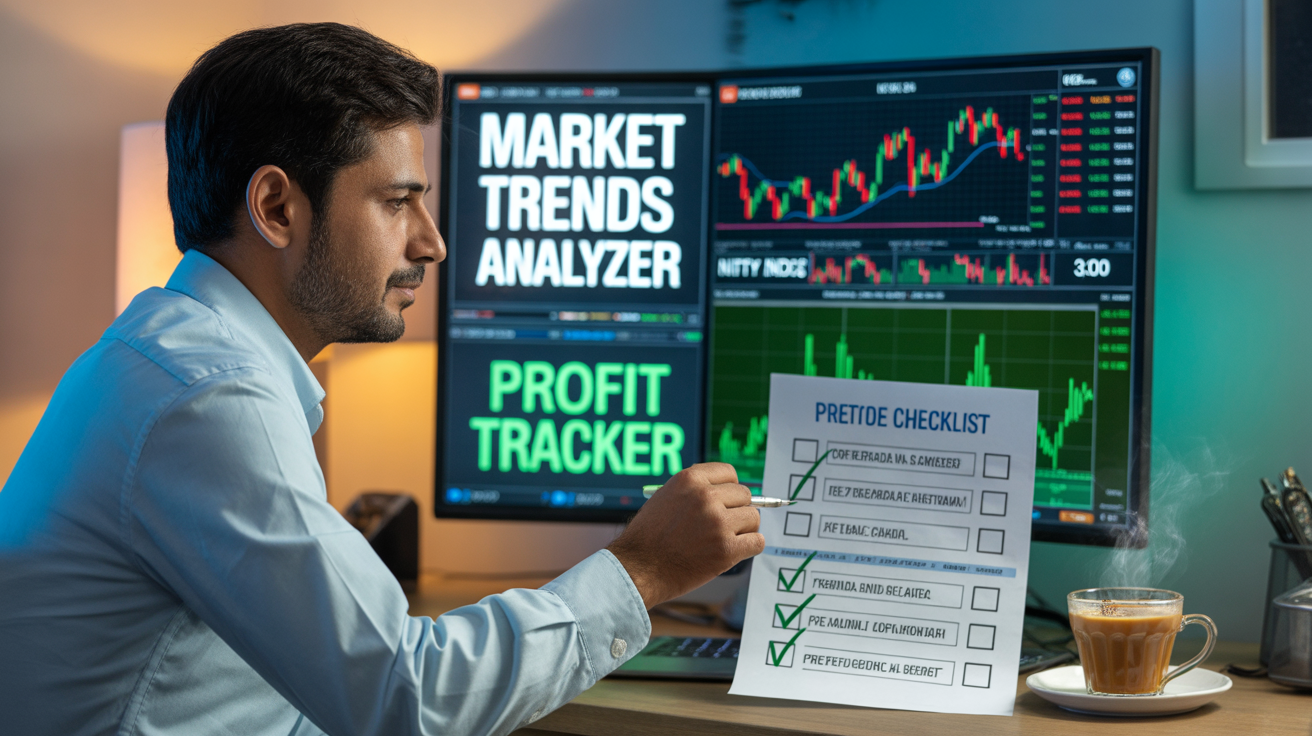
You sat down at your trading desk at 9:00 AM, opened Zerodha Kite, and within twenty minutes, you had taken three trades—none of which you had planned the night before. By 11:30 AM, your account was down ₹8,000 and you were staring at the screen, wondering what went wrong. Sound familiar? If you have ever walked away from a trading session feeling defeated, confused, or emotionally drained, the single most likely culprit is the absence of a structured intraday trading checklist.
To make it even easier for you to take action right away, I have included a free SEBI-compliant Intraday Trading Checklist PDF — covering all 7 phases from pre-market to end-of-day review — available for download at the end of this post. Print it and keep it on your trading desk from tomorrow morning.
I am Indrajit Mukherjee, founder of StockManiacs.net and an active trader since 2002. I have watched thousands of traders—many of them my own students—repeat the same costly pattern: they enter the market with energy but without a system. Over the years, mentoring more than 20,000 traders through my partnerships with Zerodha, I have seen firsthand that the traders who survive and grow are not necessarily the most intelligent ones. They are the most disciplined ones. And discipline, in trading, lives inside a checklist.
An intraday trading checklist is not just a to-do list. It is your operating procedure—a decision-making framework that runs from before the market opens to after it closes. Think of it the way a pilot thinks about a pre-flight checklist. The pilot may have flown 5,000 hours, but they will still check every instrument before takeoff. Not because they are nervous, but because the checklist removes the possibility of human error.
In the Indian market context, this is even more critical. NSE and BSE have circuit limits, T+1 settlement, SEBI-mandated margin rules (significantly tightened in 2025 for equity derivatives), and weekly expiry dynamics on indices like Nifty and Bank Nifty that simply do not exist in most global markets. If you are relying on US-focused YouTube videos or generic trading advice, you are missing the local rules that can directly get you into regulatory trouble or margin shortfalls.
This guide is your complete, practical, India-specific intraday trading checklist—broken into six phases: pre-market preparation, strategy and setup, risk management, live trade execution, psychology and discipline, and end-of-day review. Each section gives you actionable yes/no items you can print, bookmark, or build into a spreadsheet.
By the end of this article, you will have a battle-tested daily framework to trade with more confidence, fewer emotional errors, and a clear edge rooted in structure rather than speculation.
Phase 1: What Should You Do Before the Market Opens?
The answer is: Your pre-market routine determines the quality of every trade you take during the day. Skipping it is like driving on a highway with your eyes half-closed.
In my experience using AmiBroker and TradingView for over two decades, the traders who prepare before 9:15 AM consistently outperform those who react in real time. Pre-market prep is not optional—it is the foundation.
The Pre-Market Checklist (45 Minutes Before Open)
Start the night before or at least an hour before the market opens. Here is what your pre-market phase must cover:
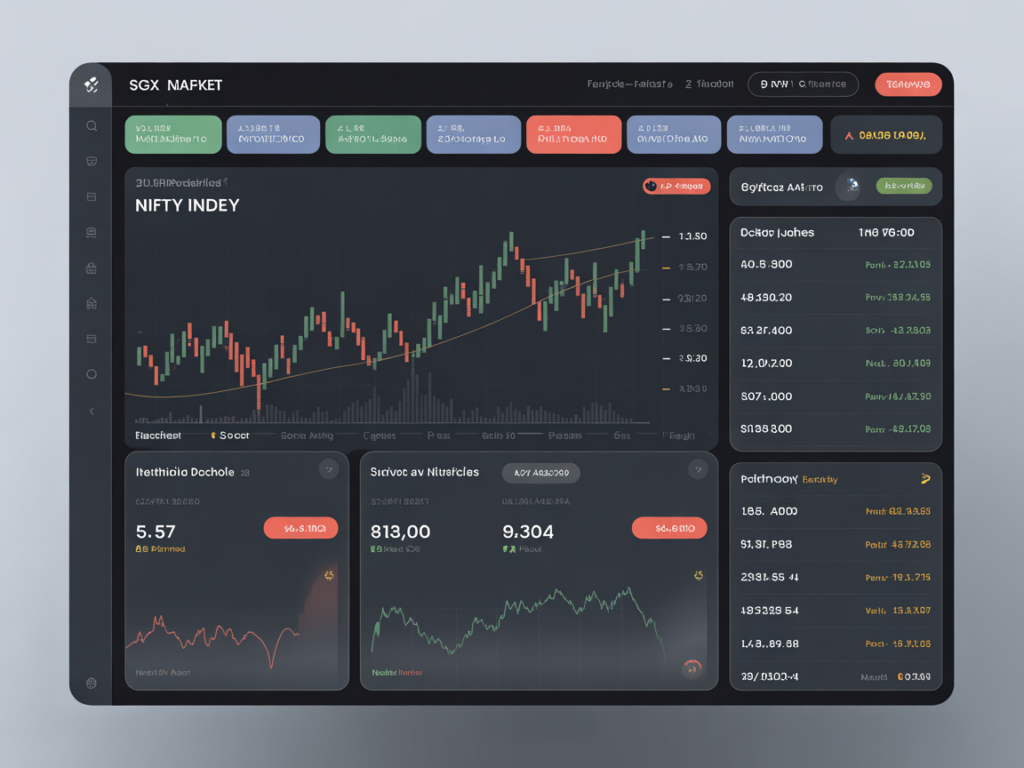
Global cues first. Check US markets (Dow, S&P 500, Nasdaq), SGX Nifty, crude oil, and gold. If Wall Street closed down 1.5%, your Nifty gap-down open is already telegraphed. You should be preparing for it, not reacting to it.
FII/DII data. Check the provisional net buying/selling data from NSE for Foreign Institutional Investors and Domestic Institutional Investors. This is one of the most powerful and most ignored pre-market signals in India. A heavy FII sell day often signals index weakness throughout the session.
Identify your watchlist. Do not trade more than 5–7 stocks on any given day. Use Screener.in or TradingView to filter stocks with high volume momentum, clean technical setups, and strong sector alignment. Avoid illiquid stocks with wide bid-ask spreads.
Mark key levels. On your chart, mark the previous day’s high, low, and close. Mark overnight gap levels. Also, mark the daily pivot point and the weekly support/resistance. These become your trade management anchors.
News and events scan. Check if any stocks on your watchlist have earnings announcements, board meetings, F&O expiry events, or SEBI/regulatory news pending. Trading a stock without knowing its news calendar is flying blind.
Practical Takeaway: Build a fixed pre-market routine you can complete in 30–45 minutes. Consistency is more valuable than perfection. If you do not have time for pre-market prep on a given day, the correct decision is often not to trade that day.
Phase 2: How Do You Identify the Right Setup to Trade?
In simple terms: A setup is a specific, repeatable pattern or condition under which you take a trade. Without setup rules, you are gambling—not trading.
After 20+ years of testing strategies across MetaStock, AmiBroker, and TradingView, I can tell you that most retail traders lose not because they cannot read charts, but because they trade every signal they see. Discipline in setup identification is what separates a professional from a punter.
The Setup Identification Checklist
Confirm the trend direction first. Always trade with the dominant trend on the 15-minute or hourly chart. If Nifty is in a clear downtrend on the hourly chart, do not look for long breakout trades on 5-minute candles. This seems obvious, but in the heat of the moment, it is easy to forget.
Wait for your entry trigger. Your pre-defined setup—whether it is a breakout above resistance, a pullback to a moving average, or an opening range breakout (ORB)—must be fully formed before you enter. Not “forming.” Fully formed.
Volume confirmation is non-negotiable. A breakout on weak volume in Indian mid-cap stocks is almost always a false breakout. Look for volume that is at least 1.5 to 2 times the 20-period average at the point of breakout.





Comparison: Strong Setup vs. Weak Setup
| Criteria | Strong Setup | Weak Setup |
|---|---|---|
| Trend alignment | Yes (multi-timeframe) | No or mixed signals |
| Volume confirmation | 1.5x–2x average | Below average |
| Risk:Reward ratio | Minimum 1:2 | Less than 1:1.5 |
| News event pending | None | Earnings/news today |
| Chart pattern | Clean, well-defined | Ambiguous or messy |
Take a hypothetical example: Ravi, a mid-level IT professional trading on Upstox, used to enter Bank Nifty options the moment he saw a candlestick pattern he recognised. Without checking volume or trend direction, he had a win rate below 35%. After implementing a setup filter checklist—requiring trend alignment, volume confirmation, and a clean 1:2 risk-reward—his win rate climbed above 50% within eight weeks.
Practical Takeaway: Write down 2–3 specific setups you know well. Only trade those. If the market does not offer you those setups on a given day, the right action is to sit on your hands.
Phase 3: What Are the Non-Negotiable Risk Management Rules?
The answer is: Risk management is the only part of trading you have full control over. It is not about predicting where the market goes—it is about controlling what happens when you are wrong.
SEBI’s updated 2025 margin rules for equity derivatives have significantly tightened leverage available to retail traders. These regulatory changes are not an inconvenience—they are a protection mechanism. They force you to be more selective.
Core Risk Management Checklist
Define your maximum daily loss before the market opens. I recommend capping this at 2–3% of your total trading capital. If you have ₹2 lakhs in your trading account, your maximum loss for the day should not exceed ₹4,000–₹6,000. Once you hit it, stop trading. No exceptions.
Set your risk per trade. Risk no more than 0.5%–1% of your capital on any single trade. This means your position size is calculated, not guessed. Use Zerodha’s margin calculator or Fyers’ position sizing tool before placing the order.
Place your stop-loss before your entry. This is absolute. Not “I will mentally stop out at that level.” Physically place the stop-loss order in your trading terminal the moment your entry order is placed.
Check your overnight margin compliance. With SEBI’s 2025 rules for equity derivatives, the upfront margin requirement is stricter. If you are trading F&O, verify your available margin before taking positions to avoid forced square-offs by your broker.
Pros and Cons of Strict Risk Management Rules
| Pros | Cons |
|---|---|
| Protects capital systematically | May cut profitable trades early |
| Removes emotion from exit decisions | Requires pre-session calculation time |
| Compliant with SEBI 2025 margin norms | Limits position size on high-conviction trades |
| Builds long-term account sustainability | Can feel restrictive initially |
Practical Takeaway: Risk management is not something you figure out during a live trade. It must be calculated and logged before you enter. Keep an Excel tracker (Indzara’s free Indian stock market template works well) to record every trade’s intended risk.
Phase 4: How Should You Behave During a Live Trade?
The answer is: Once you are in a trade, your job changes completely. You are no longer analysing—you are managing.
This is the phase where most traders sabotage themselves. I have seen it repeatedly across my mentorship sessions: a trader with a perfect setup and correct position sizing will still lose because they interfere with the trade. They move the stop-loss, they average down on a losing trade, or they exit too early out of fear.
Live Trade Execution Checklist
Do not move your stop-loss against you. Moving a stop-loss further away from entry to “give the trade more room” is one of the most dangerous habits in trading. Your original stop was placed at a logical level—if the market has gone there, the trade is invalid.
No averaging down on losing intraday positions. This is a rule I enforce strictly with every student. In intraday trading, averaging down simply multiplies your loss in a losing trade. It is not a strategy. It is hope dressed up as a plan.
Follow a strict trade management ladder. If the trade moves in your favour by 1R (your initial risk amount), trail your stop-loss to breakeven. If it moves by 1.5R, trail to 0.5R profit. This way, once you are in profit, you cannot give it all back.
Avoid over-trading. Set a maximum of 3–5 trades per day. Research from experienced traders on r/IndianStockMarket consistently shows that traders who execute fewer, higher-quality trades outperform those who chase every opportunity.
I recorded the following video in 2020, but it is an evergreen strategy. It still works like a charm and it will work in future too as it focuses only on price action.
Common Mistakes During Live Trade Execution
- FOMO entries: Entering a trade after it has already moved significantly, chasing price.
- Ignoring circuit limits: Many Indian mid-cap and small-cap stocks hit upper or lower circuits during volatile sessions—this can trap you in an illiquid position.
- Watching P&L instead of price action: When you focus on your P&L in real time, you make emotional decisions. Focus on the chart, not the money.
- Trading during the opening 15 minutes blindly: The first 15 minutes of the Indian session (9:15–9:30 AM) are the most volatile and the most deceptive. Many professional traders wait for this noise to settle before entering.
Practical Takeaway: Before you enter any trade, write down your entry price, stop-loss, target, and maximum position duration. Treat this like a contract with yourself. If you cannot articulate these four elements, do not enter the trade.
Phase 5: How Do You Master Trading Psychology and Discipline?
The answer is: Trading psychology is not a “soft skill.” It is the hardest edge to build—and the one that determines whether all your technical knowledge actually translates into consistent profits.
After two decades in the market, I can tell you that the technical part of trading—reading charts, identifying setups, understanding indicators—can be learned by anyone in six to twelve months. What takes years to master is the mental discipline to follow your system when it feels uncomfortable.
Psychology Checklist for Every Trading Day
Start with an emotional check-in. Before you look at a single chart, ask yourself honestly: Am I in the right mental state to trade today? If you had a major argument last night, if you are sleep-deprived, or if you are still feeling the sting of yesterday’s losses, your judgment is compromised. The market does not care about your emotions—but your P&L will reflect them.
Remove revenge trading from your vocabulary. Revenge trading—taking impulsive trades to recover a loss—is the single most destructive behaviour in intraday trading. It almost always turns a small loss into a large one. If you hit your daily loss limit, close the terminal.
Respect the rules you set before the market opened. In the chaos of a live market, your pre-session self is smarter than your in-session self. The person who calmly planned your stop-loss at 9:00 AM was thinking clearly. The person who wants to move it at 10:30 AM is emotional. Trust the plan.
Who Should Avoid Intraday Trading?
Not everyone is suited for intraday trading—and recognising this early can save years of frustration and significant capital.
- People with a full-time job that demands continuous attention cannot monitor intraday positions adequately and risk missing critical exit points.
- Traders with less than ₹50,000 in trading capital will find that even correct trades generate insufficient returns to justify the risk and transaction costs.
- Individuals who cannot emotionally tolerate drawdowns will find that the daily volatility of intraday trading creates unsustainable stress.
- Beginners with less than six months of market experience should first build foundational knowledge before attempting intraday trading.

Practical Takeaway: Rate your discipline on a scale of 1–10 at the end of every session. Did you follow your checklist? Did you take any impulsive trades? Honest self-assessment over time builds the self-awareness that separates professional traders from perpetual losers.
Phase 6: What Should Your End-of-Day Review Cover?
The answer is: The end-of-day review is where real growth happens. It is the feedback loop that turns experience into expertise.
Most traders close their terminal after the market closes, go for lunch, and forget the day ever happened. This is the reason most traders repeat the same mistakes for years. The review session—even just 20–30 minutes after 3:30 PM—is your edge-refinement engine.
Step-by-Step End-of-Day Review Guide
Step 1: Log every trade. Record entry price, exit price, stop-loss level, target level, actual P&L, and whether you followed your checklist. Use a simple Excel tracker or a dedicated trading journal app.
Step 2: Categorise your trades. Separate your trades into three buckets: System trades (fully aligned with your checklist), borderline trades (most criteria met), and impulse trades (taken outside your checklist rules). Track these categories over weeks to spot patterns.
Step 3: Review your mistakes, not just your losses. A loss on a perfect system trade is acceptable. An impulsive trade that happened to be profitable is more dangerous—it rewards bad behaviour. Identify rule violations, not just financial outcomes.
Step 4: Assess market context. Was today a trending day or a range-bound day? Did your strategy work well in this context? If your trend-following system lost money in a choppy, sideways market, that is not a system failure—it is a context mismatch.
Step 5: Plan for tomorrow. Update your watchlist based on today’s price action. Note any stocks that set up nicely but that you did not trade—add them to tomorrow’s watchlist. Review any upcoming events (F&O expiry, RBI policy, Index rebalancing) that may affect tomorrow’s session.

Common End-of-Day Review Mistakes
- Skipping review on profitable days (“I made money, so no need to review”)—this is how blind spots develop.
- Reviewing only the losing trades and ignoring the profitable ones that violated your system.
- Not tracking rule-adherence separately from financial performance.
Practical Takeaway: The traders I mentor who keep a detailed trade journal improve their performance within 60–90 days. Those who skip it tend to plateau or regress. Your trade journal is the most valuable document in your trading career.
📥 Free Download: Intraday Trading Checklist PDF
After years of mentoring traders across India through StockManiacs.net, one thing I have learned is that knowledge without implementation is worthless. That is exactly why I have put together this ready-to-use Intraday Trading Checklist PDF — fully updated for India Markets (NSE/BSE), SEBI-Compliant, 2025–26 — so you can stop relying on memory and start trading with a proven daily system right in your hands.
Here is a quick snapshot of what the checklist covers across 7 structured sections:
| # | Section | What It Covers |
|---|---|---|
| 1 | 🌅 Pre-Market Preparation | Global cues, Nifty/BankNifty levels, margin check, watchlist, MDD |
| 2 | 🎯 Strategy & Setup Rules | Trend, volume, momentum, circuit filters, expiry day rules |
| 3 | 🛡️ Risk Management Gate | SL placement, position sizing formula, 1% risk rule, no averaging |
| 4 | ⚡ Live Trade Execution | Order types, trail SL, T1/T2 targets, MIS square-off timing |
| 5 | ⚖️ SEBI Compliance Rules | STT rates, F&O position limits, margin rules, circuit breakers |
| 6 | 🧠 Trading Psychology Check | FOMO, revenge trading, R-multiples, planned breaks |
| 7 | 📋 End-of-Day Review | Trade journal, rule violations, weekly stats, tomorrow’s game plan |
It also includes a Quick Reference card with the position sizing formula, key IST market times, risk rules, and 2025 STT rates — everything on one page.
👇 Click the button below to download your free copy of the Intraday Trading Checklist:
📌 No signup required. This is a completely free resource from StockManiacs.net. Print it, pin it next to your terminal, and run through it every single trading day until it becomes second nature.
Conclusion: Your Checklist Is Your Edge
Let us bring this full circle. You started this article as a trader who may have felt overwhelmed, inconsistent, or unsure of where to begin. What you have now is a six-phase intraday trading checklist—pre-market preparation, setup identification, risk management, live execution, psychology and discipline, and end-of-day review—that addresses every critical decision point in a trading day.
The framework we have built here is India-specific by design. It accounts for SEBI’s 2025 margin regulations, NSE circuit limits, FII flow dynamics, Nifty and Bank Nifty weekly expiry mechanics, and the reality of trading with Indian brokers like Zerodha, Upstox, and Fyers. Generic global trading advice will only take you so far. What you need—and what this checklist provides—is a system calibrated for the market you are actually trading in.
The most important insight I can share after more than two decades in this market is this: the checklist does not guarantee profits—it guarantees process. And in trading, process is everything. The profits follow naturally when the process is sound and consistently applied.
Here is your next action step: do not try to implement all six phases perfectly from day one. Pick one phase—I recommend starting with pre-market preparation because it has the highest leverage on the rest of your day. Spend one full week executing just that phase consistently. Then add risk management rules in week two. Build the habit layer by layer, not all at once.
Use TradingView for your charts, Screener.in for your watchlist, and a simple Excel tracker for your trade journal. These tools are free or low-cost, and they are trusted by thousands of Indian traders. As you refine your approach, you can add AmiBroker or custom Python screeners—but start simple.
Trading is not a sprint. It is a career. The traders who have lasted twenty years are not the ones who made the most money in year one. They are the ones who built a system, followed it through the hard days, reviewed their mistakes honestly, and kept improving.
Your intraday trading checklist is not just a document. It is the foundation of a professional trading career. Start building it today—trade by trade, day by day.