

Introduction: Why High ROCE Small Cap Stocks Matter in India
If you have been searching for high ROCE small cap stocks India, you are already asking the right question—but most investors stop at the wrong answer.
After mentoring Indian traders and investors for more than two decades, I can confidently say this: ROCE is one of the few ratios that actually protects you from long-term mistakes, especially in small-cap investing. While price, tips, and narratives change daily, capital efficiency decides whether a business compounds or destroys wealth.
The Indian market is full of small-cap stories—some genuine, many dangerous. Retail investors often chase low-priced stocks, recent multibaggers, or Telegram “sure-shot” ideas, only to realize later that profits never converted into cash, debt quietly increased, or promoters exited at the top. This is exactly where high ROCE small cap stocks India become relevant.
ROCE (Return on Capital Employed) tells you how efficiently a company converts capital into operating profits. In simple terms, it answers one brutal question:
“If this company reinvests ₹100, how much does it earn consistently?”
In my experience since 2002—using tools like AmiBroker, MetaStock, TradingView, and custom Python screeners—stocks that deliver sustained high ROCE with low debt survive cycles, reward patience, and allow investors to sleep peacefully during market volatility.
Therefore, in this detailed guide, I’ll break down:
- What high ROCE really means in Indian small caps
- Why ROCE beats most popular ratios
- The real risks people ignore
- A step-by-step framework to identify quality
- And finally, a deep fundamental analysis of two real examples:
By the end, you’ll know how to think—not guess—when evaluating high ROCE small cap stocks in India.
What Is ROCE and Why Should Indian Investors Care?
The answer is simple: ROCE measures how efficiently a business uses its capital to generate profits before financing costs and taxes.
As an investor who has watched multiple market cycles—from Harshad Mehta aftermath to the 2020 crash—I trust ROCE more than flashy growth numbers.
ROCE Explained in Simple Words
ROCE = Operating Profit ÷ Capital Employed
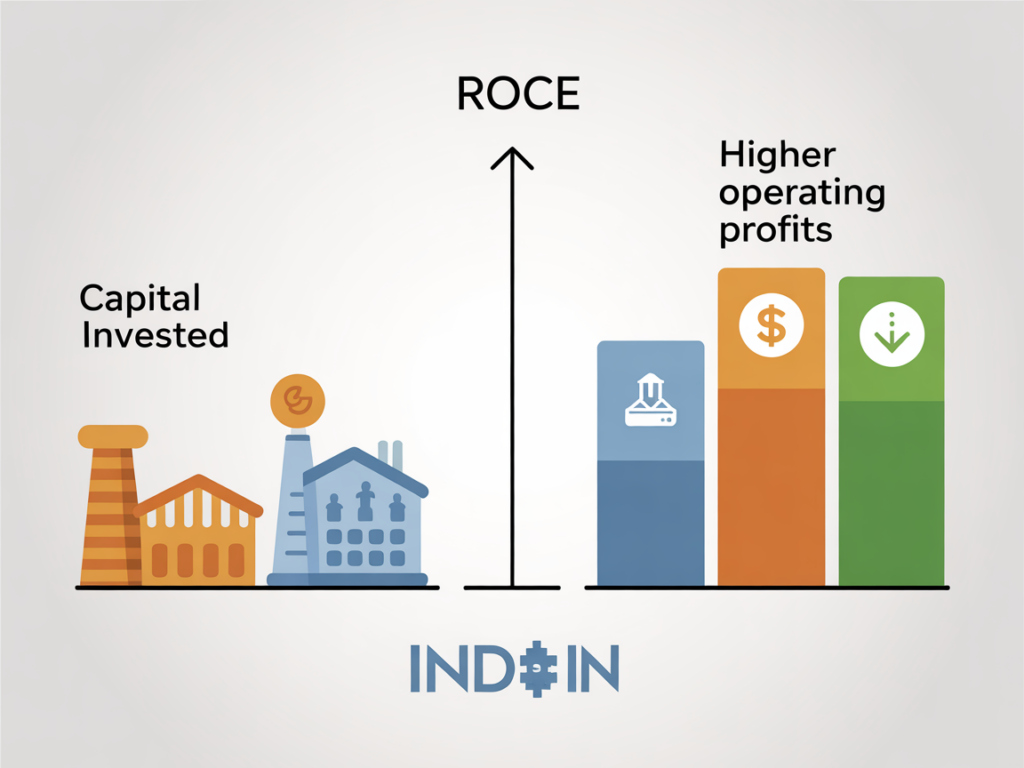
Think of ROCE like this:
- You invest ₹100 in a kirana store
- After all expenses, it earns ₹25 annually
- That’s 25% ROCE
Now compare this with a business that earns only ₹8 on the same ₹100. Which one compounds faster? The answer is obvious.
Why ROCE Works So Well in India
Indian markets have:
- Capital scarcity
- Expensive borrowing costs
- Cyclical demand patterns
- Promoter-driven businesses
In such an environment, high ROCE small cap stocks India stand out because they:
- Require less external funding
- Survive downturns better
- Reinvest profits internally
- Avoid frequent dilution
ROCE vs ROE (A Common Trap)
Many beginners focus on ROE. The problem?
- ROE can be inflated by debt
- ROCE includes debt and equity—making it harder to manipulate
- To know the difference in a detailed manner, read this blog post.
Rule from experience:
If ROCE is strong and stable, ROE will take care of itself.
How to Identify High ROCE Small Cap Stocks India (Step-by-Step)
Over the years at StockManiacs.net, mentoring more than 20,000 traders, I’ve learned that simplicity beats complexity.
Here’s the exact framework I personally follow.
Step 1: Look for Consistency, Not One-Year Spikes
A genuine high ROCE business shows:
- ROCE above 15% for 5+ years
- No extreme volatility
- Improvement during both good and bad cycles
Avoid stocks where ROCE jumped suddenly due to:
- Asset sales
- One-time margin expansion
- Temporary commodity price benefits
I’ve seen dozens of stocks show a one-year ROCE spike—only to collapse later when the cycle turned.
Step 2: Check Debt Levels
This is where high ROCE debt free small cap stocks shine.
Low debt ensures:






- ROCE is operational, not financial engineering
- Interest coverage remains high
- Cash flows stay predictable
From my screening experience, companies with:
- Debt-to-equity below 0.5
- Interest coverage above 5
tend to outperform over full cycles.
Step 3: Confirm Cash Flow Quality
Accounting profits can lie. Cash flows don’t.
Always check:
- CFO to Net Profit ≥ 0.8
- Positive free cash flow over time
Many retail investors skip this step and pay later through dilution, rights issues, or debt stress.
Step 4: Promoter Skin in the Game
In Indian small caps, promoter behavior matters more than analyst ratings.
Healthy signs:
- Promoter holding above 40%
- Zero pledging
- Stable or increasing ownership
Promoters selling quietly while ROCE looks good is often an early warning sign.
Case Study 1: Pix Transmission Ltd – A High ROCE Manufacturing Compounder
The answer is yes: Pix Transmission fits the core philosophy of high ROCE small cap stocks India.
Business Overview (Experience-Based Insight)
Pix Transmission manufactures industrial and automotive belts, largely sold in the aftermarket under its own brand. This matters because:
- Aftermarket demand is recurring
- Brand loyalty reduces price wars
- Wide SKU range creates switching costs
From years of tracking industrial stocks, aftermarket businesses usually deliver more stable ROCE than OEM-dependent ones.

Capital Efficiency Snapshot
- ROCE (Current): ~27%
- ROCE (5-Year): ~24%
- Debt-to-Equity: ~0.05
- CFO/Net Profit: >1
These numbers confirm operational excellence, not leverage tricks.
Margin & Cycle Analysis
Pix’s margins have fluctuated across cycles, but the range has narrowed over time. This is a sign of:
- Better cost control
- Stronger pricing power
- Improved product mix
Even during weak demand phases, ROCE stayed healthy—this is critical.

Working Capital Reality
Pix has a longer cash conversion cycle due to:
- High inventory SKUs
- Distributor-based sales
However:
- Inventory turnover is stable
- Receivables are controlled
- Cash flow remains positive
This is controlled complexity, not mismanagement.
Risk Reality Check
- Cyclical slowdown can hit quarterly profits
- Export demand fluctuations affect margins
But structurally, ROCE remains intact, which is what matters.
Case Study 2: Premier Polyfilm Ltd – Small but Improving ROCE Story
Now let’s look at a different flavor of high ROCE small cap stocks India.
Business Model Simplicity
Premier Polyfilm operates in specialty PVC films and sheets with:
- In-house calendaring
- Coating, embossing, lamination
- Industrial and consumer end markets
This is process-driven manufacturing, not a commodity free-for-all.
ROCE Trend (The Real Signal)
- ROCE improved from mid-teens to ~30%
- Profit growth outpaced sales growth
- Zero debt balance sheet
This is textbook operating leverage at work.
Margin Expansion Explained
Premier’s margins expanded due to:
- Better product mix
- Scale benefits
- Controlled overheads
Quarterly volatility exists, but the long-term trend is upward.

Cash Flow & Working Capital
Premier’s CFO/PAT is around 0.8, which is acceptable for a growing manufacturing company.
Key observation:
- Working capital needs are real
- Inventory cycles fluctuate
But debt remains zero—this reduces financial risk significantly.
Ownership Confidence
- Promoter holding ~68%
- No pledging
- Occasional open-market buying
From experience, this ownership behavior reflects long-term intent, not speculation.
Pix vs Premier: Two Different High ROCE Profiles
| Factor | Pix Transmission | Premier Polyfilm |
|---|---|---|
| Business Nature | Branded aftermarket | Specialty manufacturing |
| ROCE Stability | Very high | Improving |
| Debt | Near zero | Zero |
| Cyclicality | Lower | Moderate |
| Cash Flow Strength | Very strong | Adequate |
| Learning Value | Stability | Growth cycles |
Holding both teaches two different investing lessons.
Common Mistakes Investors Make With High ROCE Small Caps
Let me be blunt—most losses come from ignoring basics.
Mistake 1: Buying After ROCE Peaks
High ROCE doesn’t mean permanent. Watch for:
- Margin collapse
- Rising debt
- Promoter exits
Mistake 2: Ignoring Valuation Context
Even high ROCE stocks can disappoint if bought blindly at euphoric valuations.
Mistake 3: Overdiversification
Buying 8–10 small caps with tiny allocations teaches nothing. Focus beats noise.
Practical Strategy for Beginners (₹10,000–₹50,000 Investors)
Based on real mentoring experience:
Start Small, Think Long-Term
- Pick 1–2 high ROCE small cap stocks India
- Allocate capital in 2 tranches
- Review quarterly, not daily
What to Track Quarterly
- ROCE trend
- Debt changes
- Cash flow quality
- Promoter behavior
Ignore:
- Short-term price volatility
- Social media hype
- One-quarter earnings noise
Risks You Must Respect (Honest Warnings)
No stock is risk-free.
For high ROCE small caps:
- Liquidity risk exists
- Cycles can last longer than expected
- Governance issues can emerge suddenly
This is why process beats prediction.
Conclusion: How to Use High ROCE Small Cap Stocks India Wisely
High ROCE small cap stocks India are not magic bullets. They are filters for quality.
From my journey since 2002—through bull markets, crashes, and countless mentoring sessions—the biggest lesson is this:
Wealth is built by owning efficient businesses patiently, not by chasing excitement.
Pix Transmission represents stability and consistency.
Premier Polyfilm represents improving efficiency and growth.
Together, they demonstrate how ROCE, when combined with:
- Low debt
- Clean cash flows
- Promoter alignment
can protect capital while allowing compounding to do its job.
If you are tired of noise, tips, and false promises, start with understanding ROCE deeply. Use it as a compass, not a shortcut.
That single shift will save you years of costly mistakes—and move you closer to becoming a confident, independent Indian investor.