

As a trader, investor, and educator since 2002, here’s the straight talk many beginners ask right now: what exactly is the difference between SIP pause vs stop, and which should you choose when markets get rough or life gets messy? The answer is simple: a pause is temporary and resumes automatically, while a stop is permanent and needs a fresh setup later; in most real-world cases, a pause preserves discipline and long-term returns better than a stop. In the first few lines you’ve met the core idea behind “SIP pause vs stop,” and in this guide, you’ll learn practical answers, verified updates, real investor stories, and step-by-step execution from an Indian context you can trust.
For two decades, mentoring thousands of Indian investors through StockManiacs.net and broker partnerships, the same pattern repeats: emotions tempt investors to halt SIPs when volatility spikes, but data and outcomes consistently reward those who stay systematic. The most dramatic signal came this year when India’s SIP stoppage ratio soared to record highs, and yet disciplined contributors continued to see the benefits of rupee-cost averaging when prices swung. That gap—between what fear pushes you to do and what works—sits at the heart of this decision.
Here is the quick answer again before we go deeper. A pause suspends debits for a short period (usually 1–6 months depending on the AMC) but keeps your existing units invested and your SIP mandate ready to restart automatically. A stop permanently ends future debits; your existing units remain invested, but if you want to resume later you need to set up a new SIP mandate from scratch. With SEBI’s newer processing standards, stopping can be executed faster than before, but the strategy choice still hinges on your cash flow, goals, and time horizon, not speed. If your challenge is temporary—job transition, medical bill, wedding, short-term cash crunch—pause is typically the better instrument. If your situation is permanent—goal achieved, retirement cash flow change, fundamental strategy shift—then stop is appropriate.
From the lens of trust and transparency, this guide incorporates up-to-date regulatory changes, market data from reputable sources, and first-hand patterns observed in mentoring cohorts and community Q&As. There are no affiliate links here. If you want screenshots, calculators, or a downloadable decision checklist, you’ll find pointers in the “How to implement” section. You’ll also see practical mini case studies under every section so each part stands on its own. If you’re confused today, by the end you’ll have clarity, a plan, and confidence to act wisely—without second guessing every headline or tweet.
What is the difference between SIP pause and stop in India?
The answer is: a pause temporarily suspends your SIP instalments while keeping your investment plan intact, and a stop permanently ends future instalments, requiring a fresh SIP setup later.
Direct definitions you can use today
- Pause means your automatic debit temporarily halts for a defined window, often 1–3 or up to 6 months depending on the fund house; your units remain invested, your mandate stays live, and debits resume automatically after the pause window ends.
- Stop (also called cancel in older documents) means your SIP mandate is terminated; your units remain invested, but there will be no further debits unless you create a brand-new SIP.
At-a-glance comparison
| Feature | Pause | Stop |
|---|---|---|
| Nature | Temporary suspension | Permanent termination |
| Duration | Typically 1–6 months | Indefinite |
| Units invested | Remain invested | Remain invested |
| Auto-resume | Yes, after pause window | No, needs fresh setup |
| Mandate status | Active, time-limited hold | Fully cancelled |
| Best for | Short-term cash crunch | Permanent plan change |
Why this difference matters
- Discipline: Pausing preserves the habit loop; stopping breaks it, which many investors struggle to rebuild.
- Friction: Pausing has fewer steps and restarts automatically; stopping introduces future friction when you try to restart.
- Behavioral edge: The ease of pausing helps you avoid market-timing impulses; stopping can feel final and often delays a restart.

Mini case: Riya vs. Ankit
Riya paused her ₹5,000 SIP for three months during a cash crunch but resumed automatically, staying aligned with her long-term goal without rework. Ankit stopped his SIP and planned to restart “after things settle,” but postponed for eight more months; by then, the market had already recovered, and he missed lower-priced units.
When should you pause your SIP and when should you stop it?
The answer is: pause for temporary issues, stop for permanent changes.
Pause makes sense if your challenge is short-term
- Job change with a new offer letter and joining date
- Temporary medical expense with expected recovery
- Seasonal or one-off family spending (wedding, education fee)
- Short-term cash flow squeeze you can resolve within 1–6 months
Stop makes sense if your situation is permanent
- Goal achieved (e.g., home down payment corpus fully funded)
- Retirement or a durable income change that alters risk capacity
- A strategic asset allocation shift away from equities
- Fund strategy no longer aligns with your goals and a new plan replaces it
My coaching tip: default to pausing first
For 95% of queries on SIP Pause vs Stop, I see, a pause is the right first step because it preserves your plan, reduces emotional decisions, and keeps your long-term compounding engine intact. If the “temporary” issue becomes permanent, you can always stop later.
Mini case: salary cut vs. retirement move
A tech professional saw a 15% salary cut for two quarters. She paused SIPs for three months and restarted automatically on the fourth, barely affecting her long-term target. Contrast that with a senior executive exiting full-time work at 58; he stopped equity SIPs by design and switched to a planned SWP from conservative funds to match his new income reality.
How does pausing or stopping affect returns and rupee-cost averaging?
The answer is: pausing preserves your rupee-cost averaging through volatile phases, while stopping can break the averaging effect and delay compounding momentum.






Why rupee-cost averaging is your quiet superpower
SIPs buy more units when prices fall and fewer when prices rise; over many cycles this reduces your average cost per unit. Pausing during dips risks missing some of your most valuable purchases. Stopping halts the mechanism entirely, potentially leaving your average cost higher than it needs to be.
Simple example with easy math
- Suppose your monthly SIP is ₹5,000.
- In three down months, the NAV falls from ₹50 to ₹40, then to ₹35.
- Continuing SIP buys 100, then 125, then ~142 units.
- If you pause those three months, you miss 392 low-price units and raise your average cost.
What happens if you stop for a year?
You save cash flow short-term, but the “restart” rarely happens on time. In practice, many investors restart when prices feel “safe,” often after a recovery—not a great averaging outcome. That delay can cut future compounding by lakhs over a 10–15 year horizon.
Mini case: the 2020 recovery lesson
A corporate employee paused for two months in March–April 2020 and resumed in June, catching much of the recovery and preserving discipline. A colleague stopped and waited for “economic clarity,” then restarted eight months later at higher NAVs; her final ten-year projection was ₹6–8 lakh lower for the same monthly SIP.
What changed with SEBI’s new SIP rules and how does it impact you?
The answer is: processing got faster, clarity improved, and you have a short safety window—so you can act decisively without being locked in by admin delays.
Key operational update you should know
- Faster processing: SIP cancellations now process in about two working days.
- Short reconsideration window: You can usually reverse a fresh cancellation request within a limited timeframe if you change your mind.
- Standardization: Platforms and AMCs have aligned terminology better; newer documents use “stop” where older forms said “cancel.”
Why this matters for SIP Pause vs Stop
- If you genuinely need to stop, the process is quick, clean, and predictable.
- If you’re emotional, the short reconsideration window prevents permanent mistakes.
- For a pause, most AMCs still offer 1–6 months, though exact windows vary.
Action tip: check your AMC’s specific pause policy
Policies differ. Some allow multiple pauses over the SIP’s life; others restrict to one or two. Some require a minimum number of successful instalments before the first pause. Confirm: maximum pause duration, frequency allowed, and minimum notice days before debit.
Mini case: notice period misstep
A first-time investor tried to pause two days before the debit date and was surprised when the instalment still went through. The AMC required 7–15 days’ notice. Once he learned this, he submitted the next pause request in time and avoided the surprise debit.
What are real investors saying about SIP pause vs stop?
The answer is: investors who paused for temporary issues generally felt relieved and stayed on track, while those who stopped often delayed restarting longer than planned and regretted missing recoveries.
What comes up again and again in community threads
- “Paused for three months due to a medical bill, then auto-resumed—felt disciplined and safe.”
- “Stopped in a panic, meant to restart in a month, actually restarted after nine months.”
- “Paused to crush a high-interest loan, then resumed—best decision I made this year.”
What YouTube educators and live sessions emphasize
Educators repeatedly show how skipping a few low-NAV months raises the average cost, while sticking with SIPs—even at reduced amounts—preserves the compounding engine. The most pragmatic advice: if you must conserve cash, reduce the SIP instead of stopping completely.
My observation from mentoring cohorts
New investors confuse “disappointment” with “strategy.” Flat 12–18 month periods test patience, but SIPs are designed for 7–10 year horizons. Those who systematize decisions with calendars, reminders, and fixed rules avoid the whipsaw of headlines and social trends.
Mini case: debt-first, then SIP
A salaried professional paused three SIPs for four months to accelerate repayment on a 24% personal loan. He resumed afterwards with the same monthly total and reached his debt-free date five months earlier than planned, then stepped up SIPs by 20%.
How to implement SIP pause vs stop step-by-step (with checklists)
The answer is: follow a short, structured workflow—verify your reason, choose pause or stop, execute on your platform, and set reminders so actions stick.
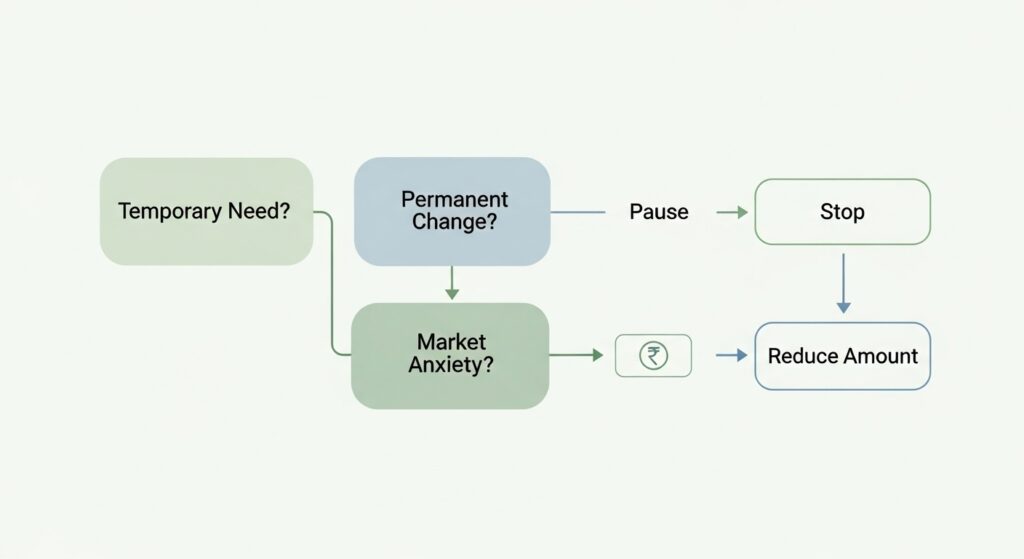
Step-by-step: pausing your SIP
- Confirm your reason is temporary and time-bound.
- Log in to your broker or AMC portal and select the SIP to pause.
- Choose a pause duration (e.g., 3 months) within the AMC’s allowed window.
- Submit at least 7–15 days before the debit date to avoid the next pull.
- Set a resume reminder one week before the pause ends, even though it auto-resumes.
Step-by-step: stopping your SIP
- Confirm your reason is permanent or strategic, not emotional.
- Log in to your broker or AMC portal and locate “stop” for the specific SIP.
- Submit your stop request; processing is typically quick now.
- Use the short reversal window if you reconsider within a day.
- Document your new plan: either shift allocation or define a fresh SIP start date.
Quick decision checklist you can use
- Is my reason temporary with a clear end date? If yes, pause.
- Am I changing my long-term plan for good? If yes, stop.
- Could I reduce the SIP instead of halting it? If yes, reduce.
- Do I have an emergency fund of 3–6 months? If no, build it, then resume.
- Have I set calendar reminders for resume/restart? If no, do it now.
Tools that make this easier
- Broker platforms with SIP management dashboards
- AMC portals that support pause/stop with clear policies
- Registrar portals (CAMS/KFintech) for consolidated SIP views
- A simple spreadsheet to track next debit dates, pause windows, and resume dates
Mini case: “reduce vs pause” hack
A first-year investor facing a tight quarter cut her total SIP from ₹12,000 to ₹5,000 across funds instead of pausing outright. She preserved rupee-cost averaging with a smaller footprint and stepped back up when her cushion returned.
What should beginners do in a volatile year like 2025?
The answer is: build a simple, rules-based approach—pause only for genuine short-term needs, avoid emotional stops, and use small reductions as a pressure release.
A calm plan for confusing markets
- Define your rule: “While choosing between SIP Pause vs Stop, I will not pause for market dips; I will only pause for life events under 6 months.”
- Set thresholds: “If my emergency fund dips below 3 months of expenses, I will pause for up to 3 months.”
- Use reductions: “If cash flow is tight, I will reduce SIP by 25–50%, not stop.”
- Review quarterly: Check performance drivers, not just returns; align with goals.
Guardrails that protect beginners
- Avoid pausing in the first 24 months of a new SIP unless it’s truly necessary; the early period builds the habit loop.
- If a fund underperforms persistently, switch funds rather than stopping equity investing altogether.
- Keep a separate buffer to avoid raiding SIPs for small surprises.
Mini case: goal-linked sanity
A beginner linked each SIP to a clear goal: education fund, home down payment, and retirement. When a family medical bill arrived, she paused only the home down payment SIP for two months and left the education and retirement SIPs untouched, keeping long-term goals on track.
Conclusion: Your calm, confident way forward
The answer is: if your situation is temporary, pause; if it’s permanent, stop; and if you’re simply anxious about markets, do neither—reduce instead and keep the engine running.
As someone who has traded through dot-com aftershocks, the global financial crisis, the 2013 taper tantrum, the 2020 crash, and 2022–2025 rotations, the pattern is dependable: disciplined investors with a written rulebook outperform anxious investors making ad hoc decisions. A “SIP pause vs stop difference” article only matters if it helps you act with clarity. Use pausing as a precision tool for short-term life needs. Use stopping when your plan fundamentally changes. In every other case, preserve the habit—because your habit, not timing, is the edge.
Here’s your practical next step. Write your rule on paper or your phone: “I will only pause for a time-bound cash need; I will not stop due to headlines; if needed, I will reduce amounts instead.” Then log in to your platform, review each SIP against its goal, and schedule quarterly check-ins. If you’re unsure about a specific fund, consider switching thoughtfully rather than cutting equity exposure entirely. You’ll find that once the rules are clear, the stress falls away.
Finally, give yourself grace. Investing is not a perfection contest; it is a consistency game. The markets will test your patience, but your written process protects your outcome. If you want templates, checklists, or a quick portfolio review workflow, set a reminder to build them this weekend. One quiet hour of planning can save years of second-guessing. And if you mentor someone else on this topic, pass along this simple truth: in the long run, staying systematic beats feeling smart.