

Introduction
Why these new rules matter now
Bank Nomination Rules 2025 transform how Indian savers pass money and locker contents to family, with the changes taking effect nationwide from November 1, 2025. The central update lets you name up to four nominees per bank account, choose how to distribute exact percentages among them, and use digital nomination with stronger verification where your bank supports it. This reform sits inside the Banking Laws (Amendment) Act, 2025 and the Banking Companies (Nomination) Rules, 2025, replacing decades‑old practices with clear, uniform, and faster processes. If you hold savings accounts, fixed deposits, recurring deposits, or a locker, these changes aim to reduce claim delays and family disputes when money must move quickly after life events.
A quick, practical promise
The answer is simple: with Bank Nomination Rules 2025 you can design who gets what, use simultaneous or successive nomination appropriately, and expect standardized timelines like a 15‑day window for deposit claim settlement once documents are complete. You do not need to be a legal expert or a techie to benefit; you only need to set nominees with intent and keep a clean trail of confirmations. As a market mentor who has helped thousands start and systematize finance, the single best step most families can take this week is to review nominees across all accounts and align them with today’s realities. In this guide, you get clear definitions, step‑by‑step flows, real stories, and simple decision tips so you can act today with confidence.
A story to set the stage
Rina, a new salaried professional in Pune, assumed “one nominee” was enough when she opened her first bank account years ago, and she never revisited it after marriage. Under Bank Nomination Rules 2025, she can now name up to four nominees and split her FDs 70:30 between spouse and parent, while setting a clean successive order for the family locker. That one hour of updates could turn a painful 3–6 month claim struggle into a smooth 15‑day settlement during a difficult time. Her situation is common, and the new rules exist precisely to make such practical fixes easy and uniform.
What changed on November 1, 2025
The short answer first
You can nominate up to four people per bank account, assign share percentages that add up to 100% for deposits, use successive order for lockers, and complete or manage nomination online with secure authentication and alerts where your bank supports it. These provisions were notified under Sections 10–13 of the Banking Laws (Amendment) Act, 2025 and came into force on November 1, 2025. The new Banking Companies (Nomination) Rules, 2025 replace the 1985 rules for both banking companies and cooperative banks. The big win is clarity and speed across deposits, safe custody, and lockers.
Before vs now at a glance
| Aspect | Before | Now |
|---|---|---|
| Number of nominees | Typically one nominee per account. | Up to four nominees permitted per account. |
| Deposit accounts | Mixed bank practices, little standardization. | Simultaneous or successive nomination; percentage splits allowed. |
| Lockers & safe custody | Inconsistent practices across banks. | Only successive nomination permitted by rule. |
| Digital nomination | Patchy availability and weak uniformity. | E‑nomination allowed with e‑sign or reliable e‑auth and alerts. |
| Claim timelines | Often unclear and slow in practice. | 15‑day settlement mandate for deposit claims once complete. |
A short real case
After a parent’s death, Arjun’s family in Jaipur had to chase three branches for updates, because nomination forms were old and unclear. Under Bank Nomination Rules 2025, Arjun updates all deposits with simultaneous shares and the locker with a clear successive line, which cuts ambiguity and forces a consistent process across banks. He keeps the SMS/email confirmations in a “Nomination Kit” folder so the family can retrieve them in minutes. This is exactly how the reform is meant to work in the real world.
Is nomination mandatory, and what must banks tell you
The short answer first
Nomination is not mandatory, but banks must inform you of the facility at account opening and record your decision, including a written opt‑out if you decline. You cannot be denied an account for choosing not to nominate, provided you meet other eligibility and KYC conditions. That said, skipping nomination can cost your family months of delay and significant legal expense later.
What to do at account opening and for existing accounts
At account opening, ask the bank to show you the updated nomination choices and to record your selection with an acknowledgement. For existing accounts, review and update nominees now to reflect marriage, children, or parental care so your structure matches reality. Decide whether you prefer simultaneous nomination with fixed percentage splits for deposits, or successive nomination for a first‑next order; remember lockers must use successive order. Keep the bank’s confirmations and any reference numbers in one place your family can find.
A simple story
Meera, age 28, opens her first salary account and thinks, “I’ll add a nominee later,” but later never comes. A health scare in the family pushes her to act, and she sets a 100% deposit share to her mother while choosing mother‑then‑sister as the locker order. The banker records her choice and hands a stamped acknowledgement, and Meera saves the app notification in her email archive. She sleeps better, because the paper trail now exists.
Step‑by‑step: how to add nominees and manage the bank nomination process
The short answer first
Plan your structure, collect nominee IDs, add or modify nominees via net banking or mobile app where supported or at the branch, authenticate securely, and retain confirmation alerts or receipts. For deposits, you may choose simultaneous nomination with percentage splits or successive nomination with a clear order, while lockers must follow successive order. Each new nomination overrides the last, so check the final record before you log out.
Digital flow you can follow today
Where available, log in to net banking or the mobile app, open Services/Requests, choose Manage Nominee, pick the account, add nominee details (name, relation, DOB, address), set the percentage if using simultaneous nomination, and confirm with OTP or e‑sign. Good platforms send an SMS or email for each nomination action, which you should file for your records. If your bank has not rolled out e‑nomination yet, use the branch form now and switch to digital management when it arrives. Authentication must comply with e‑sign or reliable e‑auth standards, so follow the prompts and do not share OTPs.
Pro tips and the “one‑hour weekend” method
- List all your bank accounts and the locker, then decide simultaneous vs successive for each.
- Add percentage splits that total 100% for deposits to avoid confusion later.
- Update every bank separately; nominations do not sync across institutions.
- Save all alerts and stamped acknowledgements in a shared “Nomination Kit” folder.
Keep list use modest and focus on action, because the quickest path is to finish everything in a single sitting with documents handy. This is also the right time to verify nominee IDs and addresses so claim teams do not call for corrections later. If a nominee is a minor, appoint a guardian in the form itself to prevent avoidable court steps. For joint accounts, remember that all holders must agree to add, change, or cancel a nomination.






A short example
Saurabh, a Kolkata entrepreneur, blocks Sunday 10–11 AM, opens two bank apps, and completes e‑nominations on his savings account and three FDs with a 60:40 spouse‑parent split, while filing a branch form for his older PSU account that lacks e‑nomination. He sets a spouse‑then‑child successive order for the locker and emails all confirmations to a trusted family inbox. In one hour, Saurabh reduces what could become a months‑long claim process to a simple, documented pathway. That is the power of a planned bank nomination process.
Claims after death: timelines, documents, and penalties
The short answer first
Banks must settle deposit claims within 15 calendar days from the date they receive complete documents, and penalties apply if they delay. For lockers and safe custody, banks must fix inventory and process claims on similar 15‑day timelines, with monetary penalties if the bank causes delay. RBI has also standardized documentation and thresholds for non‑nominee cases to simplify smaller claims and reserve succession certificates for larger ones.
How the 15‑day rule and penalties work
If a deposit claim with complete documents is delayed beyond 15 days, banks owe interest at the Bank Rate plus 4% per annum on the claim amount for the delay period. For lockers and safe custody claims, banks face ₹5,000 per day for delays attributable to the bank after receipt of required documents. These rules are designed to change behavior at the counter and make timelines predictable for grieving families. Use them by keeping a document checklist and asking for a stamped receipt on submission.
Documents you may need
For accounts with nominees, banks usually need the death certificate, nominee KYC, and standard forms, which should be listed on the bank site or at the branch. For accounts without nominees below certain thresholds, banks accept a simpler set: death certificate, claimant KYC, indemnity, and basic proofs. And, for higher‑value accounts without nominees, expect a succession certificate or a legal heir certificate, which adds time and cost. This is why strong nominations are the best time‑savers.

A real‑life experience
A user on a finance forum reported that a bank took longer than 15 days despite a complete nominee claim, prompting the family to cite the rule and escalate to the nodal officer. Another user shared that a branch demanded extra documents not listed in RBI guidance until the customer pointed to the updated directions. In both cases, knowing the 15‑day rule and penalties changed the tone of the conversation. Keep a copy of the rule extracts on your phone when you visit a branch.
Design it right: simultaneous vs successive, minors, and lockers
The short answer first
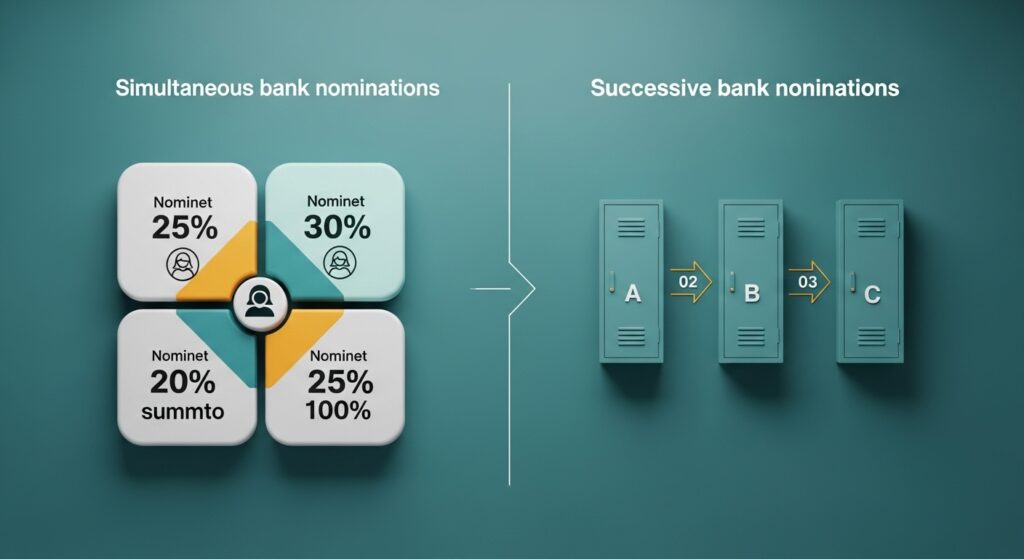
Use simultaneous nomination for deposits when you want to split money by percentage across people, and use successive nomination when you want a clear first‑next order; lockers must always use successive order. Appoint a guardian if any nominee is a minor, and remember that joint account nomination changes need consent from all holders. Each new nomination in the Bank Nomination Rules 2025 replaces the previous one, so check the final record after every change.
When to choose which structure
Simultaneous nomination shines when you want transparent distribution without future quarrels, because each person’s share is pre‑set and sums to 100%. Successive nomination is ideal when you want one person to receive first and another to receive only if the first is not available, which keeps order clear at the counter. For lockers, the law permits only successive order since percentage splits make little sense for physical custody. Think in terms of “who needs cash flow now” versus “who needs access next.”
Tips for minor nominees and joint accounts
If a nominee is a minor, naming a guardian in the form avoids court detours and speeds up access in emergencies. For joint accounts, plan updates together and store the acknowledgement where both can access it. If you, your spouse, and your parent operate multiple deposits, keep one shared tracker so nominations remain consistent across banks. Revisit choices after marriage, childbirth, or changes in dependency.
A family example
Dev and Nisha split deposits 70:30 via simultaneous nomination to spouse and parent to cover daily needs, and they list spouse‑then‑adult child as the locker order to ensure clean access. They attach the guardian detail for a minor child on a long‑term RD, which prevents future paperwork jams. They also create a one‑page “Nomination Map” and store it with their insurance and will. This is how you align rules with real life, not the other way around.
The bigger picture: unclaimed deposits and why acting now prevents losses
The short answer first
India’s unclaimed deposits were about ₹67,270 crore in 2025, mostly with public sector banks, and unclaimed assets across banks, insurers, EPFO, and shares total roughly ₹1.84 trillion. Bank Nomination Rules 2025 are designed to reduce this pile by making nominations flexible, digital, and enforceable with clear timelines. The RBI has also launched schemes to push banks to trace and return dormant money faster, including incentive programs and public discovery tools like UDGAM.
Why this links to your family’s plan
Better nominations today mean your money will not get stuck tomorrow because a name was missing or outdated. Simultaneous splits reduce fights, and successive order ensures clean locker access, cutting the most common claim hurdles. The 15‑day settlement mandate and penalties create accountability when it matters. Acting before a crisis is the best way to avoid paperwork trauma later.
A quick YouTube‑powered nudge
Mainstream personal finance channels and newsrooms have published crisp explainers on “up to four nominees,” showing step‑by‑step app flows and common mistakes. If you prefer to learn visually, watch a short explainer and follow with your bank app open, finishing the update in the same sitting. Then help your parents do it too, because older accounts are the ones most likely to be missing a nominee entirely. One hour together can save months later.
A story from the field
Prakash discovered an old FD his late aunt had left behind, but without a nominee the bank asked for a succession certificate and a newspaper notice, which dragged the process for months. After learning about the new framework, he updated nominations across his own accounts and set a clean locker order. He also helped two relatives do the same, and they documented everything in a shared folder. That is exactly how the reform’s benefits multiply across families.
Case signals, locker lessons, and community wisdom
The short answer first
Courts and customer forums keep repeating one lesson: unclear or missing nominations create stress, cost, and delays, while clear nominations plus documentation prevent many disputes. A landmark Supreme Court locker case underscored banks’ duty of care in locker operations, which supports why strict locker procedures and clean nomination records are so important. Community reports show some branches still ask for extra documents; quoting the 15‑day rule and penalties often corrects this.
What the courts taught us
In a noted locker case, the Supreme Court criticized a bank for mishandling a locker, reminding banks that locker care is a separate obligation and must be managed with high diligence. Consumer disputes also highlight how claimants struggle to prove locker contents without strong records, which is why clean successive nomination and inventory protocols matter. For customers, the take‑home is to ensure the nomination form for lockers is current and acknowledged. Store any inventory schedules and rent receipts along with your “Nomination Kit.”
What communities taught us
Reddit threads show families who faced 20–30 day delays even with a nominee until they cited RBI timelines, after which action accelerated. Others reported branches asking for legal heir certificates despite a valid nominee, which goes against the simplified direction unless thresholds demand otherwise. Carrying a printed or digital checklist and escalating with exact rule references often resolves such mismatches. Knowledge of rules is power at the counter.
A story to remember
Shalini, settling her father’s affairs, saw a branch ask for extra documents not on the updated list, so she emailed the nodal officer with the 15‑day clause and asked for a written timeline. The case moved the next week, and the branch apologized for the oversight. After the experience, Shalini updated her own nominations and documented everything in a shared folder with her spouse. Pain taught a rule‑based habit that now protects her family.
Conclusion
Your 30‑day action plan
The answer is: list all banks and the locker, choose simultaneous splits for deposits or successive order where appropriate, finish updates via app or branch, and store confirmations in a “Nomination Kit” your family can access fast. Bank Nomination Rules 2025 give you up to four nominees per account, digital pathways with secure authentication, and uniform claim timelines to reduce stress after a life event. Start with the accounts that hold the most cash flow or emergency funds, then finish the rest this week. Do the same for parents, because older accounts are most at risk of having no nominee at all.
Keep it simple and current
- Revisit nominations yearly at tax time or after life events.
- Align nominations with any will to avoid conflict later.
- For lockers, always use successive order, not percentage splits.
- For deposits, use simultaneous nomination when you want clear shares that add to 100%.
Keep list use light and focus on action, because action is what turns rules into real protection. If a branch pushes back or delays, quote the 15‑day rule and penalties and escalate politely in writing with dates. If your bank app supports e‑nomination, use it; if not, finish the form at the branch now and manage digitally later. The framework is in place to help you, so use it fully.
A final story and a promise
A Bengaluru couple spent one hour on a Sunday updating nominations across two banks and a locker, then helped their parents do the same over a video call, saving confirmations in a shared cloud folder. Six months later, a family claim closed within the 15‑day window, and the branch even guided them on documents because everything matched the rules. That is the difference a clear plan makes when life tests your paperwork. Use Bank Nomination Rules 2025 today, and secure tomorrow with calm and clarity.