
If you’ve searched how to make diamond at home, you’ve probably seen videos showing graphite, a pressure chamber, electricity, or some clever-looking homemade setup. The idea sounds simple: diamond is carbon, so why not take some carbon and turn it into diamond yourself?
The problem is that the chemistry is much easier to understand than the engineering.
Diamond and graphite are both made from carbon. What changes is how those carbon atoms are arranged. The catch is that getting carbon to form the diamond structure requires conditions that aren’t remotely similar to what you can create with a kitchen oven, pressure cooker, hydraulic jack, or ordinary laboratory equipment.
There are two major industrial methods for making synthetic diamond. HPHT, or high-pressure high-temperature growth, uses extreme pressure and heat around a diamond seed. CVD, or chemical vapour deposition, grows diamond inside a controlled vacuum chamber from carbon-containing gas. These aren’t simply recipes with expensive ingredients. The equipment itself is a major part of the process.
That’s why I wouldn’t recommend trying to build a homemade diamond reactor.
You can certainly experiment with carbon, crystals, pressure, heat and materials science at home. But trying to reproduce commercial diamond-growth conditions without proper engineering controls is a different matter. Extreme pressure can release enormous amounts of stored energy if something fails. High temperatures add another failure mode. CVD systems also involve vacuum equipment, high temperatures, electrical power and flammable gases.
So this article takes a slightly different approach.
I’ll explain what actually happens when a laboratory grows diamond, why the popular “make diamond from graphite at home” idea doesn’t work, what a real setup looks like, and what you can realistically do if your interest is experimental rather than commercial.
I’ll also walk through a hypothetical home experiment so you can see where the line between an interesting materials experiment and an unsafe diamond-growth project really sits.
The short version is simple: you can understand diamond synthesis at home, but producing a useful gem-quality diamond at home isn’t a sensible DIY project.
What actually happens when a laboratory makes diamond?
A laboratory-grown diamond isn’t fake diamond. It’s diamond formed through a controlled manufacturing process rather than geological formation.
The key is controlling how carbon atoms arrange themselves.
Why carbon alone isn’t enough
Think about graphite in a pencil. It’s carbon too, but its atoms are arranged in layers. Diamond has a very different three-dimensional structure.
That difference gives diamond its famous hardness and many of its other properties.
So putting graphite under some pressure doesn’t automatically turn it into diamond. You need the right combination of pressure, temperature, chemical environment, a suitable starting surface and carefully controlled growth conditions.
The two main approaches are HPHT and CVD.
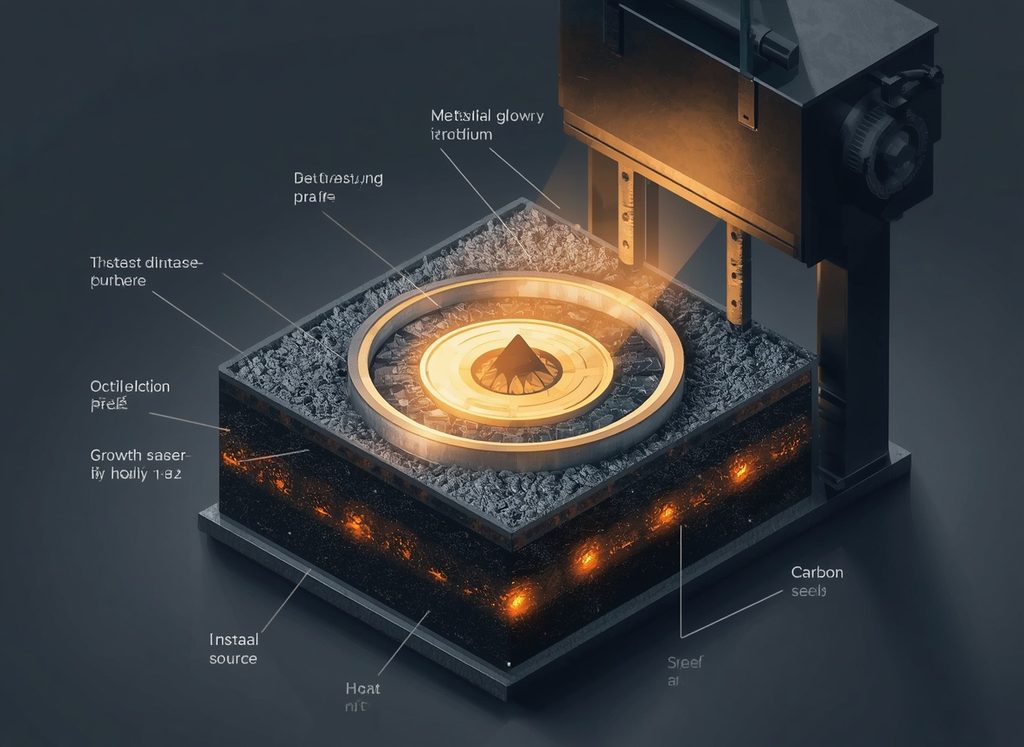
HPHT stands for high-pressure high-temperature. A diamond seed is placed with a carbon source and a metal flux inside a specially designed growth cell. The system reaches roughly 1300–1600°C and around 5–6 GPa of pressure. That’s an extreme environment, far beyond anything a normal household pressure device can provide.
The metal flux helps dissolve the carbon. Under the controlled temperature gradient, carbon moves through the molten material toward the cooler diamond seed and crystallises onto it.
CVD works very differently.
How CVD grows diamond
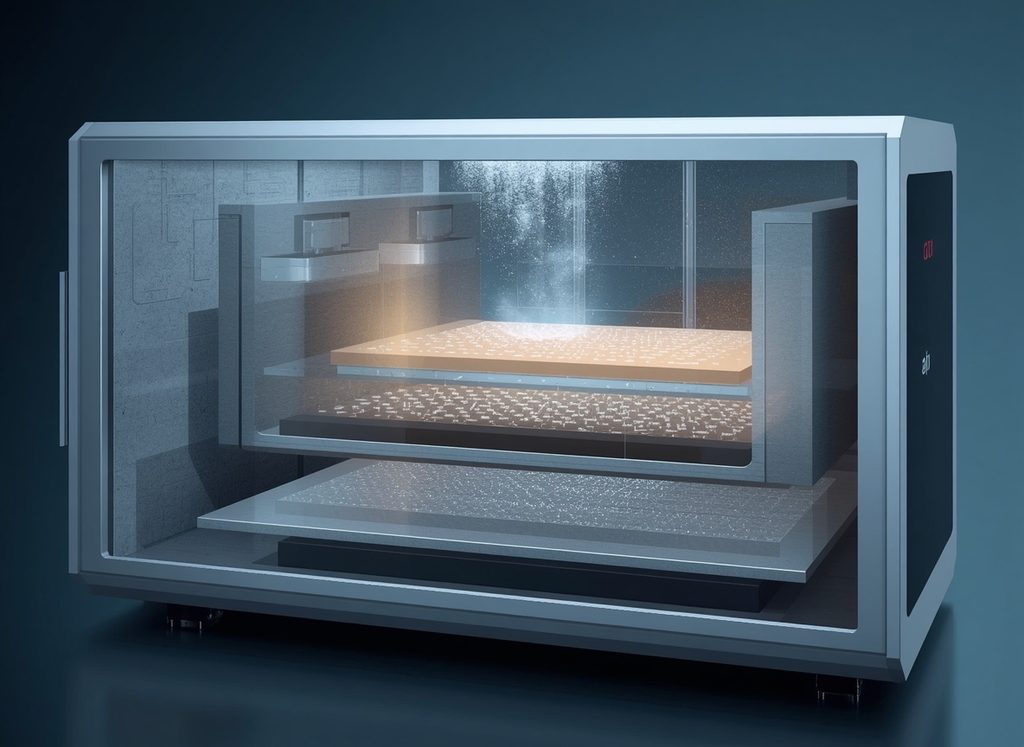
CVD stands for chemical vapour deposition. Instead of squeezing carbon under enormous pressure, the process uses a vacuum chamber containing carbon-containing gas. Energy creates a plasma, breaking apart the gas molecules. Carbon species then deposit onto a diamond seed and grow the crystal layer by layer.
This is why the phrase “diamond from gas” isn’t science fiction. CVD really does grow diamond from a gas mixture.
But don’t mistake lower pressure for low difficulty.
A CVD reactor still requires controlled vacuum conditions, gas handling, high temperature and a carefully managed plasma. Commercial systems are designed around all of those variables.
Hypothetical: graphite in a homemade pressure vessel
Suppose you put graphite into a strong-looking metal chamber and somehow apply substantial pressure.
You haven’t solved the diamond-growth problem.
You still need the required pressure range, temperature profile, carbon transport mechanism and growth surface. Worse, a pressure vessel designed casually at home can become a serious hazard because the energy stored in compressed material is released extremely quickly if the vessel or fitting fails.
That’s the part many DIY demonstrations skip.
Diamond synthesis is an engineering problem as much as a chemistry problem.
Can you set up a diamond-making machine at home?
Technically, a research laboratory can be built outside a traditional factory. But that’s very different from saying you can make a practical diamond machine with household equipment.
What a real setup needs
An HPHT system needs a specialised high-pressure apparatus capable of producing several gigapascals while simultaneously operating at very high temperatures. GIA describes pressures of about 5–6 GPa and temperatures around 1300–1600°C for HPHT diamond growth.
CVD avoids the enormous HPHT pressure, but replaces it with another collection of demanding requirements.
You need a controlled chamber, vacuum system, gas delivery, heating and plasma generation. CVD diamond growth commonly uses hydrogen and a carbon-containing gas such as methane. The diamond seed sits inside the reactor while carbon is deposited onto its surface.
That’s a proper laboratory system, not a modified microwave oven.
And I wouldn’t recommend improvising one.
What about the famous microwave experiment?
This is where online content can become misleading.
You may find demonstrations involving carbon material and a microwave oven. Some experiments can create interesting carbon structures or small amounts of unusual material. That doesn’t mean you’ve produced a faceted, gem-quality diamond.
There’s a big difference between detecting some diamond-like material and deliberately growing a controlled diamond crystal.
For someone interested in materials science, that distinction matters.
If your goal is simply to see whether carbon can transform under extreme conditions, that’s an interesting scientific question. If your goal is to make a jewellery-quality stone, a kitchen experiment isn’t the route I’d take.
Hypothetical: building an HPHT press
Imagine you have a powerful hydraulic press and think, “I only need to add heat.”
That’s still not enough.
The pressure has to reach the right range inside the growth cell. The cell must tolerate both pressure and temperature. The carbon source, catalyst, seed and temperature gradient have to work together. The entire assembly needs to remain stable while the process runs.
A failure isn’t like a failed cooking experiment.
A damaged heating element is one thing. A failed high-pressure assembly is another.






That’s why I draw a hard line here: understanding the process is a worthwhile DIY science project; constructing an improvised HPHT reactor isn’t.
If you’re serious about making synthetic diamond, work with purpose-built research equipment and appropriate laboratory supervision.
What would happen if you tried to make diamond at home?
Let’s make this practical with a hypothetical example.
Hypothetical: the home experiment
Suppose someone wants to make a tiny diamond at home.
They start with graphite because graphite is carbon. They buy a strong metal container, add the carbon and try to generate high pressure and heat.
At this point, there are several possible outcomes, and none is the neat result shown in many internet diagrams.
The graphite may remain graphite.
The material may transform into another carbon structure.
The container may fail before the desired conditions are reached.
Or the experiment may produce material that requires laboratory analysis before you can even say what you’ve made.
That’s an important point. Seeing a shiny black or transparent particle doesn’t prove that you’ve created diamond.
A proper identification can involve microscopic examination and other gemological or spectroscopic characteristics. Laboratories such as GIA distinguish laboratory-grown diamonds from natural diamonds by examining features such as inclusions, growth patterns and reactions to ultraviolet light.
What a commercial process looks like
Now compare that hypothetical experiment with an actual CVD process.
A diamond seed is placed in the chamber. A controlled gas environment is established. Energy creates plasma. Carbon-containing species break down and deposit onto the seed. The crystal grows gradually, often requiring repeated growth and surface-cleaning cycles. GIA describes CVD growth taking weeks for many diamond products.
That’s a completely different level of control.
You aren’t simply “making carbon into diamond”. You’re managing a crystal-growth process.
The seed matters because it gives the new carbon a diamond structure to continue growing from. Temperature matters because growth conditions determine what carbon structure forms. Gas composition matters because unwanted graphite can interfere with diamond growth.
A useful way to think about it
Imagine building a brick wall.
Throwing bricks, cement and water into a box doesn’t give you a wall.
You need the right surface, placement, timing and conditions.
Diamond growth is similar, except the “bricks” are atoms and the conditions are much more extreme.
That also explains why a laboratory-grown diamond can be a genuine diamond even though it wasn’t underground for millions of years. The manufacturing process creates the same basic diamond crystal structure, just through controlled laboratory conditions.
So if you’re asking how to make diamond at home, the most useful answer isn’t a recipe. It’s understanding why the recipe doesn’t exist in the way most DIY videos suggest.
Why does trying to make diamond at home usually fail?
The biggest mistake is treating diamond synthesis as a simple pressure-and-heat problem.
It isn’t.
Pressure is only one part of the equation
HPHT does use enormous pressure. But the pressure has to be combined with the right temperature, materials and growth geometry.
GIA puts typical HPHT growth around 5–6 GPa and 1300–1600°C.
Those numbers should immediately tell you something.
This isn’t a stronger version of a pressure cooker.
Even if someone could generate enough pressure, maintaining that pressure safely while heating the growth cell is a major engineering challenge.
CVD has its own failure points
CVD looks more approachable because it doesn’t require several gigapascals.
That’s misleading.
You still have high temperatures, vacuum conditions, electrical systems and controlled gases. The chemistry has to favour diamond growth instead of unwanted carbon deposition.
Hydrogen plays an important role in suppressing graphite and other non-diamond carbon during CVD growth.
So if the gas chemistry or plasma conditions are wrong, you don’t simply get a smaller diamond.
You can get the wrong material entirely.
What does failure cost?
There’s the obvious cost of equipment.
But there’s another cost that gets ignored: false confidence.
Suppose you spend money building a homemade reactor and produce a tiny crystal. You might assume you’ve succeeded because it looks convincing under a magnifying glass.
Then you discover that the material isn’t what you thought.
Commercial synthetic diamonds can look very similar to natural diamonds to the unaided eye, which is why laboratory identification matters.
There is also the safety cost.
Extreme pressure, high temperature, vacuum equipment and flammable gases aren’t combinations I’d experiment with casually.
Hypothetical: the cheaper shortcut
Say someone has ₹50,000 to spend and decides to build a DIY setup rather than buying or accessing proper laboratory equipment.
Even if the experiment doesn’t fail physically, there’s no guarantee the result will be a usable diamond.
That money might produce a fascinating science project. It might also produce a pile of damaged components.
If the actual goal is to own a lab-grown diamond, buying one is vastly more sensible.
If the goal is to learn diamond growth, access to a proper laboratory or educational facility is the better route.
Is HPHT or CVD better for making diamond?
Neither method is simply “better”. They solve the diamond-growth problem in different ways.
But for someone thinking about DIY work, I wouldn’t treat them equally.
HPHT versus CVD
| Feature | HPHT | CVD |
|---|---|---|
| Basic idea | High pressure and high temperature | Carbon deposition from gas |
| Typical growth environment | About 5–6 GPa and 1300–1600°C | Low pressure with high temperature and plasma |
| Diamond seed | Yes | Yes |
| Main challenge | Extreme pressure and heat | Vacuum, gas and plasma control |
| Typical crystal form | Often cubic/octahedral growth sectors | Often tabular layers |
| DIY suitability | Very poor | Still poor |
These are broad descriptions, not operating instructions. Actual growth conditions vary with equipment, material and the desired result.
Which one is more realistic?
CVD is generally more approachable from a research perspective because it doesn’t require HPHT’s enormous pressure.
That doesn’t make it a home appliance.
A CVD system still needs proper engineering and controlled gas and electrical systems. The fact that the pressure is much lower can create a dangerous psychological trap: “If it’s low pressure, it must be safe.”
It isn’t.
HPHT has the opposite problem. The pressure alone makes the engineering challenge obvious.
Hypothetical: choosing equipment
Imagine you’re a university student interested in diamond materials.
If you have access to a materials-science lab with a properly designed CVD reactor, CVD is a sensible process to study.
If you have access to an established HPHT facility, HPHT is equally legitimate.
And if you’re sitting in a garage deciding whether to build either system from internet parts, I’d choose neither.
That’s not being conservative for the sake of it. The specialised equipment exists because controlling the process is part of making the diamond.
There’s also an interesting commercial point.
CVD has become increasingly important in laboratory-grown diamond production. GIA notes that CVD submissions now dominate its laboratory-grown diamond grading workload, and many CVD diamonds undergo post-growth treatment to modify colour.
So the choice isn’t just academic. These are established industrial processes.
What should you do if you really want to make a diamond?
If your interest is genuine, first decide what you actually want.
Do you want to own a diamond, understand how diamonds grow, or produce diamond material yourself?
Those are three very different projects.
If you simply want a diamond
Buy a laboratory-grown diamond.
You don’t need to reproduce the manufacturing process any more than you need to build a semiconductor fab to own a smartphone.
A lab-grown diamond is still a diamond, and proper grading documentation can identify its laboratory-grown origin.
If you want to learn the science
Study HPHT and CVD growth in detail.
This is where the subject gets genuinely interesting. You can learn about crystal nucleation, carbon phases, temperature gradients, plasma chemistry and why hydrogen changes the CVD environment.
You can also do safe home experiments around crystallisation and materials without trying to reproduce industrial diamond-growth conditions.
For example, you could study how crystals form from solutions and compare different growth rates. You won’t get diamond, but you’ll learn the underlying idea of controlled crystal growth without building an extreme-pressure system.
If you want to produce synthetic diamond
Work through a proper laboratory, university, research institution or established equipment supplier.
The interesting part isn’t just buying a machine. You need someone who understands how to operate it, maintain it and interpret the resulting material.
And don’t underestimate identification.
Hypothetically, imagine you successfully grow a tiny transparent crystal. Before calling it diamond, you’d want independent testing. Appearance alone isn’t enough.
That’s the same reason professional gem laboratories use multiple observations rather than simply looking at a stone and declaring it natural or synthetic.
So, can you make diamond at home?
If by “make” you mean putting ordinary household materials into a simple device and producing a reliable gem-quality diamond, no, not realistically.
If you mean studying the science at home, absolutely.
And that’s the route I’d recommend.
There’s a useful lesson here that applies well beyond diamonds. A process can look simple on paper because the chemistry is simple, while the engineering needed to control that chemistry is extremely difficult.
Diamond is a perfect example.
Carbon is common. Diamond isn’t.
The next step I’d take is to learn the HPHT and CVD processes rather than attempting to build either reactor yourself. Once you understand what the equipment is actually controlling, the internet’s “easy DIY diamond” claims become much easier to judge.